
Mathematics skills Addition & Subtraction Worksheets for Ages 6-7
3 filtered results
Difficulty Level
Grade
Age
-
From - To
Subject
Activity
Standards
Welcome to our engaging Addition and Subtraction Worksheets designed for children aged 6-7! These worksheets provide a fun and interactive way to build essential mathematics skills. Tailored for early learners, they feature a variety of exercises that foster understanding and confidence in basic operations. With vibrant illustrations and clear instructions, children will enjoy working through equations, solving problems, and developing their number sense. Our worksheets cater to different learning styles, ensuring that every child thrives in mastering addition and subtraction. Discover our comprehensive resources and watch your child's math skills grow with enthusiasm and ease! Perfect for home or classroom use.
Favorites
With answer key
Interactive
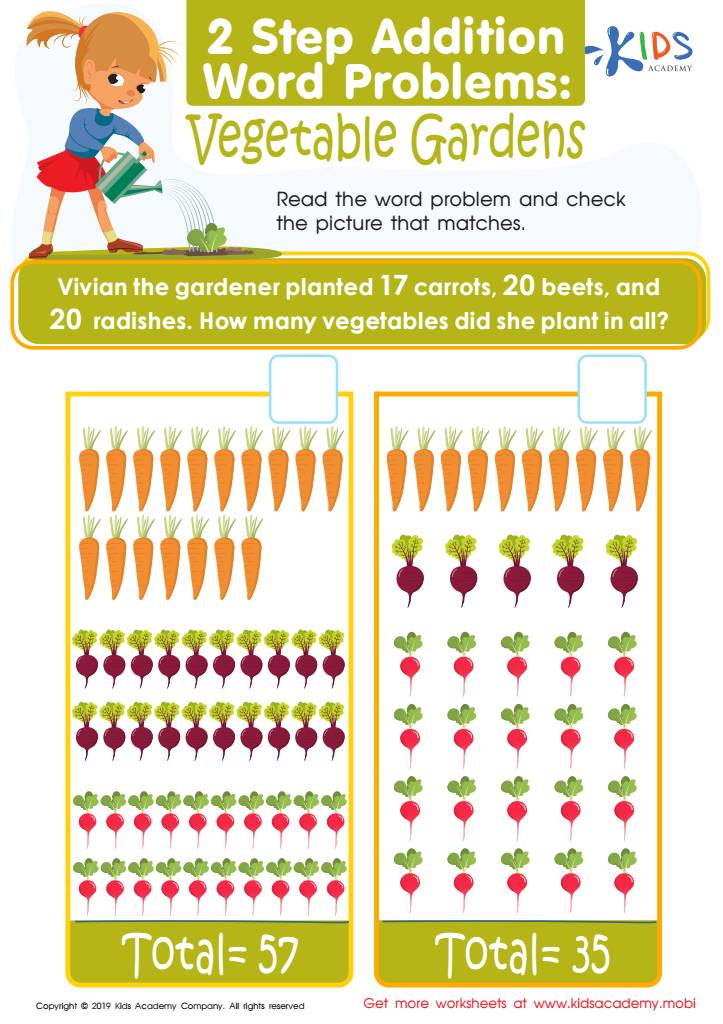
Vegetable Gardens Worksheet
Kids will have fun helping their buddy Vivian solve the addition word problems. Using one-to-one representation, they'll count the beets, carrots and radishes, then figure out the multi-step word problems. After, they'll check the picture that matches the answer, boosting their understanding of adding multiple numbers for one answer.
 Assign to My Students
Vegetable Gardens Worksheet
Worksheet
Join Kids Academy for Free
Who is primarily going to use this learning content?








Mathematics skills, particularly addition and subtraction, are foundational for children aged 6-7, forming the basis for future academic success and everyday problem-solving. At this age, children are developing critical thinking and cognitive abilities, and mastering these skills enhances their confidence and self-esteem in math-related tasks.
Addition and subtraction not only help children understand quantity and value but also equip them with essential life skills. Proficiency in these operations enables them to tackle real-world scenarios, such as counting money, measuring ingredients for a recipe, or dividing snacks among friends, fostering independence in daily tasks.
Furthermore, strong performance in early math is linked to later achievements in more advanced math concepts, which are critical as they progress through their education. Teachers and parents play crucial roles in providing a supportive and engaging learning environment. Encouraging play-based activities, games, and discussions around math can make learning enjoyable and impactful.
By caring about these fundamental skills, parents and teachers can help children build a solid mathematical foundation, promoting a lifelong appreciation for learning while opening doors to future opportunities in higher education and career paths. Ultimately, fostering addition and subtraction skills is vital for holistic child development.








