
Understanding money Addition & Subtraction Worksheets for Ages 6-7
4 filtered results
Difficulty Level
Grade
Age
-
From - To
Subject
Activity
Standards
Boost your child's math skills with our "Understanding Money Addition & Subtraction Worksheets" tailored for ages 6-7! These engaging worksheets help young learners grasp the value of money while practicing essential addition and subtraction concepts. Each activity features real-life scenarios involving coins and bills, making math fun and relatable. Your child will gain confidence in money management and enhance problem-solving abilities through interactive exercises. Perfect for homeschooling or classroom use, our worksheets ensure a solid foundation in math as well as financial literacy. Encourage your child to explore, learn, and master money concepts with our thoughtfully designed resources today!
Favorites
With answer key
Interactive
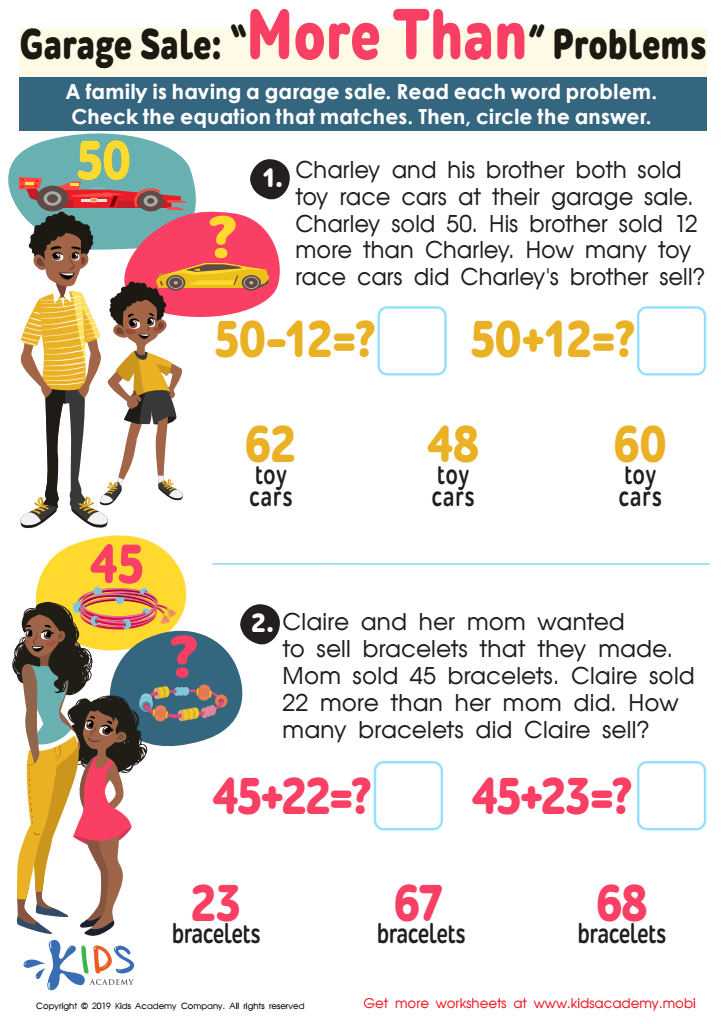
Garage Sale - More yhan Worksheet
The whole family can join in on the fun with this free worksheet! It helps kids practice math word problems while assisting their friends with a garage sale. Kids learn to identify "More Than" key words and pick the right equation, improving their order of operations skills. Download the PDF and get started!
 Assign to My Students
Garage Sale - More yhan Worksheet
Worksheet
Join Kids Academy for Free
Who is primarily going to use this learning content?








Understanding money and basic operations like addition and subtraction is crucial for children aged 6-7 because it establishes foundational skills that extend beyond math. At this age, children are developing their cognitive abilities, and relating math to real-world contexts, like handling money, enhances their engagement and comprehension. These lessons nurture critical thinking and problem-solving skills.
Teaching money concepts also introduces the value of currency, budgeting, and financial decision-making. As children learn to add and subtract monetary amounts, they become more capable of managing their personal finances in the future. This knowledge builds confidence, fosters independence, and prepares them for the complexities of financial literacy as they grow.
Additionally, financial education early in life can spark an interest in math, promoting a positive attitude toward the subject. Parents and teachers have a vital role in ensuring that students are equipped with practical skills that will serve them well in school and everyday life. Instilling these concepts at an early age can lead to better academic performance and informed adults who make responsible financial choices. Thus, understanding money through addition and subtraction should be prioritized in early education to nurture capable, financially savvy individuals.








