Recognizing equivalent fractions Addition Worksheets for Ages 6-7
5 filtered results
-
From - To
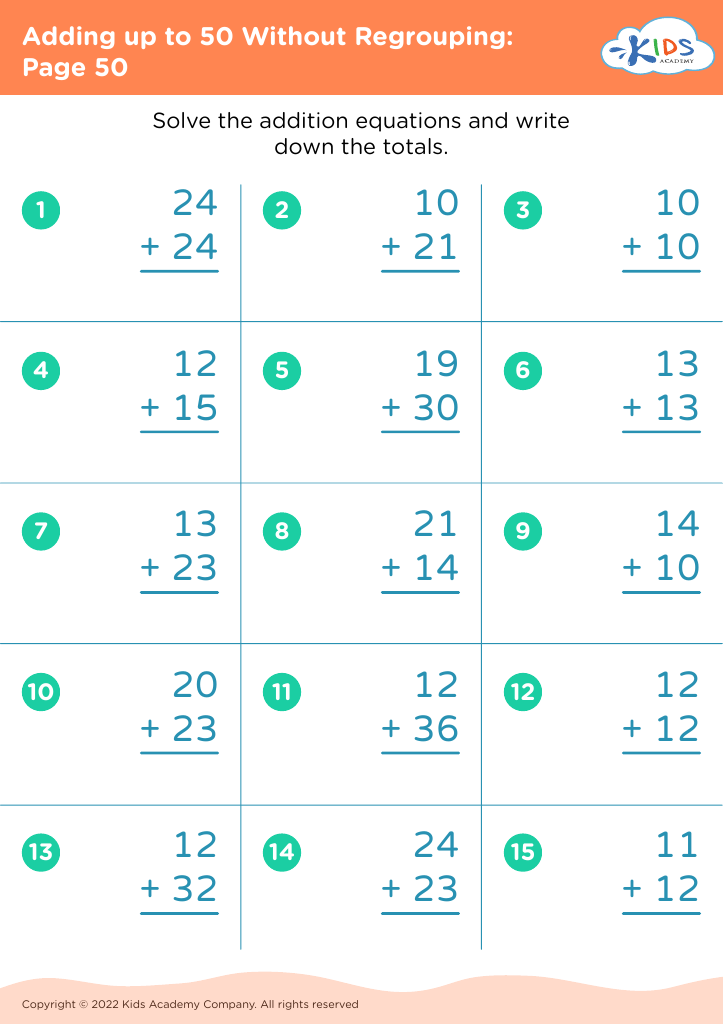
Explore our "Recognizing Equivalent Fractions Addition Worksheets" designed specifically for ages 6-7! These engaging and interactive worksheets help young learners grasp the concept of equivalent fractions while honing their addition skills. Tailored to be fun and visually appealing, our resources provide a solid foundation in math, allowing children to develop confidence and mastery in recognizing fractions. These worksheets offer clear instructions, attractive illustrations, and diverse problems that encourage critical thinking and reinforce learning. Perfect for classroom use or homeschool settings, they turn fraction exploration into an enjoyable adventure. Give your child the tools to succeed in math today!
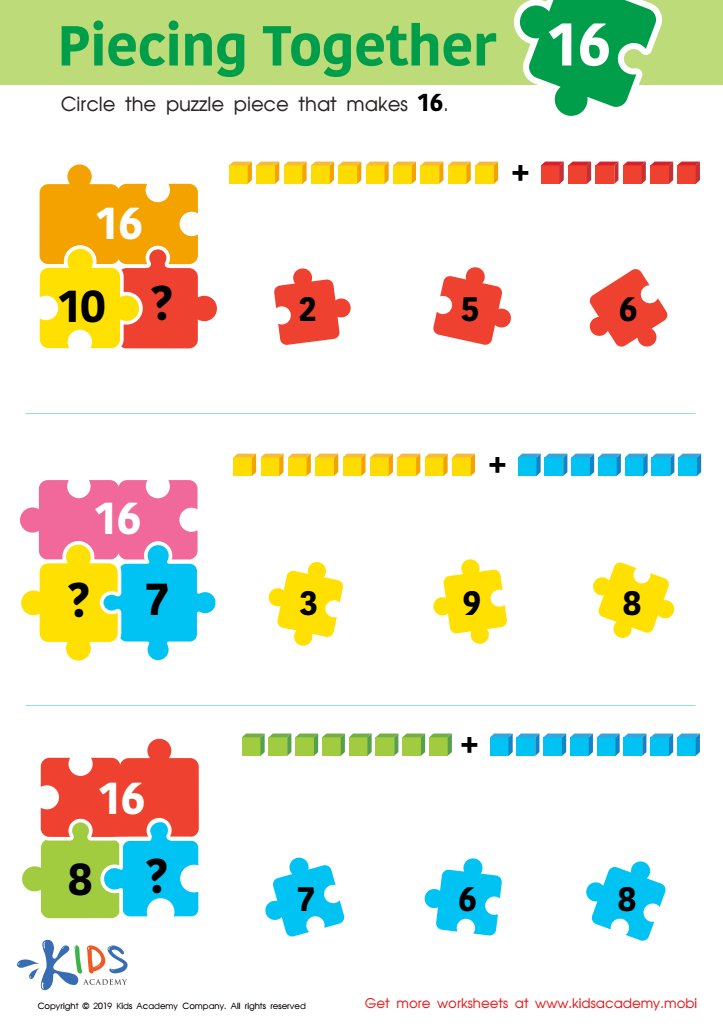
Piecing Together 16 Worksheet
 Assign to My Students







Recognizing equivalent fractions is a foundational skill in mathematics, especially for young learners aged 6-7, forming a critical part of their understanding of fractions and basic arithmetic operations like addition. Parents and teachers should care about this concept because it fosters a deeper comprehension of numbers and the relationships between them.
When children learn to identify equivalent fractions, they develop a flexible mindset towards mathematics, which allows them to visualize and manipulate numbers more easily. This skill enhances their confidence when solving problems, aiding in the transition to higher mathematical concepts such as ratios and proportions.
Moreover, mastering equivalent fractions simplifies the process of adding fractions, making it easier for students to find common denominators and combine fractions effectively. This understanding can help prevent frustration and build a more positive attitude toward mathematics as a whole.
Encouraging children to explore fraction equivalence also integrates critical thinking and problem-solving skills, as they learn to evaluate and compare fractions. By instilling these abilities early on, parents and teachers lay the groundwork for a lifetime of mathematical reasoning, promoting both academic success and self-assurance in tackling future math challenges.








