
Counting practice Coins Worksheets for Ages 6-7
5 filtered results
Difficulty Level
Grade
Age
-
From - To
Subject
Activity
Standards
Discover our fun and engaging "Counting Practice Coins Worksheets" designed for ages 6-7! These printable resources from Kids Academy help young learners develop essential math skills by identifying and counting coins. Perfect for both classroom activities and at-home learning, our worksheets transform learning basic arithmetic into an enjoyable and hands-on experience. With a variety of challenging exercises featuring real-world scenarios, children will build confidence while improving their money counting abilities. Simply download and print these educational tools to support your child's journey towards math mastery today! Visit Kids Academy to explore our full collection of interactive worksheets.
Favorites
With answer key
Interactive
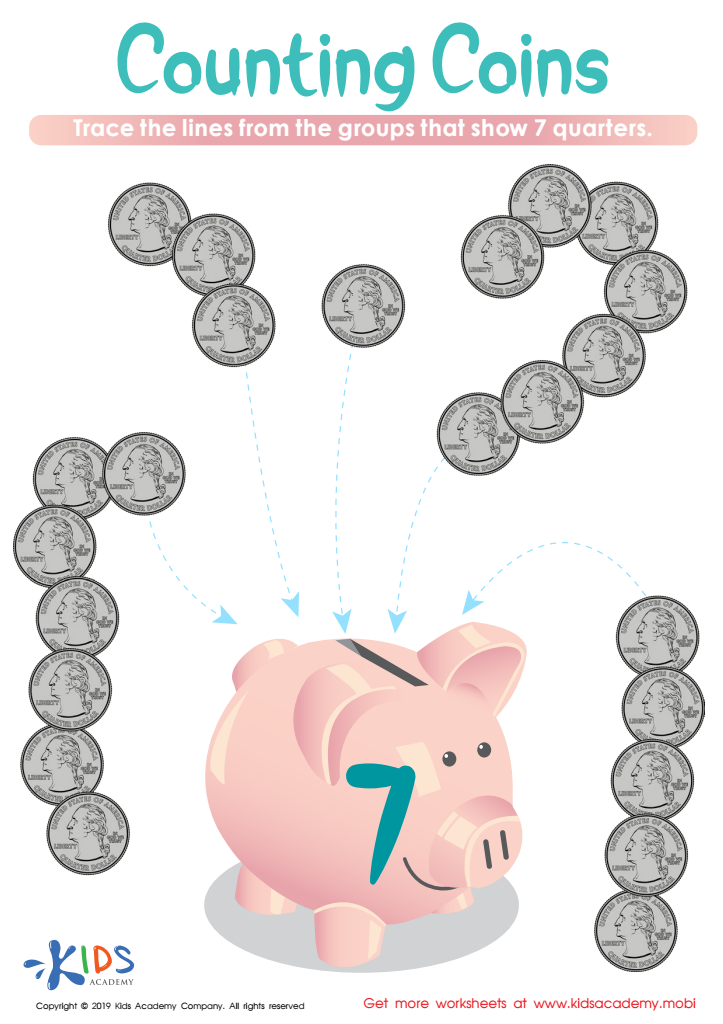
Counting Coins Worksheet
Help your students overcome their fear or aversion of counting and learning numbers with this fun worksheet! It features colorful pictures with four groups of coins. Ask the students to count each group, then trace the lines to the piggy bank. Show them it's easy to count and learn numbers!
 Assign to My Students
Counting Coins Worksheet
Worksheet
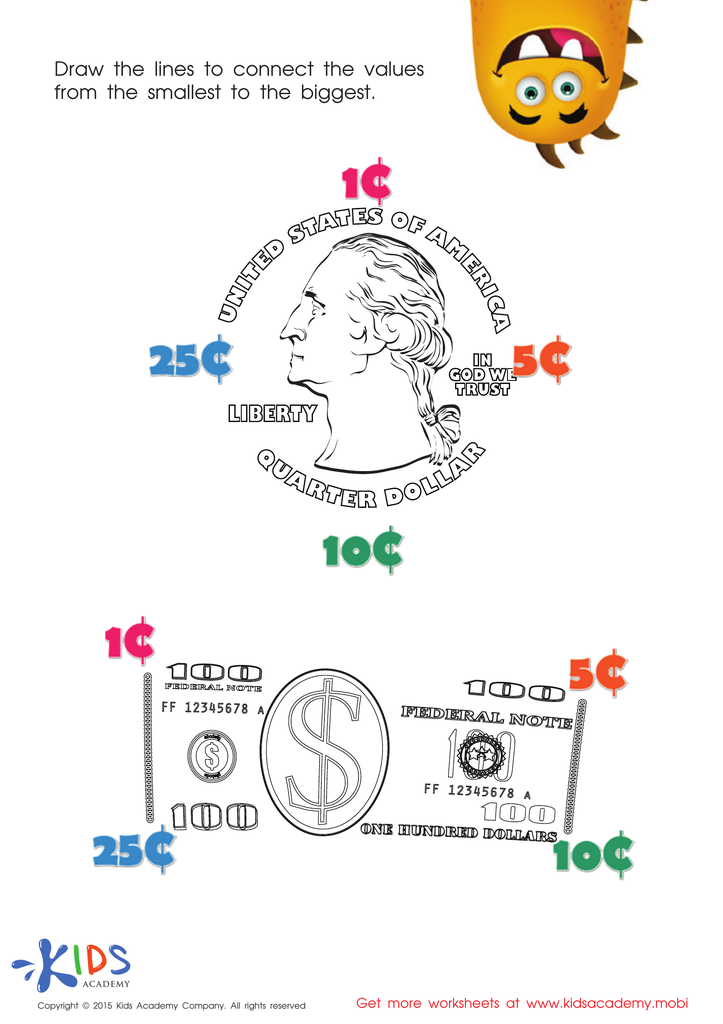
Connecting the Values Money Worksheet
Counting games are a fun way to teach kids about money and counting money. We've learnt the penny, nickel, dime and quarter - can you identify them from the pictures? Draw a line from the smallest to the biggest value and remember the order. Kids Academy has more fun and informative worksheets on counting money.
Connecting the Values Money Worksheet
Worksheet
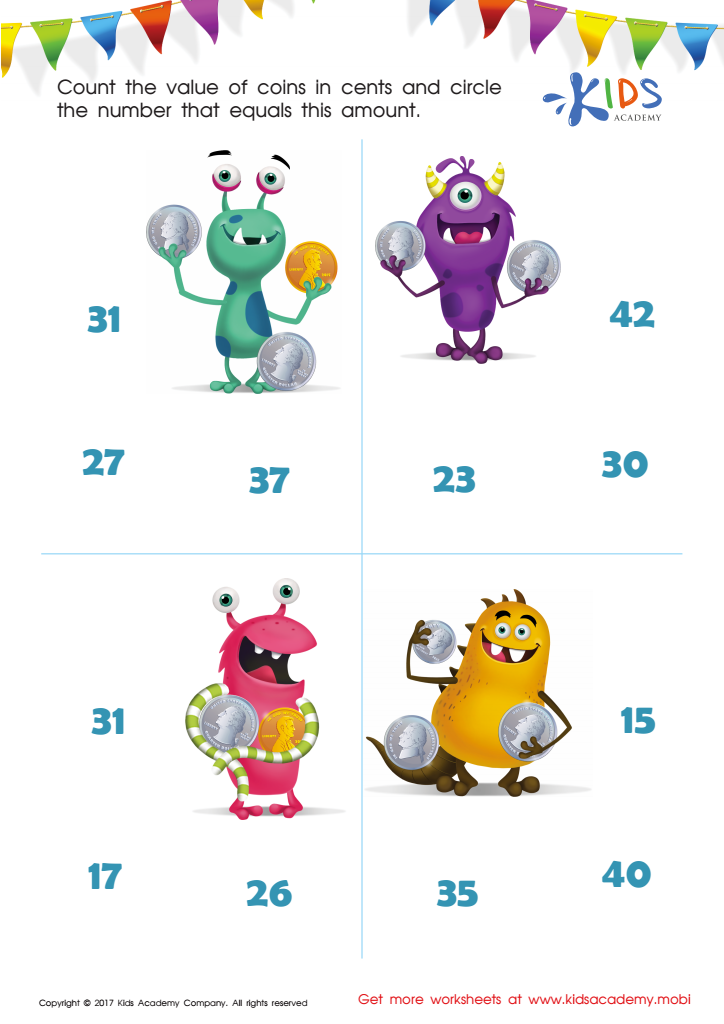
How Many Coins Money Worksheet
Have fun while counting coins: look at the monsters and count the coins in their hands. Challenge your little learners to count and write down the number of coins each one has. Enjoy the time together!
How Many Coins Money Worksheet
Worksheet
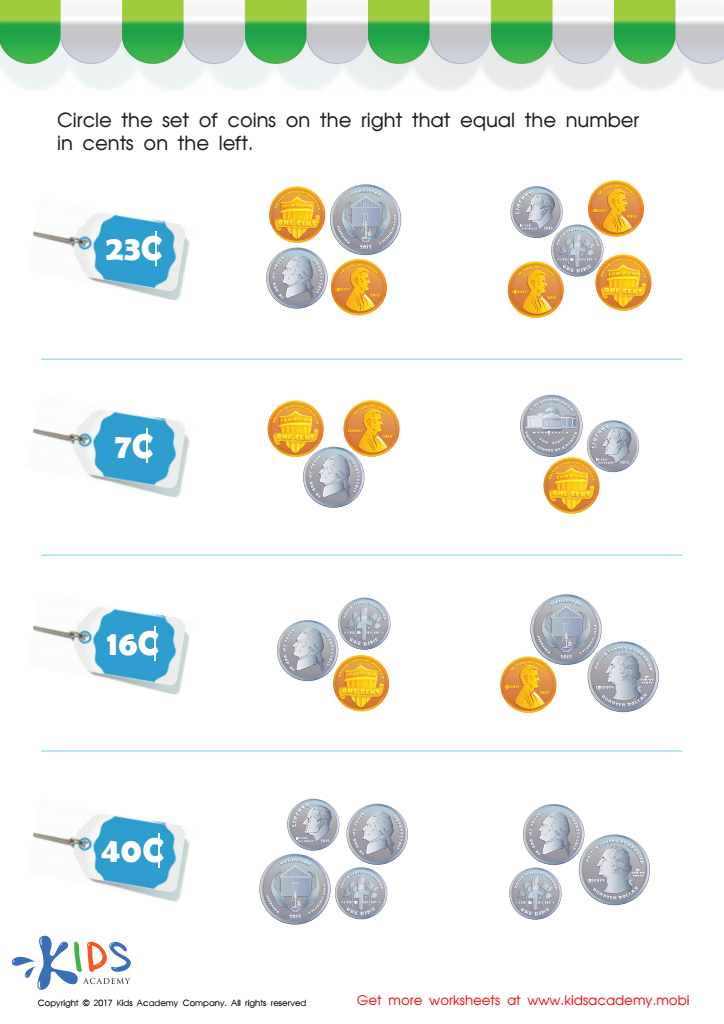
Picking the Coins You Need Money Worksheet
Let's learn to count money with Parents and Kids Academy! Investigate a real shop together: buy a globe, pencils, books, and a school bag using coins. Then, circle the coins you'll need. Visit our website for more free and fun money games for kids!
Picking the Coins You Need Money Worksheet
Worksheet
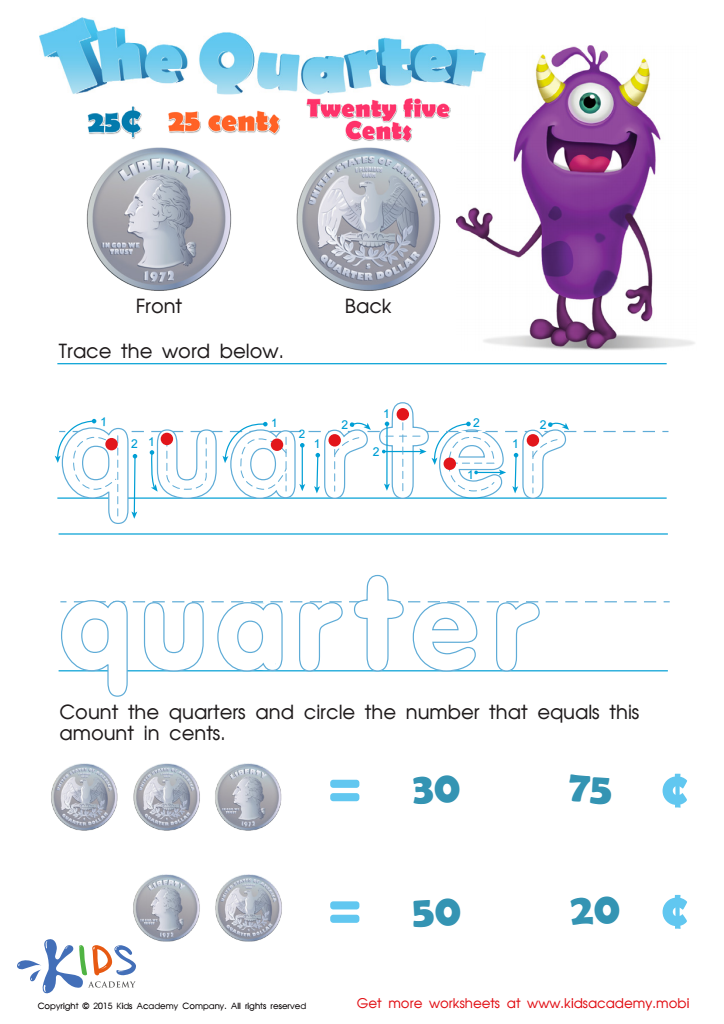
Twenty Five Cents or the Quarter Money Worksheet
Check out our new printable money games - learn to count money easily! With quarters, trace the word, count them and calculate the amount in cents. More worksheets at our website. Give it a try!
Twenty Five Cents or the Quarter Money Worksheet
Worksheet
Join Kids Academy for Free
Who is primarily going to use this learning content?








Counting practice with coins is tremendously beneficial for children ages 6-7 and should be a focal point for parents and teachers. At this developmental stage, young learners are not only solidifying their basic arithmetic skills, such as addition and subtraction, but also becoming familiar with concepts of money, a crucial life skill.
Firstly, coins present a tangible way for children to engage with numbers, helping them visualize what abstract numbers represent. For example, a child who understands that five pennies equal one nickel and that five nickels make a quarter begins to grasp multiplication, division, and the notion of equivalence, laying a strong foundation for more complex math topics.
Secondly, counting practice coins promote financial literacy early on. Understanding the value of different coins and learning to count money can foster essential budgeting and saving habits. These are important life skills that will support their independence as they grow older.
Moreover, incorporating coins in learning activities makes math more interactive and engaging. Hands-on experiences can significantly enhance retention and understanding, making learning more enjoyable.
In essence, counting practice coins combine practical financial knowledge with fundamental math skills, setting children up for success both academically and in their everyday lives. Therefore, this practice deserves enthusiastic support from both parents and teachers.








