
Mathematical reasoning Numbers Worksheets for Ages 6-7
7 filtered results
Difficulty Level
Grade
Age
-
From - To
Subject
Activity
Standards
Discover our engaging Mathematical Reasoning Numbers Worksheets designed specifically for children ages 6-7! These printable resources help young learners develop essential math skills through fun and interactive activities. Our worksheets focus on number recognition, ordering, and basic arithmetic, promoting critical thinking and problem-solving abilities. With colorful designs and age-appropriate challenges, children will be excited to tackle each exercise while building a strong foundation in math. Perfect for classroom use or at-home learning, our materials encourage self-paced exploration and mastery of fundamental concepts. Help your child unlock their mathematical potential with our thoughtfully crafted worksheets today!
Favorites
With answer key
Interactive
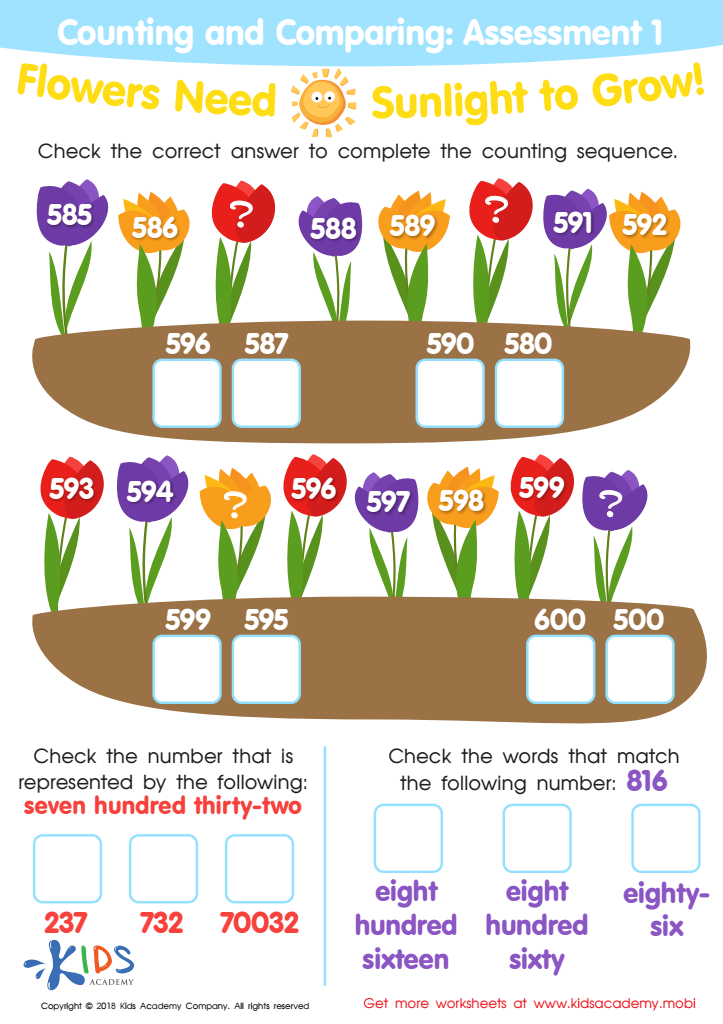
Counting and Comparing: Assessment 1 Worksheet
Download this worksheet and let your students show their progress in identifying, sequencing, and matching numbers and written forms. They'll practice number line skills and matching numeric expressions with numbers. Quickly see how well they understand computation concepts.
 Assign to My Students
Counting and Comparing: Assessment 1 Worksheet
Worksheet
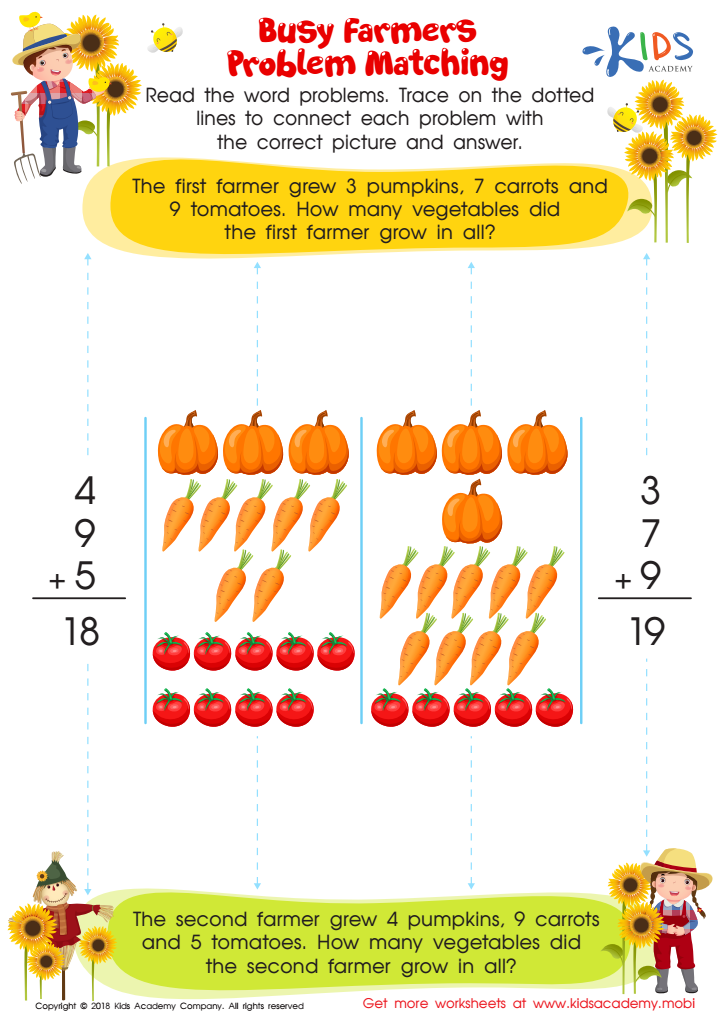
Busy Farmers: Problem Matching Worksheet
Farming is tough, so help your mathematician out with this fun and stimulating worksheet! They'll read word problems and connect each to its correct picture, using traceable lines. They'll practice addition with three addends, and use the harvest veg pictures to ensure accuracy.
Busy Farmers: Problem Matching Worksheet
Worksheet
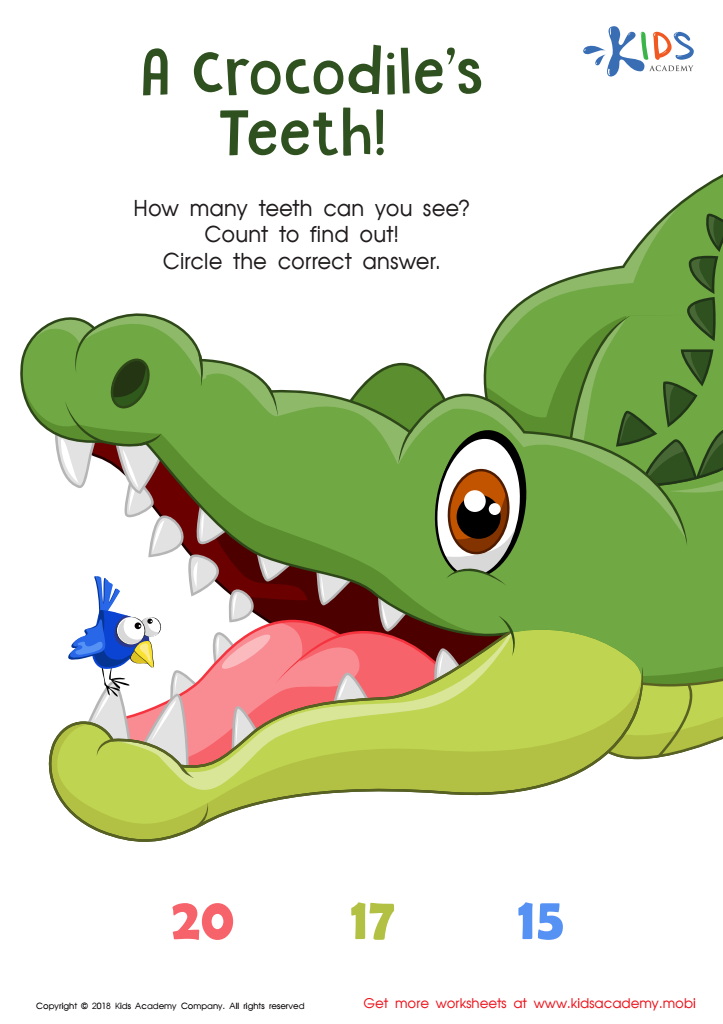
A Crocodile's Teeth Worksheet
Show your child the animal image and ask them to identify it. If they watch animal shows, they'll likely be interested. Count the teeth together, then look at the options and help them circle the right one.
A Crocodile's Teeth Worksheet
Worksheet
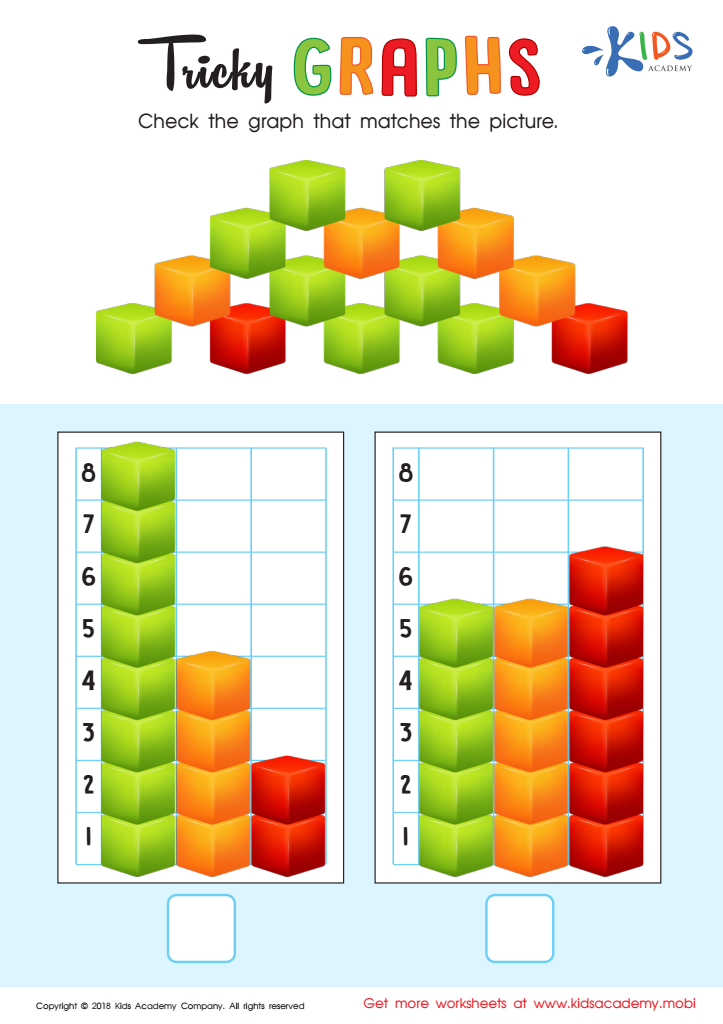
Tricky Graphs Worksheet
Looking for a fun way to sharpen your kid's graphing skills? Get this colorful PDF worksheet! They'll get to practice visual discrimination, counting, and creating bar graphs. Plus, graphing and reading graphs are essential for problem-solving in math.
Tricky Graphs Worksheet
Worksheet
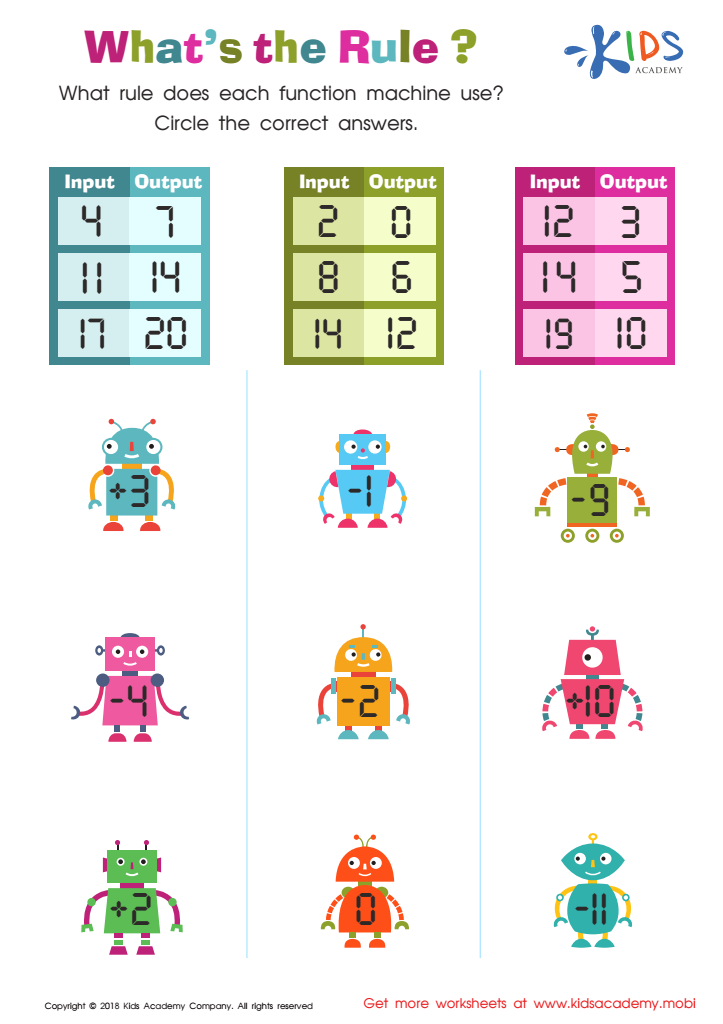
What's the Rule Worksheet
Robots are here to help your child find the relationship between each set of numbers! Adorably illustrated worksheets use vivid pictures that each contain a rule. Look at each function machine and find the pattern or relationship between the input and output. Then, complete the sheet by circling the correct answer!
What's the Rule Worksheet
Worksheet
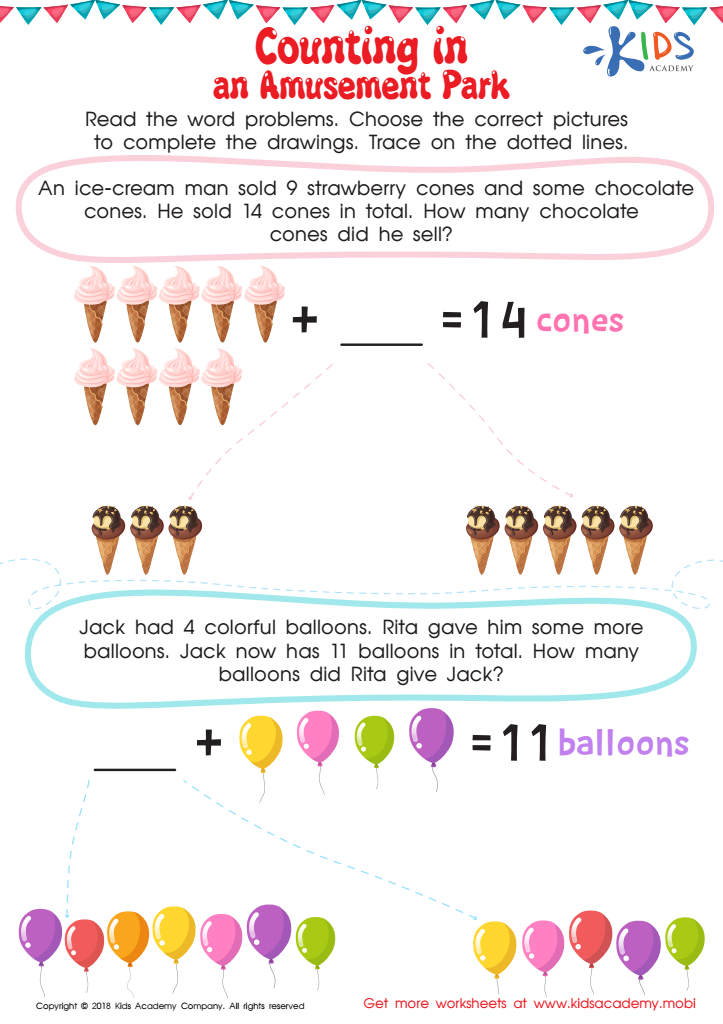
Counting in an Amusement Park Worksheet
Love amusement parks? This colorful worksheet is sure to delight your child as they solve basic addition problems with missing addends. Picture representations help them solve the math equations, while traceable lines help them accurately complete the drawings. No roller coaster ride here, but still loads of fun!
Counting in an Amusement Park Worksheet
Worksheet
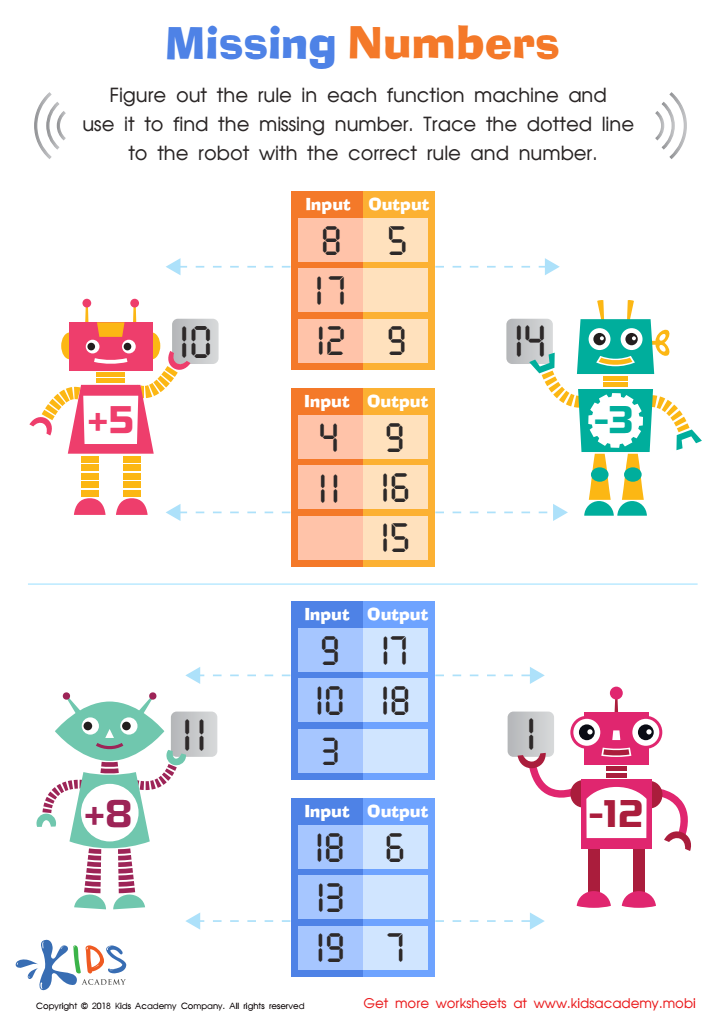
Missing Numbers Worksheet
Elementary students can learn the important pre-algebra skill of solving for missing numbers! Our robots guide them along with number-filled bellies and missing answers in their hands. Kids can examine the other numbers in each graph, use the rule to solve the missing number, and check their work with the missing number to ensure correctness.
Missing Numbers Worksheet
Worksheet
Join Kids Academy for Free
Who is primarily going to use this learning content?








Mathematical reasoning is essential for children aged 6-7 as it lays the groundwork for their future academic success and everyday problem-solving skills. At this stage, children transition from basic counting to understanding numerical relationships and operations such as addition and subtraction. Parents and teachers should care about fostering mathematical reasoning because it develops critical thinking, logical reasoning, and the ability to analyze situations—skills vital not only in math but in all areas of learning and life.
Engaging children in discussions about their thought processes while solving problems encourages them to articulate their reasoning, enhancing their understanding. Encouraging explorative learning through games and real-life scenarios makes math relatable and enjoyable, reinforcing its importance beyond the classroom. Students begin to recognize patterns, make predictions, and justify their answers, all of which are foundational skills not only for math but for engaging with the world around them. Additionally, strong mathematical reasoning can instill confidence, reduce math anxiety, and promote a positive attitude towards learning. Thus, fostering mathematical reasoning in young learners is crucial for developing resilient, capable individuals ready to tackle both academic challenges and real-world mathematical situations.








