
Money identification Math Worksheets for Ages 6-7
4 filtered results
Difficulty Level
Grade
Age
-
From - To
Subject
Activity
Standards
Boost your child's money management skills with our Money Identification Math Worksheets for ages 6-7. These engaging worksheets, designed by educational experts at Kids Academy, help young learners recognize and differentiate coins and bills. With colorful illustrations and age-appropriate challenges, children will enjoy mastering the basics of money identification while building essential math skills. Perfect for classroom or home use, these printables provide a solid foundation for financial literacy and support cognitive development. Start laying the groundwork for your child's financial success today with our fun and effective money identification worksheets!
Favorites
With answer key
Interactive
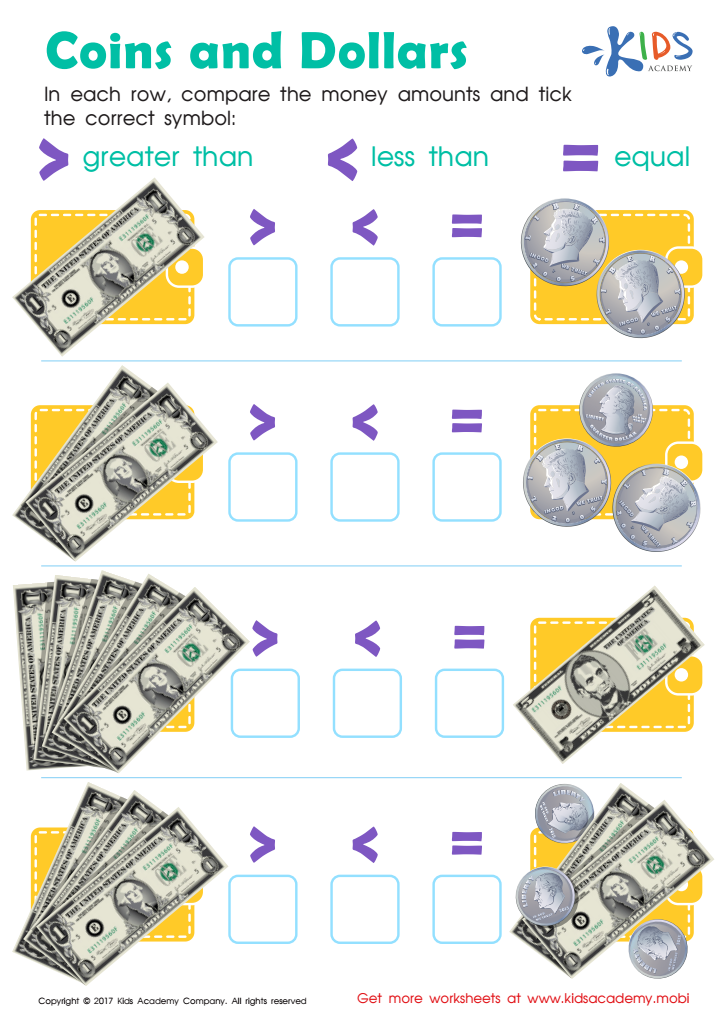
Money: Coins Dollars Printable
Motivate your kid to learn and practise essential math skills, like 'greater than' and 'less than', by introducing the importance of money! The money worksheet "Coins and Dollars" will give them a hands-on experience of counting coins and dollars, making math symbols more memorable.
 Assign to My Students
Money: Coins Dollars Printable
Worksheet
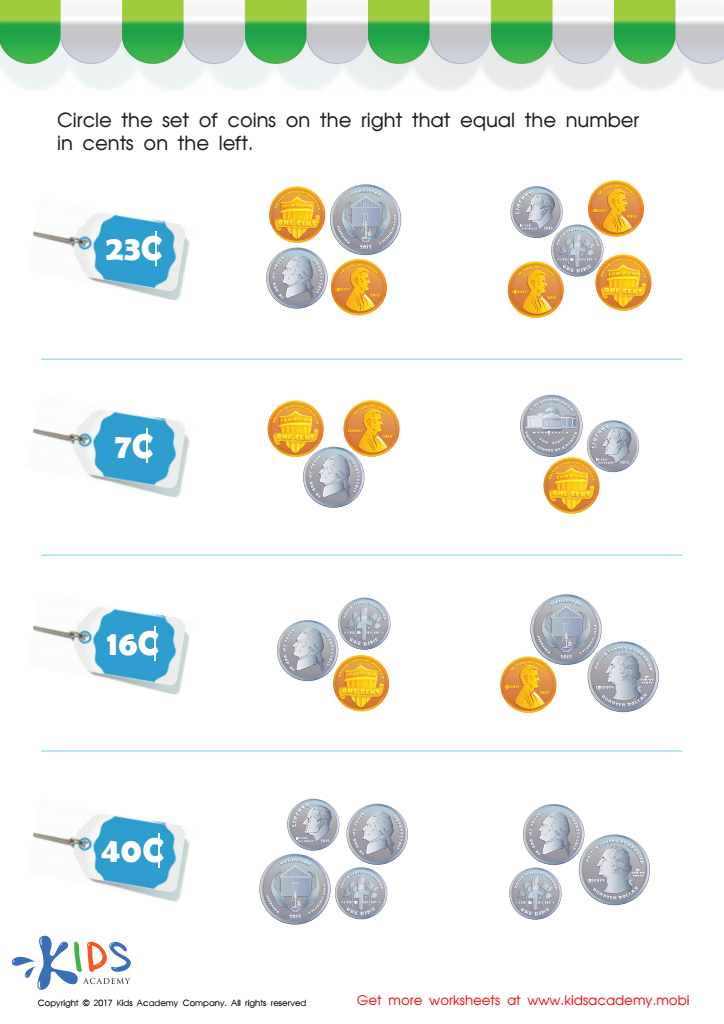
Picking the Coins You Need Money Worksheet
Let's learn to count money with Parents and Kids Academy! Investigate a real shop together: buy a globe, pencils, books, and a school bag using coins. Then, circle the coins you'll need. Visit our website for more free and fun money games for kids!
Picking the Coins You Need Money Worksheet
Worksheet
Join Kids Academy for Free
Who is primarily going to use this learning content?








Parents and teachers should care about money identification math for children ages 6-7 because it lays the foundation for essential life skills early on. At this age, kids are just starting to understand the world beyond their immediate surroundings, and recognizing money introduces them to basic economic concepts. Understanding currency values and differentiating between coins and bills helps develop their numeric and cognitive skills. It strengthens their ability to count, add, and subtract, which are crucial math competencies.
Moreover, early money identification fosters financial literacy, setting the stage for more complex financial understanding later on. When children familiarize themselves with different denominations and their respective values, they begin to grasp the worth of various items, encouraging wise spending and saving habits. This practical knowledge can translate into positive lifelong attitudes toward money management.
Introducing money identification in a playful, interactive manner also keeps young learners engaged. Activities like role-playing stores or using toy money can make the learning process enjoyable, fostering a positive attitude toward mathematics and learning in general.
In summary, money identification math for young children is vital as it enhances numerical skills, promotes financial literacy, and prepares them for real-world experiences. Parents and teachers play a key role in making this learning both effective and enjoyable.








