Motor skills development Math Worksheets for Ages 6-7
5 filtered results
-
From - To
Enhance your child's motor skills while they engage with math through our expertly designed worksheets for ages 6-7. These resources are tailored to boost fine and gross motor abilities alongside essential mathematical concepts. Children will enjoy practicing writing numbers, tracing shapes, and solving fun puzzles that promote hand-eye coordination and dexterity. Our worksheets guide young learners through interactive activities that make math enjoyable, ensuring they develop both confidence and competence. Whether at home or in the classroom, these engaging math worksheets support holistic development, preparing your child for future learning challenges. Start fostering your child's motor and math skills today!
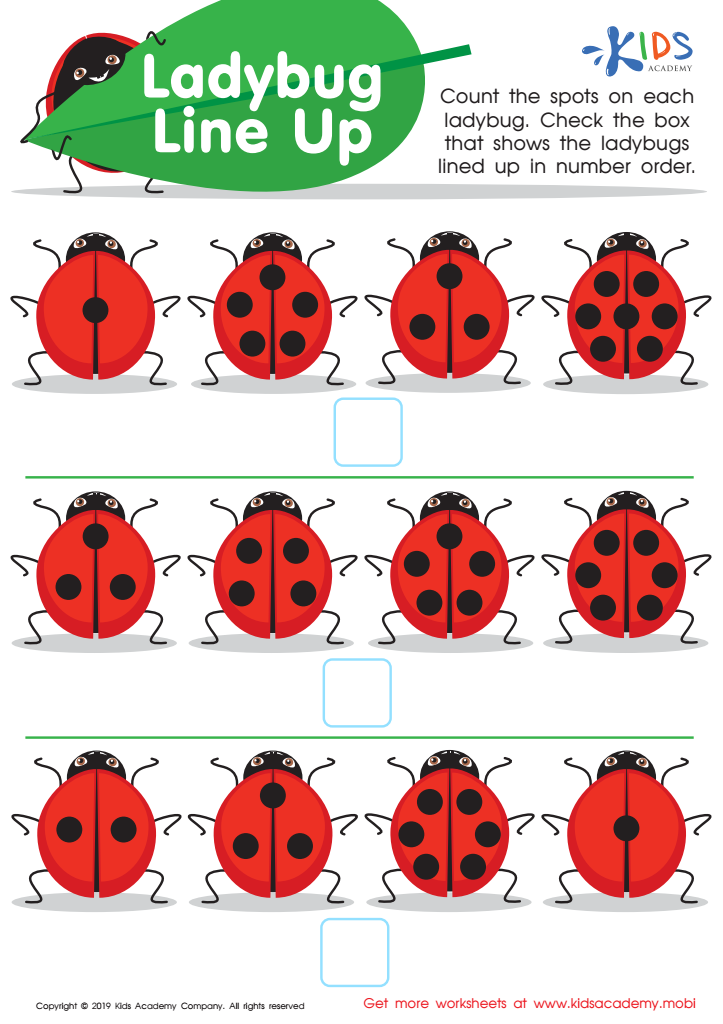
Ladybug Line Up Worksheet
 Assign to My Students







Motor skills development plays a crucial role in the overall growth of children aged 6-7, particularly in the context of learning math. At this stage, children are transitioning from concrete to more abstract thinking, where fine motor skills become essential for tasks such as writing numbers, drawing shapes, and manipulating math tools. Developing these skills helps children master essential pre-math tasks, fostering confidence in their abilities.
Parents and teachers should recognize that strong motor skills can also enhance cognitive development. Activities that require precise hand movements—like cutting shapes, stringing beads, or using manipulatives like blocks—actually engage brain regions associated with logical thinking and problem-solving, which are foundational for math proficiency. Furthermore, as children engage in hands-on activities, they also build social skills by collaborating with peers, allowing them to communicate mathematical ideas more effectively.
When motor skills are nurtured, children are more likely to approach math with enthusiasm and confidence, reducing math-related anxiety. This positive experience not only promotes math success but also sets the stage for lifelong learning and positive attitudes toward challenges. By prioritizing motor skills development, parents and teachers can create a richer educational experience that bridges physical coordination with mathematical understanding.








