
Solve word problems Math Worksheets for Ages 6-7
3 filtered results
Difficulty Level
Grade
Age
-
From - To
Subject
Activity
Standards
Discover our engaging "Solve Word Problems Math Worksheets" designed specifically for ages 6-7! These worksheets provide a fun and interactive approach to developing essential problem-solving skills. Children will tackle age-appropriate word problems that enhance their critical thinking and comprehension abilities. By addressing real-life scenarios, our resources make math relatable and enjoyable. With diverse topics and colorful illustrations, students will stay motivated as they practice addition, subtraction, and more. Perfect for classroom use or at-home learning, these worksheets empower young learners to gain confidence and master the art of solving word problems. Start your child’s math journey today!
Favorites
With answer key
Interactive
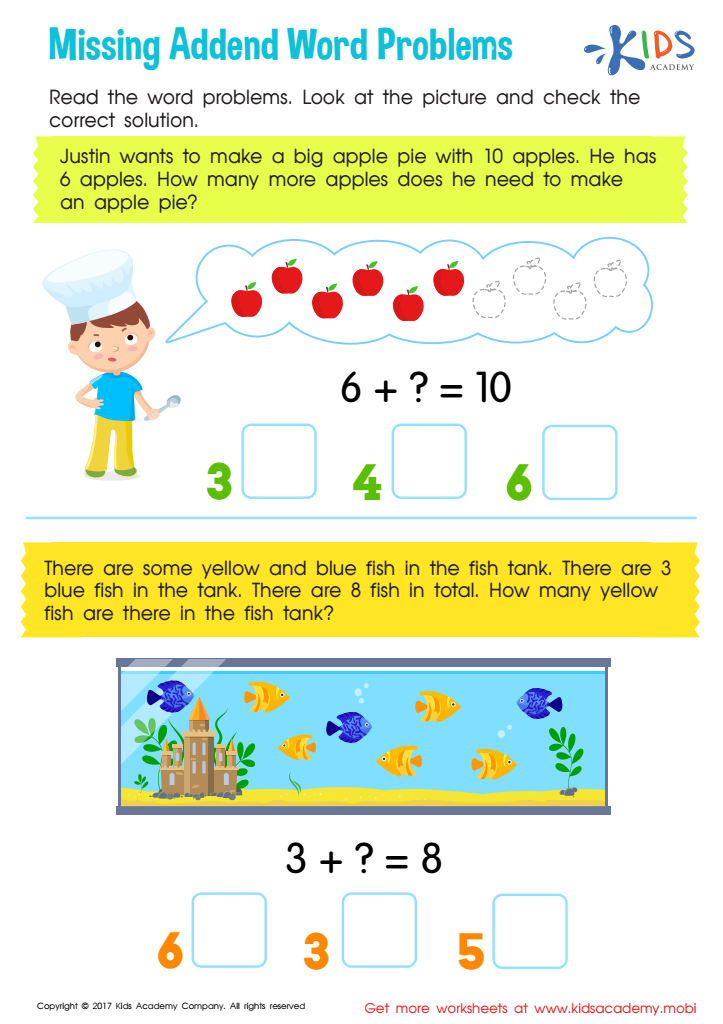
Missing Addend Word Problems Worksheet
Doing many addition and subtraction problems is key for fluency and mastery. Word problems can help kids understand how math works in everyday life. Our math worksheet uses fun scenarios and pictures to teach how to find the missing addend. It's the perfect tool to help kids understand math better!
 Assign to My Students
Missing Addend Word Problems Worksheet
Worksheet
Join Kids Academy for Free
Who is primarily going to use this learning content?








Parents and teachers should prioritize solving word problems in math for ages 6-7 because it fosters critical thinking and problem-solving skills essential for lifelong learning. At this age, children are developing foundational skills in logic and reasoning, and word problems, in particular, encourage them to apply mathematical concepts in real-world contexts. This practice helps bridge the gap between abstract numbers and practical applications, making math more relatable and engaging for young learners.
Moreover, tackling word problems enhances reading comprehension, as students must interpret the language, identify key information, and determine the appropriate operations to use. This cross-disciplinary skillset not only bolsters their math abilities but also supports their literacy development, as they learn to decipher meaning and context within sentences.
Encouraging children to approach math through storytelling provides a fun and interactive way to engage with numbers, fostering a positive attitude towards the subject. Ultimately, developing these skills early on lays a strong foundation for more complex mathematical concepts in the future, contributing to academic success and confidence in learning. Thus, word problems serve as a vital tool for holistic development in both mathematics and literacy among young learners.








