
Understanding sizes Math Worksheets for Ages 6-7
3 filtered results
Difficulty Level
Grade
Age
-
From - To
Subject
Activity
Standards
Discover our "Understanding Sizes Math Worksheets for Ages 6-7" designed to make learning fun and engaging for young minds. These printable worksheets help children grasp the concept of size comparison, enhancing critical thinking and problem-solving skills. With a variety of activities, such as matching, ordering, and comparing objects, kids will master terms like bigger, smaller, taller, and shorter. Perfect for both classroom and at-home practice, these worksheets ensure consistent progress in your child's mathematical journey. Start boosting your child's confidence and understanding of sizes with our expertly crafted resources at Kids Academy!
Favorites
With answer key
Interactive
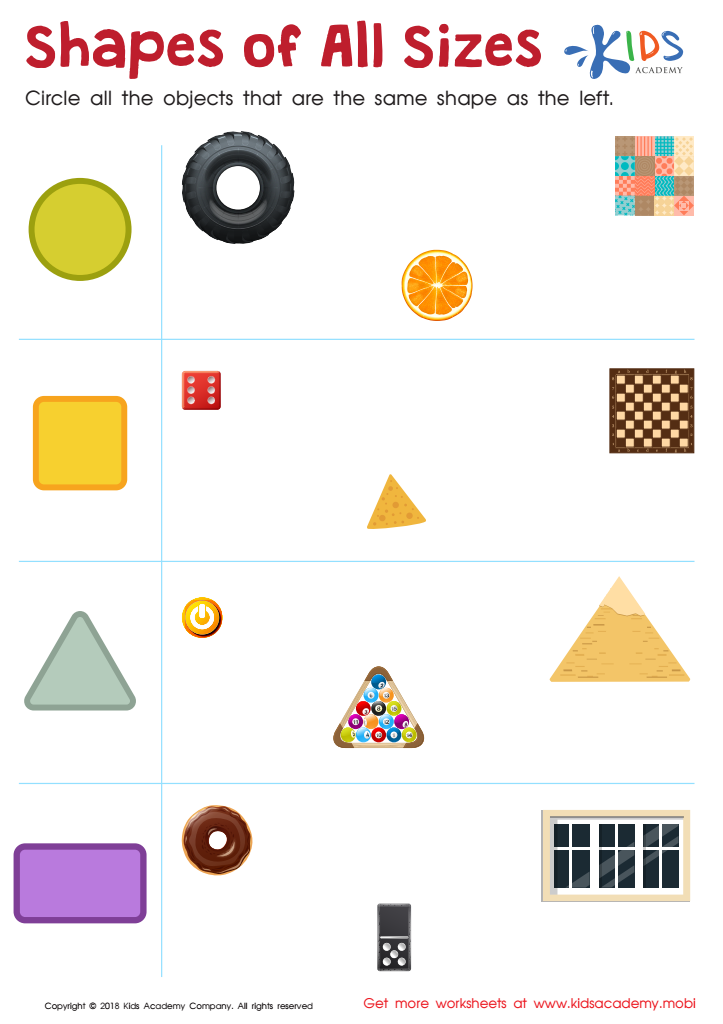
Shapes of All Sizes Worksheet
Students will have fun comparing basic shapes to familiar objects with this worksheet. It's an excellent way to help them recognize similarities in geometric shapes, building strong foundations for understanding congruence and similarity.
 Assign to My Students
Shapes of All Sizes Worksheet
Worksheet
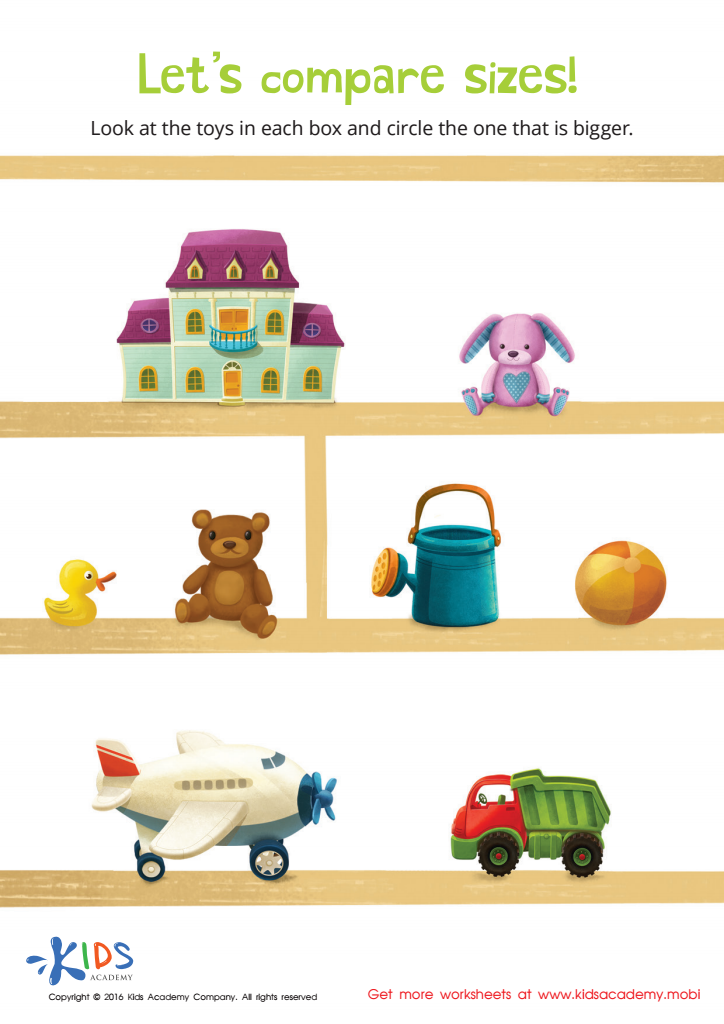
Classifying by Size Sorting Worksheet
Help your preschooler recognize differences in size using this fun worksheet! Your child will engage in important spatial recognition and problem-solving skills while talking with you about objects that can be small or large. Enjoy the vibrant pictures together!
Classifying by Size Sorting Worksheet
Worksheet
Join Kids Academy for Free
Who is primarily going to use this learning content?






Understanding sizes in mathematics is fundamental for children ages 6-7 because it lays the groundwork for more complex math concepts and real-world applications. At this stage, children are in what Piaget refers to as the "preoperational" period, where they begin to understand that objects can be compared and classified based on different attributes such as length, width, height, and volume.
When kids grasp the basics of sizes, they can better understand measurements, spatial reasoning, and geometric concepts later on. For example, comprehending big and small, long and short, or tall and short helps children predict and compare quantities and develop critical thinking skills. These abilities are essential for practical tasks, from sorting household items to understanding distances and locations in their environment.
Parents and teachers play a vital role by incorporating size comparison activities into everyday routines, such as cooking (measuring ingredients) or playtime (building blocks). This makes the learning process engaging and relevant. Moreover, early mastery of these concepts boosts a child's confidence and encourages a positive attitude towards math learning, setting the stage for academic success across various subjects.
Ensuring children understand sizes at a young age helps build a solid mathematical foundation, equipping them with skills they will use throughout their lives.








