Handwriting practice Alphabet Worksheets for Ages 6-8 - Page 3
49 filtered results
-
From - To
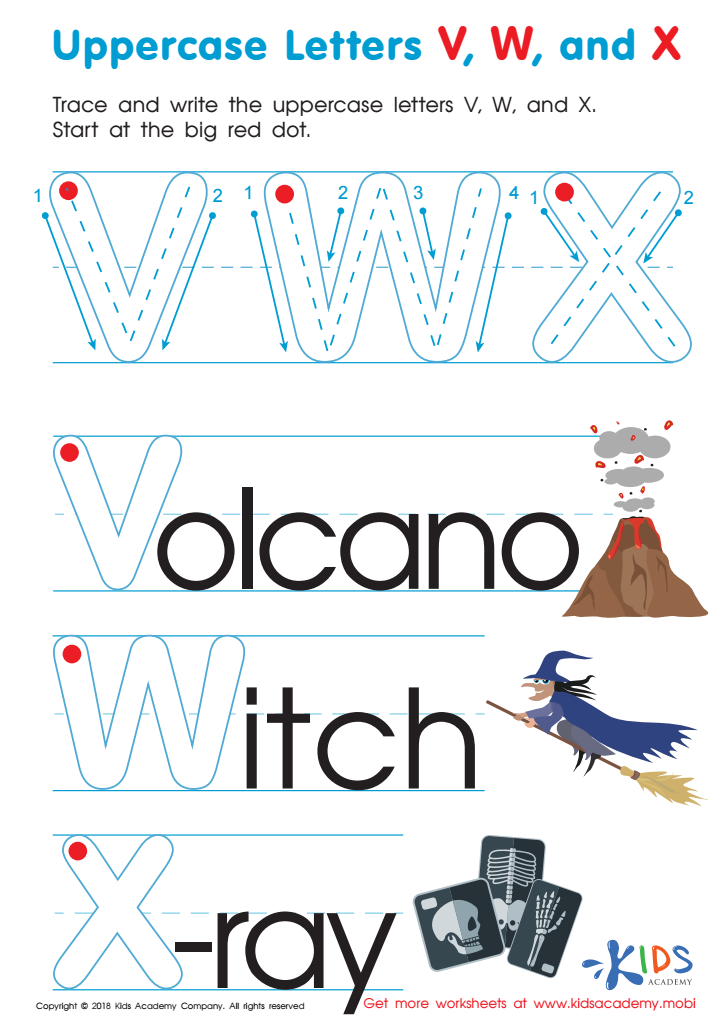
Uppercase Letters V, W, and X Worksheet
 Assign to My Students








Handwriting practice is crucial for children aged 6-8 as it lays a essential foundation for their cognitive, motor, and academic development. At this formative stage, children's brains are highly adaptable, making it an optimal period to refine fine motor skills. Practicing handwriting helps strengthen these skills, enhancing hand-eye coordination, dexterity, and muscle memory.
Moreover, handwriting aids in cognitive associations and retention. Writing alphabets reinforces the recognition and sounds of letters, crucial for literacy development. This tactile learning experience creates neuro-pathways that facilitate reading and spelling proficiency. Through consistent practice, children improve their ability to form letters correctly, which mitigates frustration and boosts self-confidence in their academic undertakings.
Beyond literacy, handwriting practice instills a sense of discipline and attention to detail. Sitting down to write, even for short periods, encourages focus and perseverance, skills that are beneficial across all subjects and tasks. Additionally, neat handwriting makes their work more readable, reducing errors and enabling clearer expression of ideas.
Lastly, in an era dominated by digital devices, nurturing handwriting ensures that children retain this essential skill, promoting a balanced development suited for various contexts in life, both academic and personal. Hence, parents and teachers should emphasize handwriting practice, acknowledging its broad and lasting benefits.







