
Long vowel recognition Phonics Worksheets for Ages 6-8
3 filtered results
Difficulty Level
Grade
Age
-
From - To
Subject
Activity
Standards
Discover our engaging Long Vowel Recognition Phonics Worksheets designed specifically for children aged 6-8. These creative learning tools help young learners identify and practice long vowel sounds, enhancing their reading and pronunciation skills. Our worksheets feature a variety of fun activities, including matching, sorting, and fill-in-the-blank exercises, to keep your child motivated and excited about learning. Crafted by educational experts, these printable resources provide clear instructions and vibrant illustrations to ensure effective and enjoyable learning experiences. Perfect for both classroom use and homeschooling, these worksheets will support your child's journey to reading success.
Favorites
With answer key
Interactive
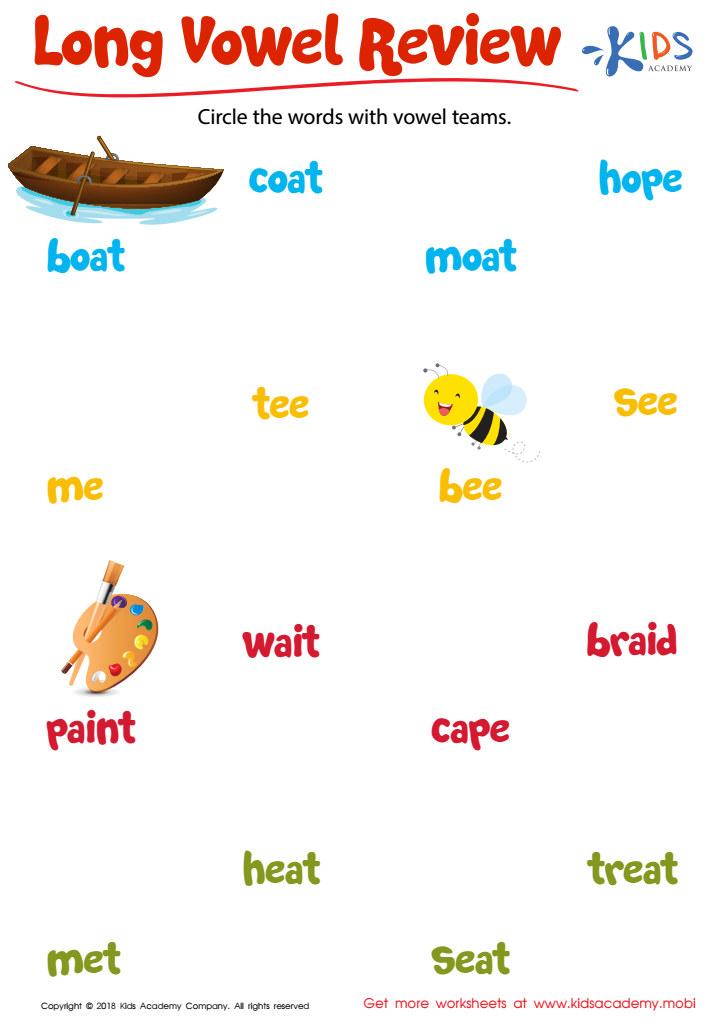
Long Vowel Review Worksheet
Vowel teams like "ea" and "ai" help us make words, and understanding these patterns aids emerging readers in becoming more fluent. This review worksheet has students finding words with vowel teams that make the long vowel sound, and helps them recognize high-frequency words.
 Assign to My Students
Long Vowel Review Worksheet
Worksheet
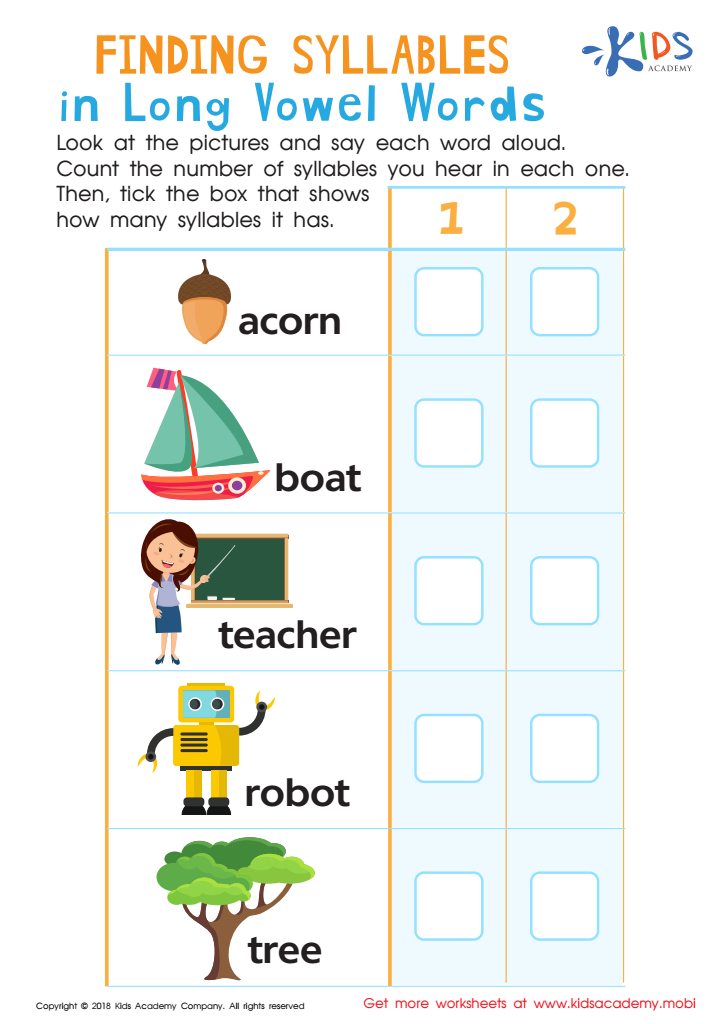
Finding Syllables in Long Vowel Words Worksheet
Help your kids identify objects and better count syllables in words. Look at the printout images with them and have them say each word out loud. Ask them to count syllables and tick the box with the correct number. With this worksheet, your kids will become more skilled.
Finding Syllables in Long Vowel Words Worksheet
Worksheet
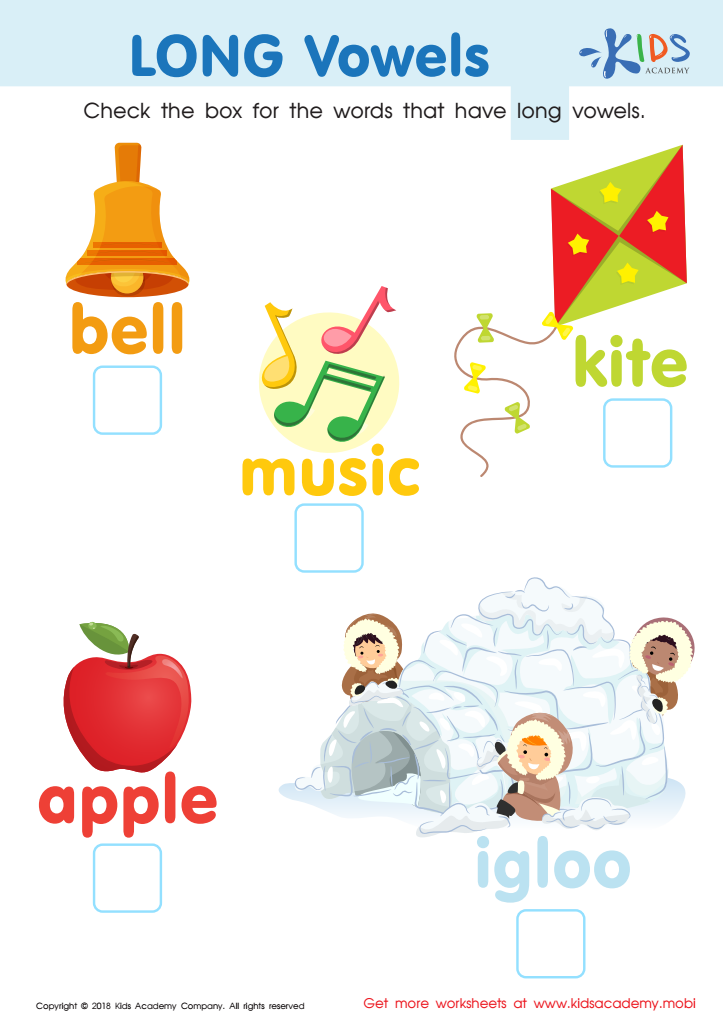
long vowels Worksheet
Have your early learner identify long vowels with this quick review. Ask them to name each picture aloud and listen out for the long vowel sounds to separate them from the shorter ones. Circle the ones that are long! Watch out for words with two vowels - they can be tricky!
long vowels Worksheet
Worksheet
Join Kids Academy for Free
Who is primarily going to use this learning content?








Parents and teachers should care about long vowel recognition phonics for children aged 6-8 because it is a critical component of early literacy development. At this stage, children transition from learning to read to reading to learn. Mastery of long vowel sounds significantly enhances their reading fluency, enabling them to read words accurately and effortlessly.
Understanding long vowels also aids in spelling, as children who recognize vowel patterns can more easily decode and encode words. For instance, knowing that the "ea" in "meat" makes a long "e" sound helps them both in reading and writing the word correctly. This builds a stronger foundation for more complex literacy skills, supporting overall academic success.
Moreover, early proficiency in recognizing long vowels boosts children's confidence and motivation to read, as they encounter fewer barriers while learning. Phonics instruction, emphasizing long vowels, provides tools and strategies for tackling new words, fostering independence in reading.
Encouraging long vowel recognition in 6-8-year-olds aligns with their brain development, making it an optimal time for phonics instruction. Investing in this aspect of literacy primes children for continued educational engagement and success beyond their early years, influencing their lifelong learning trajectory. Therefore, prioritizing long vowel phonics is crucial for fostering competent, confident learners.







