
Basic geometry comprehension Worksheets for Ages 6-8
3 filtered results
Difficulty Level
Grade
Age
-
From - To
Subject
Activity
Standards
Unleash your child's mathematical potential with our Basic Geometry Comprehension Worksheets designed for ages 6-8, available at Kids Academy. These fun and educational worksheets help young learners grasp foundational geometry concepts through engaging activities and interactive exercises. With a focus on shapes, symmetry, spatial understanding, and problem-solving, our worksheets are specifically tailored to enhance cognitive skills and foster a love for math. Download and print to provide your child with hours of constructive learning while developing crucial geometry comprehension. Perfect for classroom use or at-home practice – make math exciting and accessible today!
Favorites
With answer key
Interactive
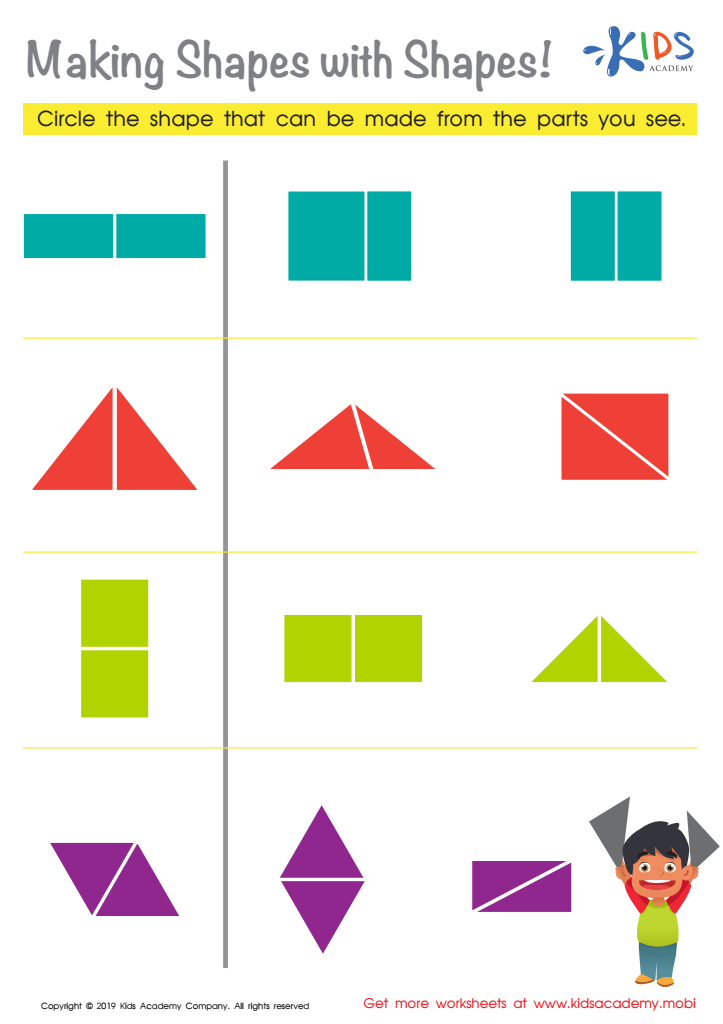
Making Shapes with Shapes Worksheet
Help your kindergartners identify shapes with this simple worksheet. Examine the shapes on the left and have them circle the one they can make from the parts in the picture. Shapes can be tricky, but this exercise will help clear up any confusion.
 Assign to My Students
Making Shapes with Shapes Worksheet
Worksheet
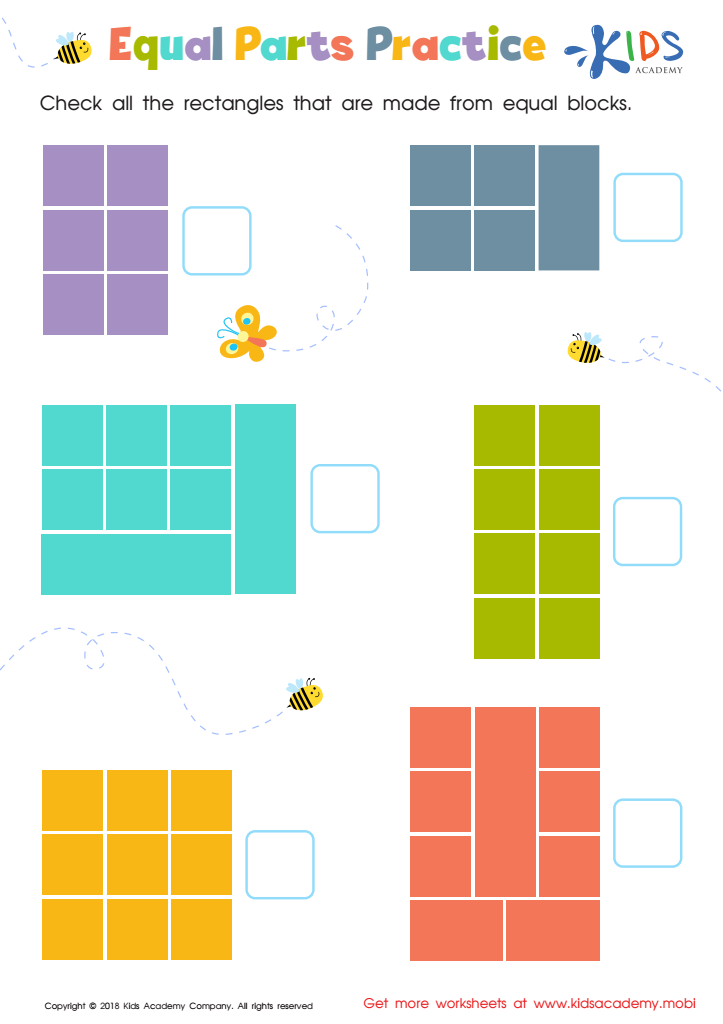
Equal Parts Practice Worksheet
This worksheet checks your child's knowledge of halves and equal pieces. Have them go through the rectangles and check those made up of equal blocks. Your kids should be able to tell which parts are equal and which are not after the exercise.
Equal Parts Practice Worksheet
Worksheet
Join Kids Academy for Free
Who is primarily going to use this learning content?


.jpg)





Basic geometry is crucial for children aged 6-8 because it serves as a foundation for various essential skills and future learning. First, understanding shapes, sizes, and spatial relationships enhances cognitive development. It aids children in making sense of their physical world, enabling them to interpret and navigate their environments effectively.
Geometry also supports mathematical thinking and problem-solving. By learning basic concepts like circles, squares, and triangles, children grasp the basics of mathematics, which contributes to more complex skills like fractions and algebra later on. Shapes and spatial understanding are integral in daily tasks, such as fitting objects into different spaces and understanding directions and maps.
Moreover, early geometry skills are linked to better performance in other subjects. For example, recognizing patterns, an essential aspect of geometry, directly benefits reading and comprehension skills. Learning geometry encourages logical reasoning and critical thinking, which are vital for academic success across various disciplines.
Additionally, hands-on activities like playing with blocks or drawing shapes make learning interactive and fun, promoting a love for learning. Teachers and parents should therefore emphasize basic geometry comprehension to nurture well-rounded development in young children, laying down a strong foundation for their future educational journey and practical life skills.








