
Encourage attention to detail Worksheets for Ages 6-8
3 filtered results
Difficulty Level
Grade
Age
-
From - To
Subject
Activity
Standards
Explore our "Encourage Attention to Detail Worksheets" designed specifically for children aged 6-8! These engaging worksheets promote concentration and sharpen observational skills through fun, age-appropriate activities. Kids will enjoy identifying differences in pictures, completing puzzles, and engaging with interactive challenges that foster critical thinking. Each worksheet supports young learners in developing essential skills necessary for academic success and everyday life. Perfect for home or classroom use, these resources make learning enjoyable and effective. Empower your child to become more attentive and detail-oriented with our easy-to-use, print-ready worksheets, helping them thrive academically and enjoy the learning process!
Favorites
With answer key
Interactive
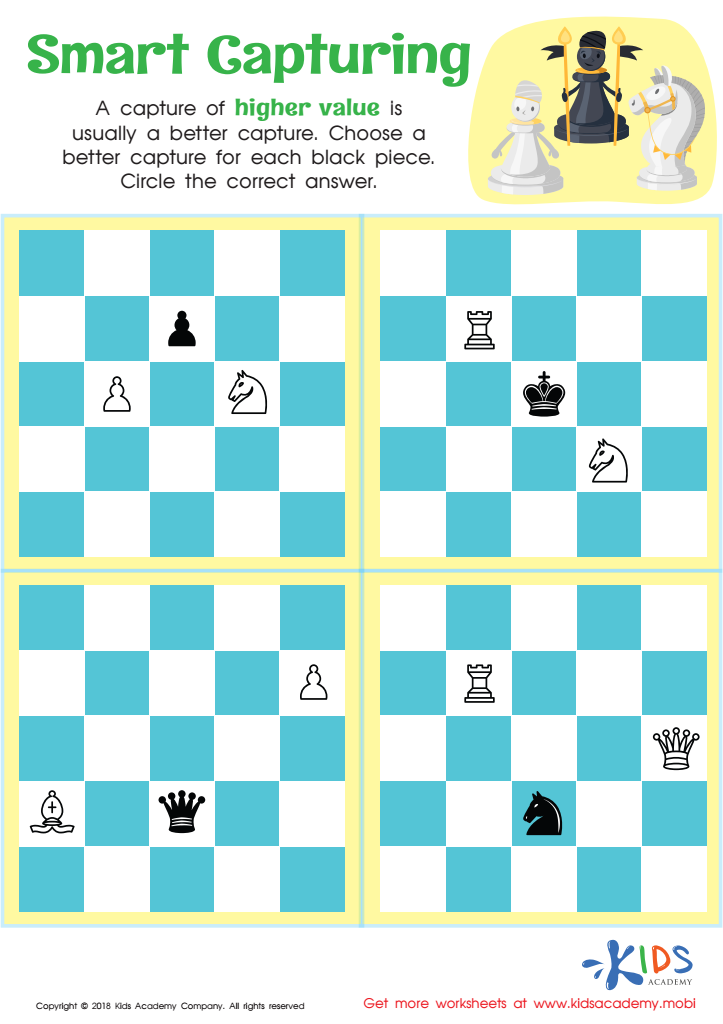
Smart Capturing Worksheet
Chess is a game of strategy and calculation. When presented with two captures, a player should always go for the one that yields the highest value. For example, taking a knight over a pawn. In this worksheet, your children will choose the best capture for each black piece. Ask them to circle the correct answers. (80 words)
 Assign to My Students
Smart Capturing Worksheet
Worksheet
Join Kids Academy for Free
Who is primarily going to use this learning content?








Encouraging attention to detail in children aged 6-8 is vital for their cognitive and emotional development. During these formative years, children are honing their observational skills, which aid in reading comprehension, mathematics, and problem-solving. By fostering attention to detail, parents and teachers help children develop a habit of thoroughness and precision that extends beyond academics into everyday life.
Attention to detail enhances a child's ability to notice patterns, follow instructions, and critically assess their work. This skill encourages students to take pride in their accomplishments, boosting their confidence and self-esteem as they recognize the link between detail-oriented efforts and positive outcomes. Moreover, an emphasis on detail fosters critical thinking, as children learn to analyze information and evaluate accuracy.
In social contexts, attention to detail aids in communication and relationships, enabling children to pick up on non-verbal cues and understand emotions better. Furthermore, it sets the groundwork for lifelong learning, as detail-oriented individuals often excel in professional environments, advancing their careers. By instilling these skills early, parents and educators cultivate attentive, conscientious individuals ready to face the complexities of the world around them. Making this a priority lays a foundation for success in all aspects of life.








