Fraction comparison Worksheets for Ages 6-8 - Page 2
44 filtered results
-
From - To
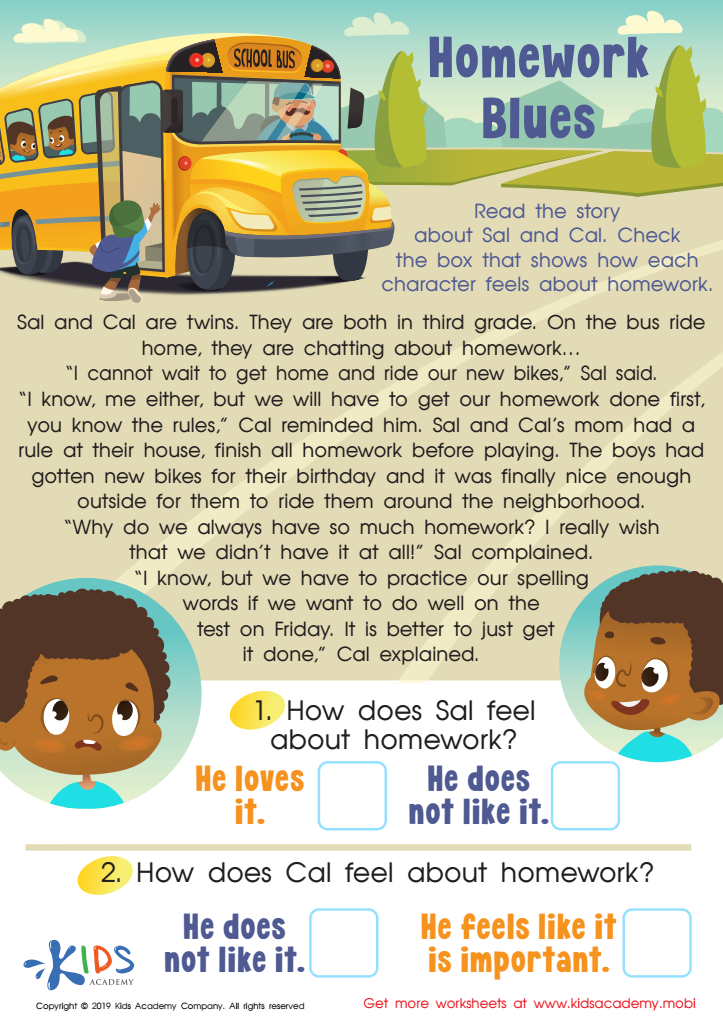
Homework Blues Worksheet
 Assign to My Students




.jpg)
Understanding fraction comparison is crucial for children ages 6-8, as it lays the foundation for more advanced mathematical concepts. During these formative years, children develop essential critical thinking and problem-solving skills, and learning to compare fractions enhances these abilities.
When parents and teachers focus on fraction comparisons, they help students grasp the idea of parts of a whole— a fundamental concept in mathematics. This understanding serves not only in math but in real-life situations, like cooking or sharing items equally. Mastering fractions promotes numerical fluency, allowing children to engage with various mathematical tasks confidently.
Moreover, the process of comparing fractions encourages students to use visual aids—like pie charts or fraction strips—which strengthens their cognitive skills through hands-on activities. It also fosters a sense of logical reasoning, as children learn to recognize patterns and relationships between numbers.
Integrating fraction comparisons in early education empowers children to tackle more complex math related concepts in later grades, such as addition and subtraction of fractions, which can be daunting without a solid foundational understanding. Therefore, parents and teachers should prioritize fraction comparisons to support long-term academic success and build a strong mathematical foundation in young learners.








