Problem solving enhancement Worksheets for Ages 6-8
3 filtered results
-
From - To
Unlock your child's potential with our Problem Solving Enhancement Worksheets designed specifically for ages 6-8! Our engaging worksheets provide fun and educational activities that encourage critical thinking and creativity. Each worksheet is crafted to challenge young minds, fostering essential problem-solving skills through interactive exercises, puzzles, and scenarios. Children will enjoy sharpening their reasoning abilities while developing confidence in tackling challenges. With a variety of topics to explore, these worksheets are perfect for homeschool settings, classrooms, or supplemental learning at home. Empower your child’s learning journey today and watch them thrive as independent thinkers and skilled problem solvers!
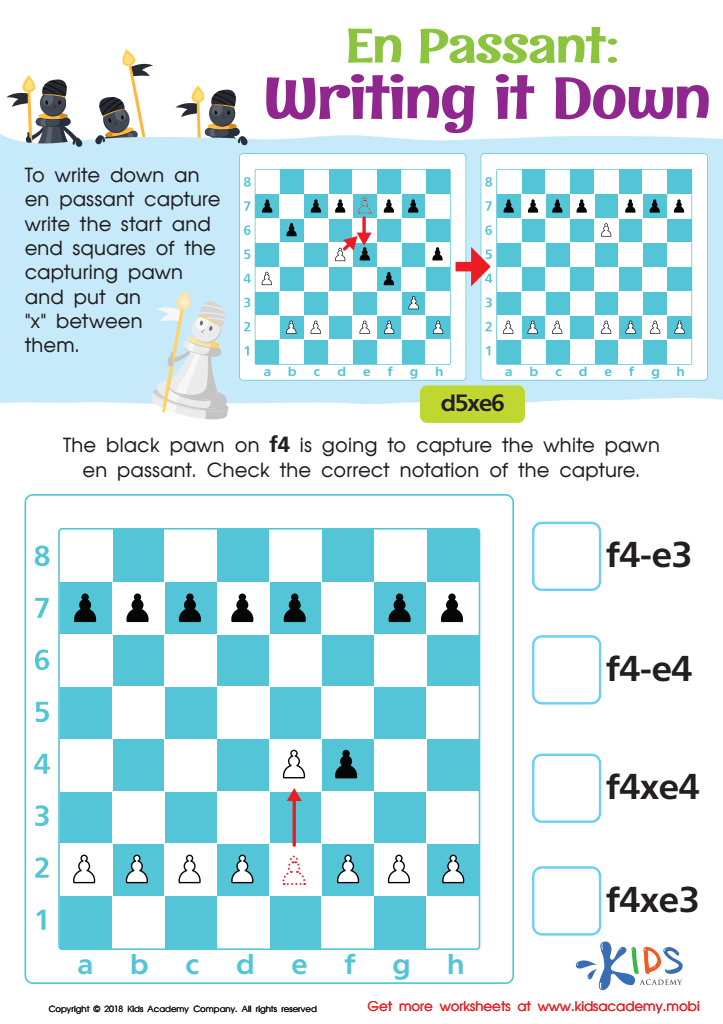
En Passant: Writing it Down Worksheet
 Assign to My Students
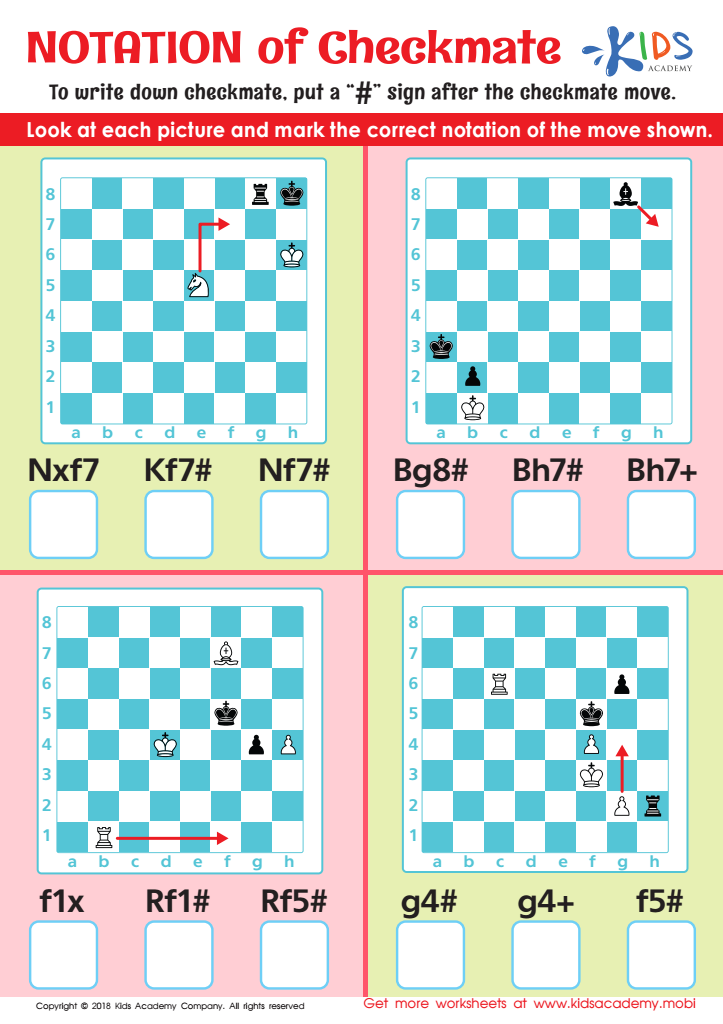
Notation of Checkmate Worksheet








Problem-solving enhancement for children ages 6-8 is crucial for their cognitive and social development. At this stage, children begin to develop critical thinking skills and the ability to approach challenges with confidence. By nurturing their problem-solving abilities, parents and teachers lay the foundation for lifelong learning.
Engaging children in problem-solving activities not only helps them grasp basic concepts in mathematics and science but also fosters skills such as perseverance, creativity, and collaboration. When children encounter and resolve challenges, they learn to assess situations, make decisions, and reflect on the outcomes. This process teaches them that mistakes are valuable learning opportunities, fostering resilience—a key life skill.
Moreover, enhancing problem-solving skills cultivates curiosity and encourages children to ask questions and seek solutions independently. In an increasingly complex world, these abilities are essential for future academic and vocational success. Ultimately, when parents and teachers prioritize problem-solving enhancement, they empower children to take initiative, communicate effectively, and work well with others, preparing them for life's varied challenges. Fostering an environment that encourages exploration, reasoning, and innovation, makes problem-solving a vital component of Early Childhood Education.








