Telling time Worksheets for Ages 6-8
4 filtered results
-
From - To
Introduce your child to the essential skill of telling time with our engaging worksheets designed for ages 6-8. Our printable resources make learning fun, featuring colorful clock faces and interactive activities that help young learners grasp the basics of hours and minutes. Developed by educational experts, these worksheets guide children step-by-step from recognizing numbers to reading both analog and digital clocks. Perfect for reinforcing school lessons or additional practice at home, these time-telling exercises enhance mathematical thinking and daily time management skills. Set your child on the path to success with our comprehensive telling time worksheets that inspire confidence in learning.
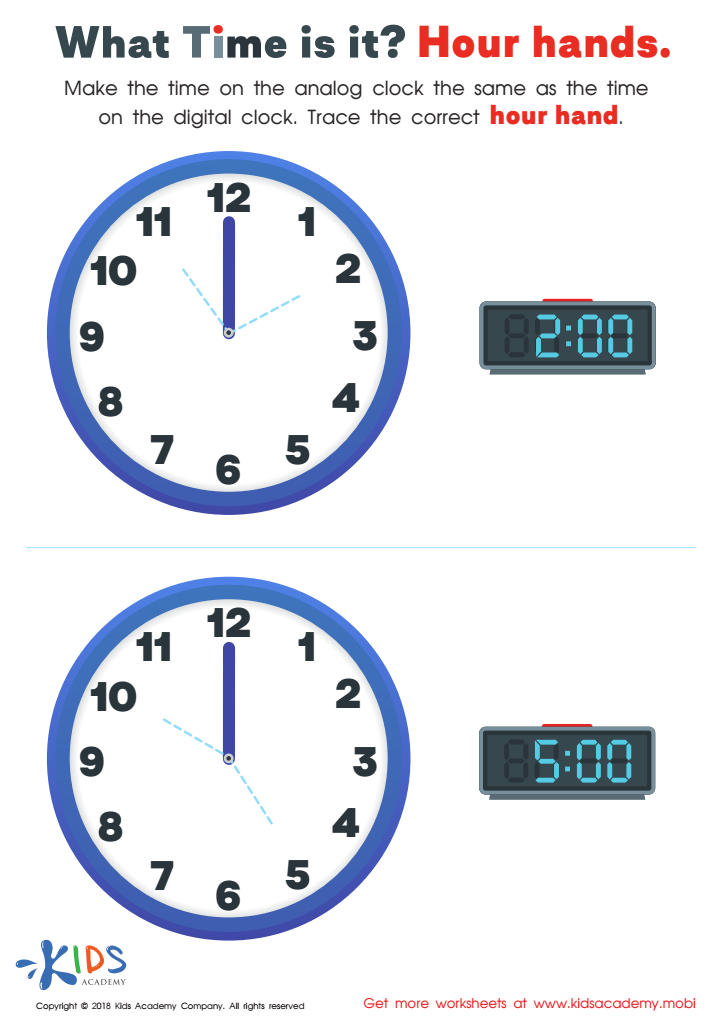
What Time Is it? Hour Hands Worksheet
 Assign to My Students







Telling time is a fundamental skill for children ages 6-8 that parents and teachers should prioritize. At this developmental stage, kids are not just learning to read the numbers on a clock; they're cultivating an understanding of the concepts of time, responsibility, and routine.
First, telling time enhances mathematical skills. Mastering the analog clock requires children to grasp important concepts such as counting by fives, basic arithmetic, and number recognition. These are foundational math skills that translate to other areas of learning.
Second, knowledge of time fosters independence and self-regulation. Children who can read a clock can manage their daily schedules more effectively. This helps them transition smoothly between activities, know when it's time for homework or play, and understand the duration of tasks. The ability to self-manage increases their responsibility and prepares them for more structured environments, such as higher grades or extracurricular activities.
Finally, understanding time promotes better communication and planning. Children can more effectively discuss plans or expectations about future events with peers and adults. This improves their ability to participate in social and family routines, fostering a sense of security and predictability.
Therefore, investing time in teaching these skills at an early age sets the groundwork for lifelong benefits, underscoring the importance of time-telling proficiency.








