Understanding patterns Adding up to 100 Without Regrouping Worksheets for Ages 6-8
3 filtered results
-
From - To
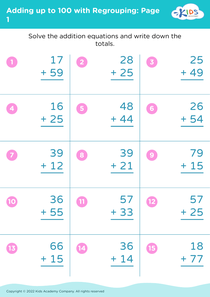
Our "Understanding Patterns Adding up to 100 Without Regrouping Worksheets" are designed for children ages 6-8 to reinforce math skills in a fun and engaging manner. These worksheets aim to help young learners recognize and understand number patterns while focusing on addition problems within 100 that do not require regrouping. Through a variety of exercises, kids will enhance their problem-solving skills, develop mathematical thinking, and build a solid foundation for future math concepts. Each worksheet is crafted to offer just the right level of challenge, ensuring a blend of learning and confidence-building. Perfect for classroom or home practice!
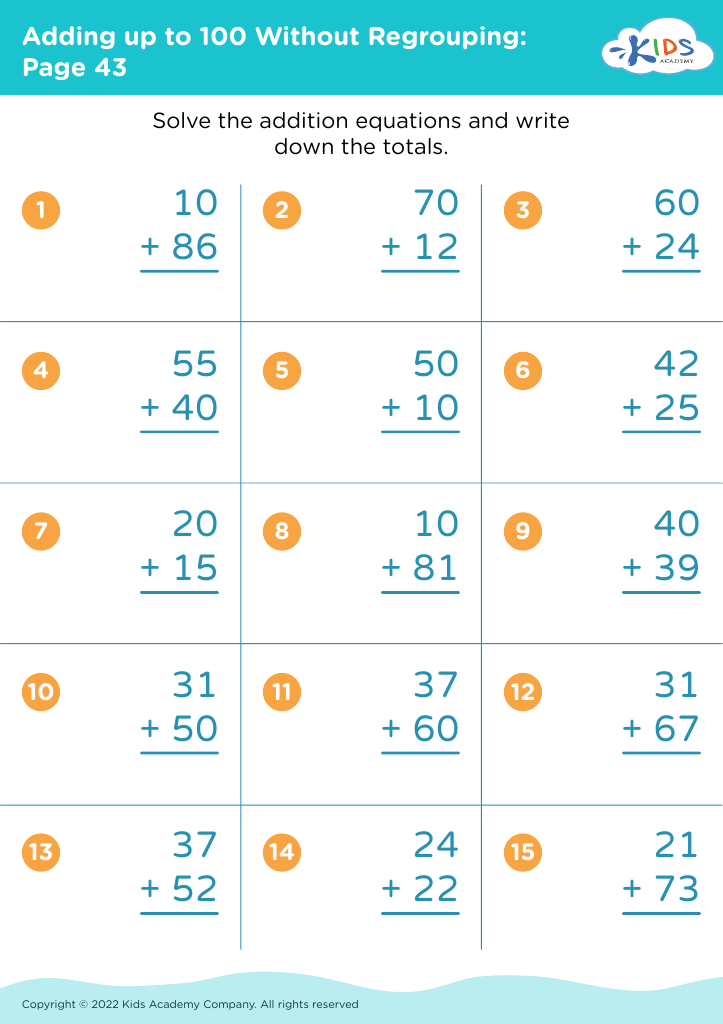
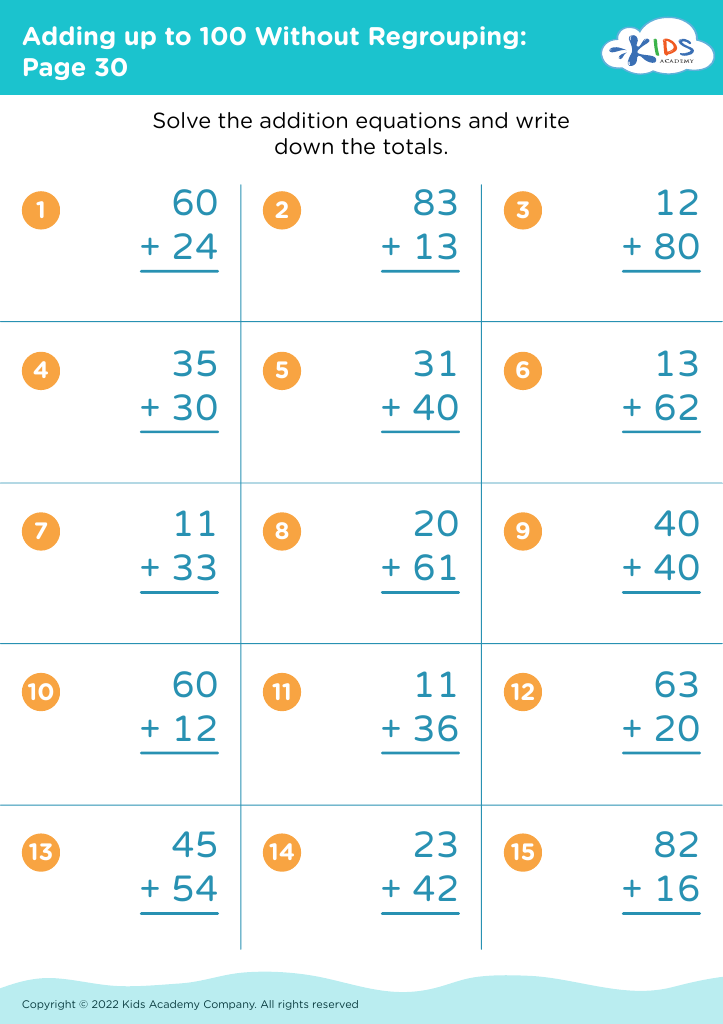
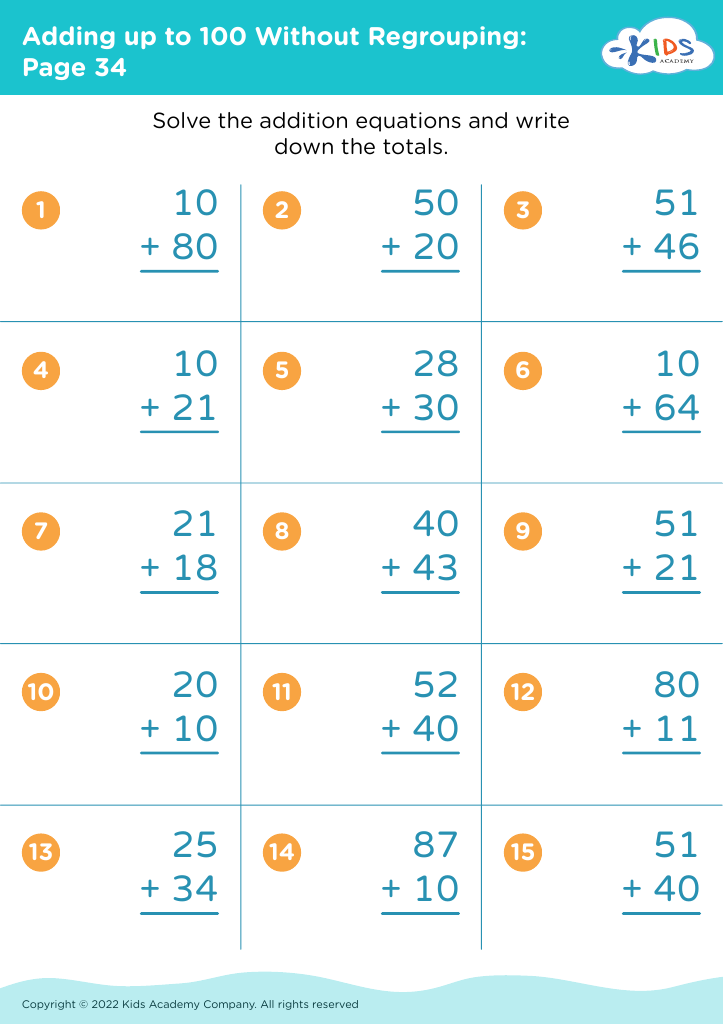




Understanding patterns adding up to 100 without regrouping for children aged 6-8 is crucial for several reasons. First, it reinforces basic arithmetic skills fundamental for future mathematical learning. Recognizing number patterns helps children develop mental math capabilities, increasing their ability to quickly and accurately solve problems. Additionally, grasping the concept of addition up to 100 sets a solid foundation for more complex operations like subtraction, multiplication, and division.
This age group is at a critical stage for cognitive development. Introducing systematic techniques early fosters logical thinking and problem-solving skills, which are valuable in academics and everyday life. Patterns simplify seemingly complex information, aiding memory retention and facilitating learning through repetition and predictable sequences.
Beyond academics, mastering addition patterns boosts their confidence. Success in math can encourage a positive attitude toward the subject, reducing anxiety and avoidance behavior often associated with math tasks. Teachers and parents should therefore emphasize activities that incorporate identifying and generating addition patterns, integrating them into playful, engaging contexts that resonate with young learners.
Moreover, nurturing these skills early helps bridge learning disparities. All students, regardless of background, can achieve proficiency through targeted, consistent practice. Understanding addition patterns actively supports a child's overall mathematical fluency and acts as a catalyst for higher-order thinking skills that underpin academic success across disciplines.