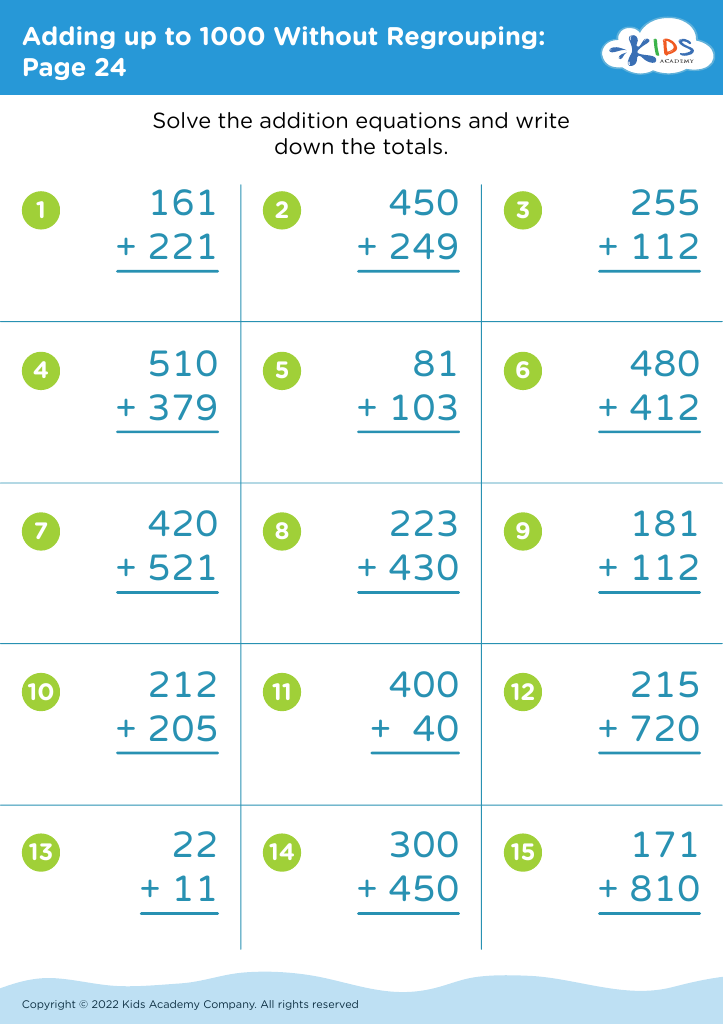
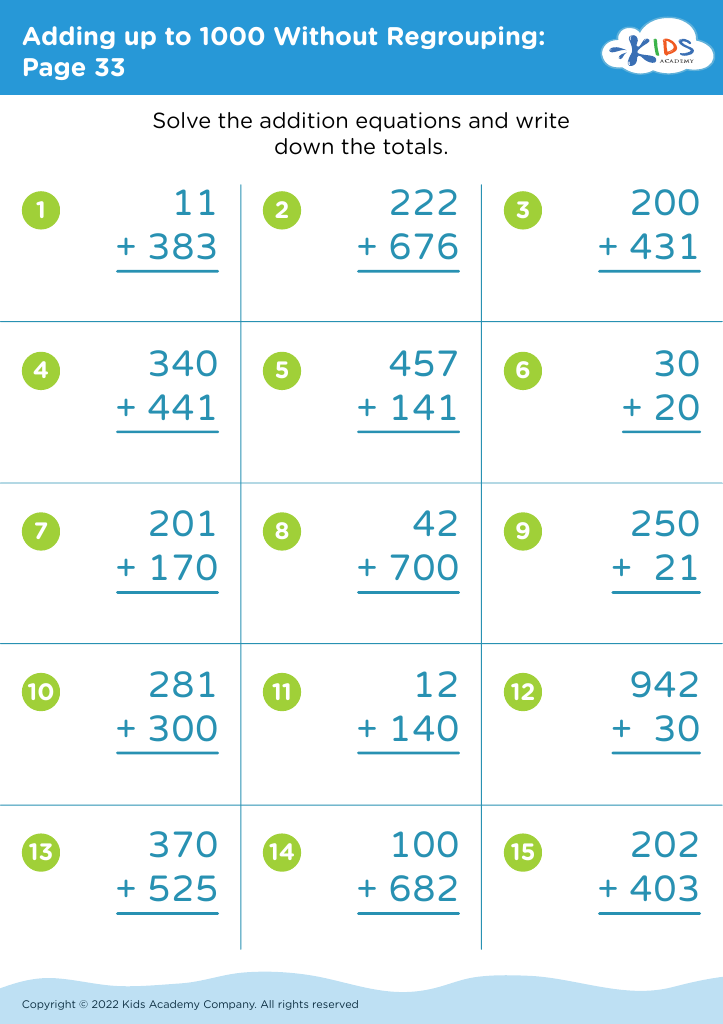
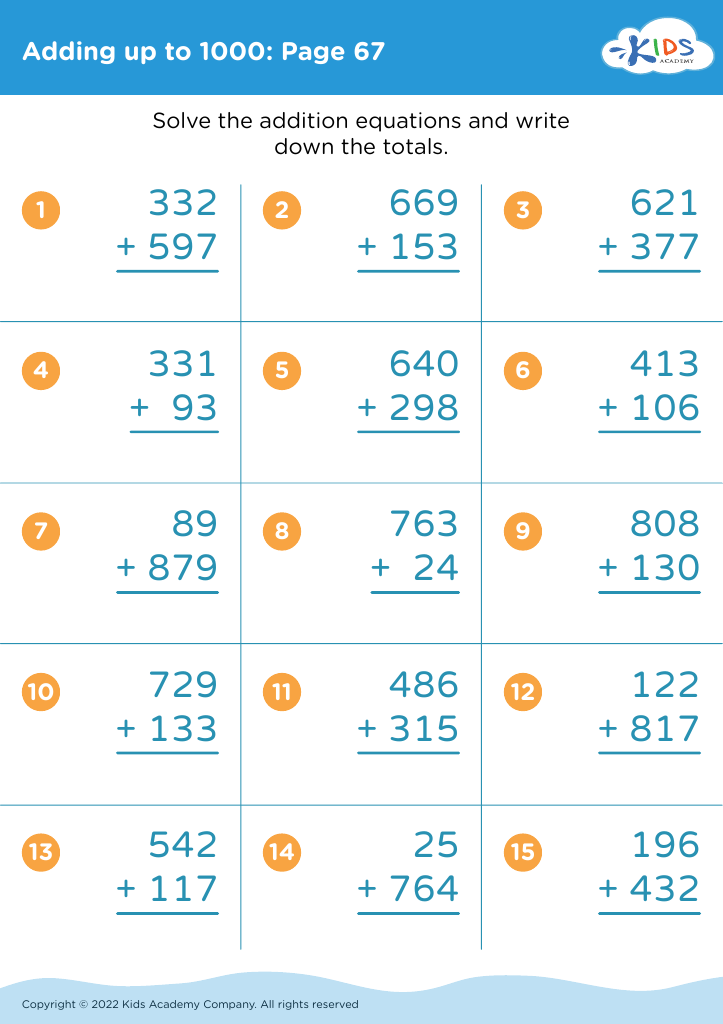




Teaching children aged 6-8 to "add up to 1000" is vital for various reasons. First, mastering this skill fosters a strong foundation in arithmetic that is crucial for their future academic success. Addition is one of the basic building blocks of mathematics, and confidence in handling larger numbers instills a sense of achievement and proficiency.
Second, understanding addition to 1000 promotes number sense, which encompasses an understanding of numerical relationships and the ability to manipulate numbers effectively. This skill goes beyond rote learning; it encourages mental math strategies, problem-solving, and critical thinking, facilitating greater comprehension of more complex mathematical concepts down the line.
Additionally, in everyday life, being adept at handling larger numbers prepares children for practical situations such as budgeting, measuring, and estimation—skills that are beneficial both in school and adulthood.
Finally, engaging with mathematical concepts at this age can enhance cognitive development and improve a child's focus and persistence. By addressing addition to 1000 early on, parents and teachers are equipping children with vital skills that will pave the way for lifelong learning and critical engagement with mathematics and logic. All these reasons make it crucial for educators and parents to prioritize this mathematical competency.








