Identifying shapes Addition & Subtraction Worksheets for Ages 6-8
25 filtered results
-
From - To
Welcome to our "Identifying Shapes Addition & Subtraction Worksheets" tailored for children aged 6-8! These engaging worksheets combine math practice with shape recognition, helping young learners enhance their skills in a fun and interactive way. Each worksheet is designed to support students in mastering addition and subtraction while also identifying various geometric shapes. Through colorful visuals and hands-on activities, kids will develop a strong foundational understanding of both math concepts and spatial awareness. Perfect for classroom use or at-home learning, our worksheets encourage critical thinking and problem-solving skills in your budding mathematicians. Start shaping bright futures today!
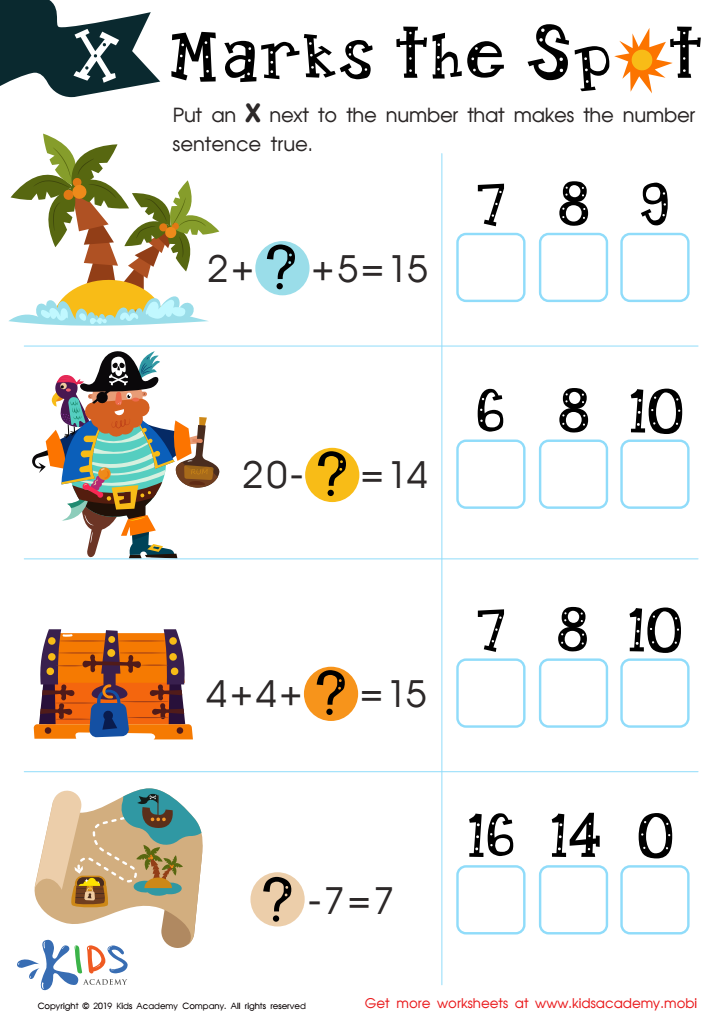
X Marks the Spot Worksheet
 Assign to My Students








Identifying shapes and mastering basic addition and subtraction are foundational skills for children ages 6-8 that significantly influence their overall cognitive development. Parents and teachers should care about these skills because they lay the groundwork for more complex mathematical concepts and problem-solving abilities. Recognizing shapes helps children understand spatial relationships and enhances their ability to categorize and organize their surroundings. This skill not only enriches their geometric knowledge but also supports artistic expression and creativity.
On the other hand, proficiency in addition and subtraction is critical for developing mathematical fluency, which is essential for everyday tasks. By building a strong arithmetic foundation, children become more confident in their ability to tackle word problems, measurement tasks, and financial literacy skills as they grow. Furthermore, these mathematical understandings promote logical reasoning, critical thinking, and the ability to analyze patterns, which are vital in all areas of learning.
Moreover, early mastery encourages a positive attitude toward math, reducing anxiety and resistance to learning in later grades. Hence, fostering skills in identifying shapes and performing basic arithmetic is not just about numbers; it’s about nurturing well-rounded learners prepared for future academic challenges. Parents and teachers play a crucial role in this developmental phase.








