
Improve counting Addition & Subtraction Worksheets for Ages 6-8
3 filtered results
Difficulty Level
Grade
Age
-
From - To
Subject
Activity
Standards
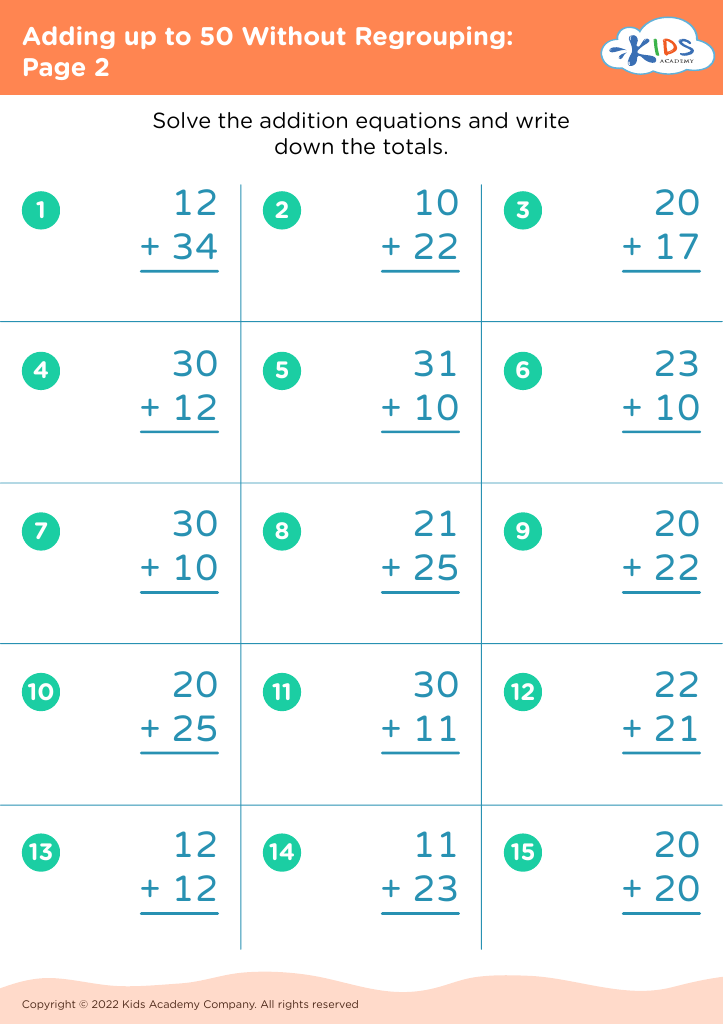
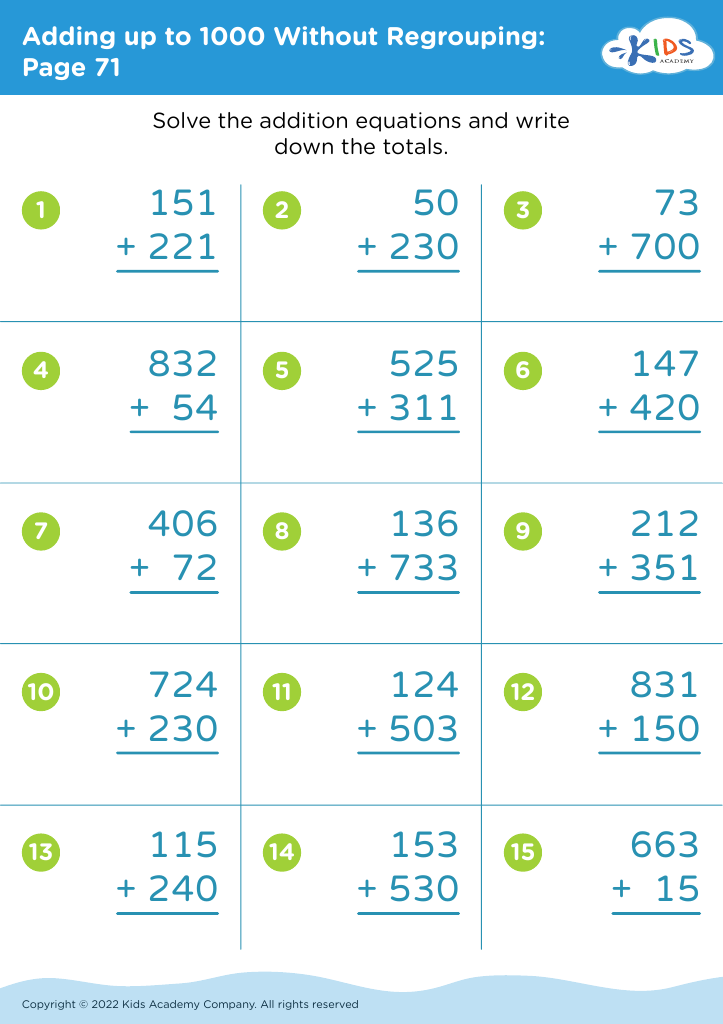
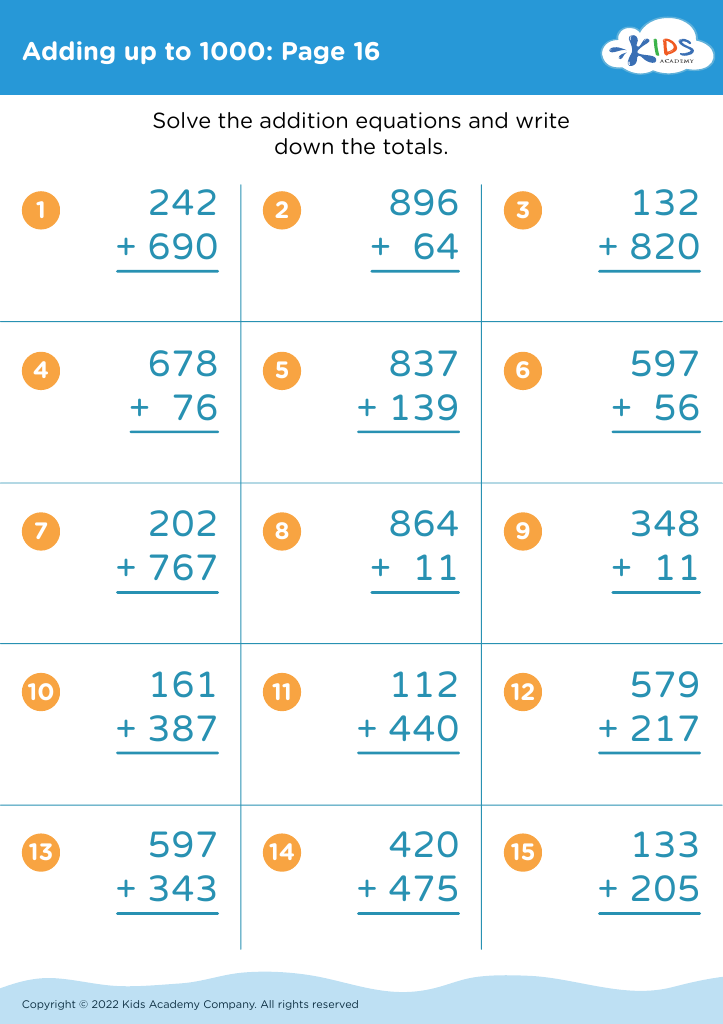
Boost your child's math confidence with our "Improve Counting: Addition & Subtraction Worksheets" tailored for ages 6-8. Designed to reinforce foundational math skills, these educational worksheets provide engaging and interactive tasks that help kids enhance their counting abilities while mastering addition and subtraction. Perfect for classroom or home use, our comprehensive materials aid in developing problem-solving skills, critical thinking, and numerical fluency. With colorful visuals and age-appropriate challenges, these worksheets make learning fun and effective. Visit our webpage to access a wide variety of printables that support and accelerate your child's math journey today!
Favorites
With answer key
Interactive
Join Kids Academy for Free
Who is primarily going to use this learning content?








Fostering strong counting, addition, and subtraction skills in children aged 6-8 is pivotal for their overall mathematical development. At this formative stage, children are developing their foundational understanding of numbers, which is crucial for their ability to grasp more complex mathematical concepts later on.
Firstly, proficiency in counting lays the groundwork for numerical literacy. Counting enables children to understand number sequences, recognize patterns, and form a basis for future arithmetic learning. Practicing addition and subtraction enhances mental math skills, boosts problem-solving abilities, and improves logical thinking. These fundamental operations are not only essential mathematical skills but also have everyday applications, helping children manage tasks such as telling time, handling money, and measuring quantities.
Moreover, early success in mathematics often builds confidence in young learners, fostering a positive attitude toward the subject. This confidence encourages further exploration and learning, creating a strong academic foundation across different subjects, as mathematics is integral to fields like science, engineering, and technology.
Additionally, mastering these skills at an early age prepares students for more advanced mathematical concepts, such as multiplication, division, and algebra. Parents and teachers play a crucial role in nurturing these abilities by providing a supportive learning environment, engaging activities, and consistent practice, thus ensuring that children develop a solid mathematical foundation for future success.








