
Understanding money Addition & Subtraction Worksheets for Ages 6-8
4 filtered results
Difficulty Level
Grade
Age
-
From - To
Subject
Activity
Standards
Dive into a fun and educational journey with our "Understanding Money Addition & Subtraction Worksheets" designed for children ages 6-8. These engaging resources help young learners master essential math skills by combining addition and subtraction with real-world scenarios involving money. Each worksheet offers a variety of exercises that reinforce counting, calculating, and financial literacy. Perfect for both classroom and home use, these activities make learning math exciting and practical. Encourage your child’s confidence and proficiency in handling money while they enhance their arithmetic abilities. Explore now to support and inspire your little mathematician!
Favorites
With answer key
Interactive
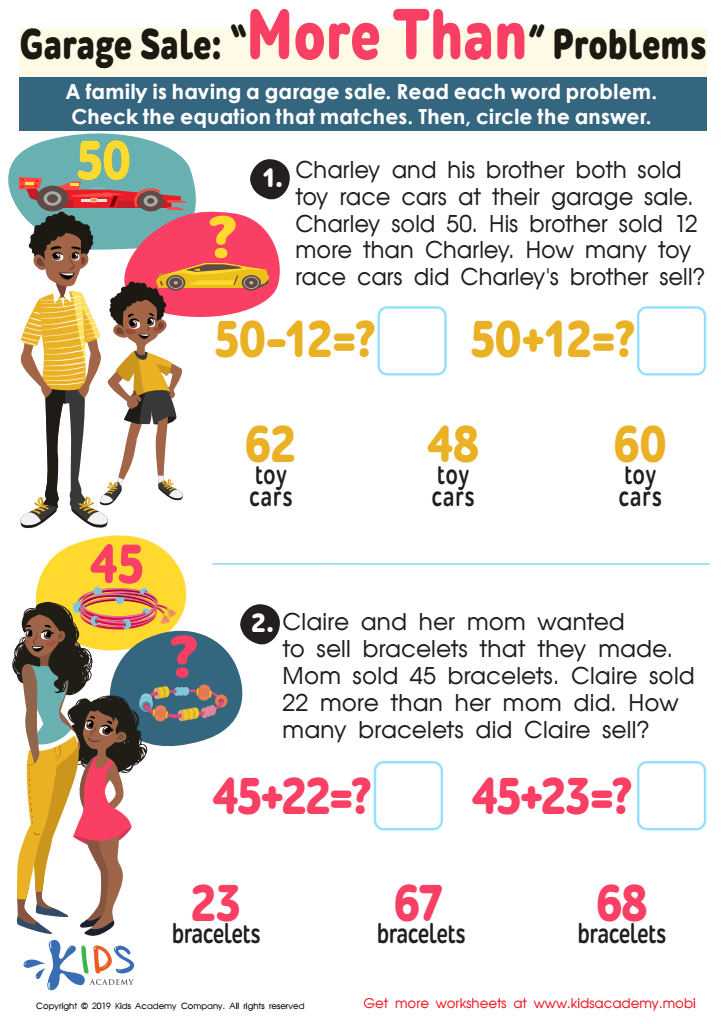
Garage Sale - More yhan Worksheet
The whole family can join in on the fun with this free worksheet! It helps kids practice math word problems while assisting their friends with a garage sale. Kids learn to identify "More Than" key words and pick the right equation, improving their order of operations skills. Download the PDF and get started!
 Assign to My Students
Garage Sale - More yhan Worksheet
Worksheet
Join Kids Academy for Free
Who is primarily going to use this learning content?








Understanding money and basic arithmetic, such as addition and subtraction, is crucial for children aged 6-8 because it lays the foundation for essential life skills. At this young age, children are naturally curious and eager learners, which makes it a prime time to introduce fundamental financial concepts. By recognizing the value of different coins and bills, kids learn to make sense of numerical relationships in a practical context.
Parents and teachers play pivotal roles in nurturing this understanding. By guiding children through simple transactions, like counting change or saving for a small toy, adults help reinforce math skills in a real-world setting. This not only builds numerical confidence but also fosters a positive attitude towards money management. Additionally, early lessons in money handling promote critical thinking and problem-solving abilities.
Developing these arithmetic skills supports broader academic success. Math proficiency at an early age is linked to better performance in more advanced subjects later on. Moreover, these lessons can introduce the concept of delayed gratification and wise decision-making, crucial aspects of financial literacy. In sum, caring about teaching money addition and subtraction equips children with foundational skills that benefit multiple aspects of their lives.








