
Improve comprehension Addition Worksheets for Ages 6-8
3 filtered results
Difficulty Level
Grade
Age
-
From - To
Subject
Activity
Standards
Welcome to our "Improve Comprehension Addition Worksheets for Ages 6-8" page! Designed for young learners, these worksheets creatively blend fun and education to enhance addition skills. With engaging visuals and interactive exercises, children will develop a deeper understanding of basic addition concepts. Our worksheets feature varied difficulty levels, ensuring that every child can progress at their own pace. Additionally, activities encourage problem-solving and critical thinking, making math enjoyable and approachable. Ideal for classroom use or home practice, these resources will help your child build confidence and competence in addition, paving the way for future success in math. Dive in and explore!
Favorites
With answer key
Interactive
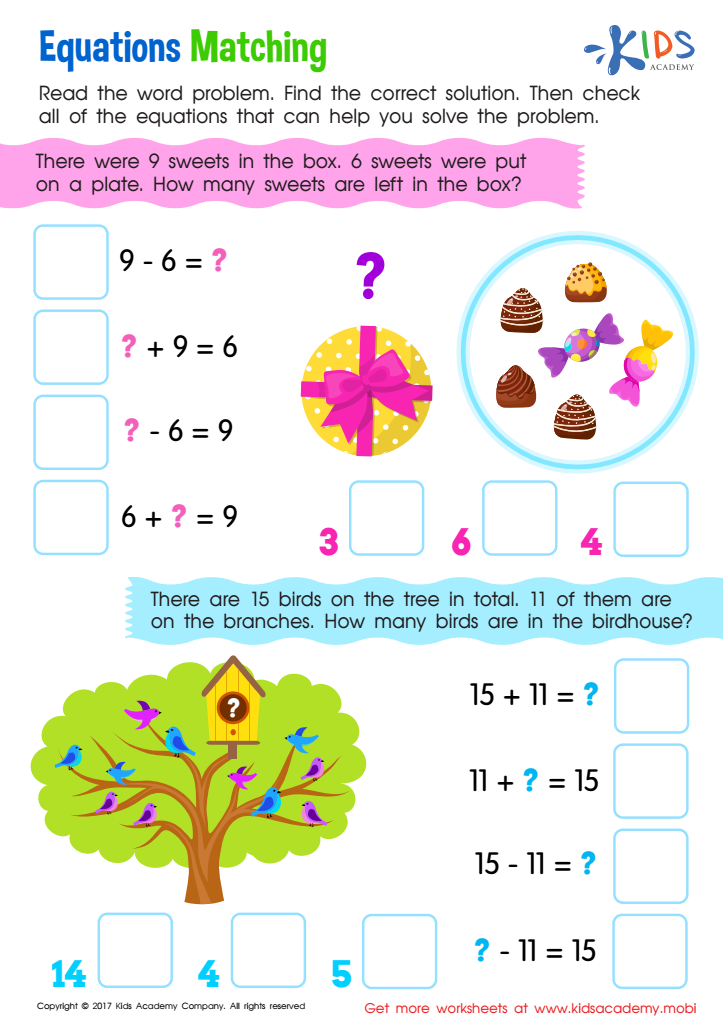
Equations Matching Word Problems Worksheet
Download this worksheet and give your young mathematician practice in solving equations using matching numbers and number family facts. They'll solve word problems, develop critical thinking and algebraic reasoning, and gain success with addition and subtraction.
 Assign to My Students
Equations Matching Word Problems Worksheet
Worksheet
Join Kids Academy for Free
Who is primarily going to use this learning content?








Improving comprehension in addition for children aged 6 to 8 is crucial for their overall academic development and confidence in math. This age group is at a pivotal stage where foundational skills are established, and their understanding of addition sets the groundwork for more complex mathematical concepts. When parents and teachers prioritize comprehension over rote memorization, they foster a deeper understanding of number relationships, helping children grasp the 'why' behind addition, not just the 'how.'
Engaging children in discussions about their problem-solving processes enhances critical thinking and nurtures a growth mindset. Improvement in comprehension also promotes enthusiasm for math, reducing anxiety and building confidence, which are essential traits that contribute to lifelong learning. Furthermore, as families and educators work together to reinforce these skills, they create a supportive learning environment that encourages exploration and resilience.
Moreover, early proficiency in addition leads to better performance in subsequent math topics, including subtraction, multiplication, and fractions. By investing in a solid comprehension foundation now, we equip our children with the tools they need for future success in mathematics and beyond. This collaborative effort not only benefits individual students but also strengthens the overall academic community.








