
Mathematical thinking Addition Worksheets for Ages 6-8
3 filtered results
Difficulty Level
Grade
Age
-
From - To
Subject
Activity
Standards
Enhance your child’s mathematical thinking with our expertly designed addition worksheets for ages 6-8! At Kids Academy, these engaging worksheets help young learners build a solid arithmetic foundation through fun and interactive exercises. Each worksheet is crafted to develop problem-solving skills, foster critical thinking, and boost confidence in handling numbers. Perfect for both classroom use and home practice, our addition worksheets make learning enjoyable while ensuring consistent progress. Visit our page to download these valuable resources and support your child's journey toward mathematical mastery in a playful and effective way. Let's nurture a love for math together!
Favorites
With answer key
Interactive
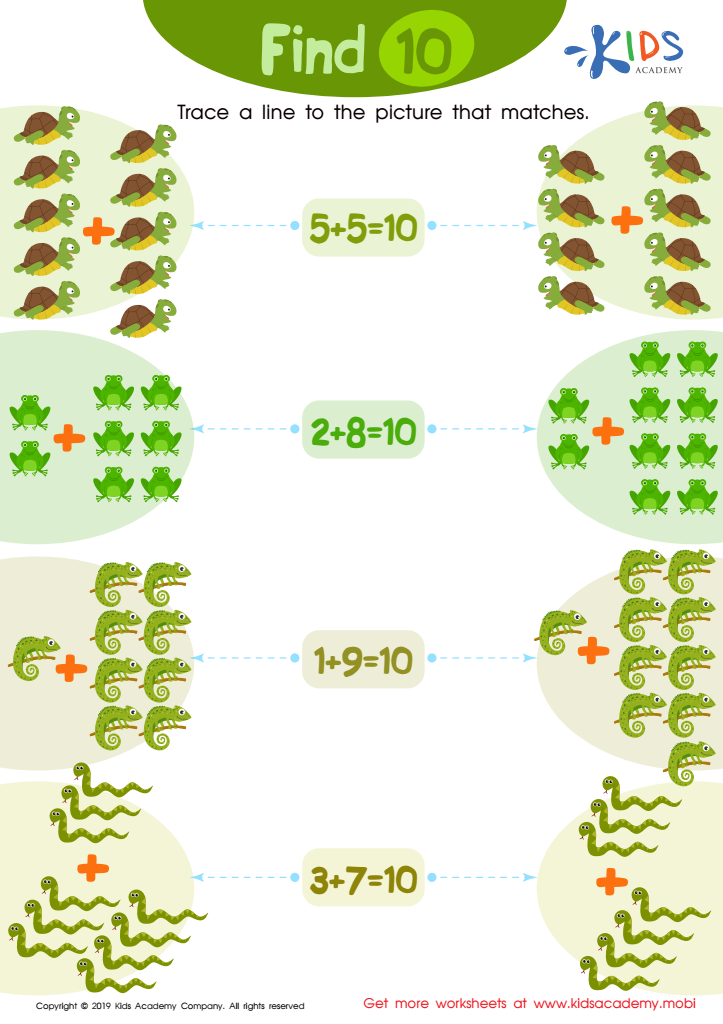
Find 10 Worksheet
Counting can be tricky, but your kids can master it with regular practice. Here's a fun activity to help: count the animals, then trace a line to the pictures that matches. With these tips, math will be an easy walk in the park.
 Assign to My Students
Find 10 Worksheet
Worksheet
Join Kids Academy for Free
Who is primarily going to use this learning content?








Mathematical thinking and addition are critical foundational skills for children aged 6-8, serving as building blocks for their overall cognitive development and future academic success. At this stage, children are naturally curious and capable of grasping basic mathematical concepts when taught effectively.
Firstly, mastering addition helps children develop essential problem-solving skills. By understanding how numbers work together, they learn to think logically and strategically. This translates into better reasoning abilities in other academic subjects and everyday life scenarios.
Secondly, addition is a precursor to more complex mathematical concepts such as subtraction, multiplication, and division. A strong grasp of addition ensures that children are well-prepared for these future challenges. For instance, knowing that 4 + 3 = 7 helps them understand that 7 – 3 = 4.
Thirdly, learning addition reinforces core skills like memory, attention, and focus. It trains children to follow steps methodically and boosts their confidence in handling numbers.
Lastly, early success in mathematics fosters a positive attitude towards the subject. When children feel competent and confident in their math abilities, they are more likely to enjoy and pursue mathematical learning in higher grades.
For these reasons, parents and teachers should prioritize cultivating mathematical thinking and addition skills in young learners to set them up for academic and personal success.








