
Observational skills Addition Worksheets for Ages 6-8
3 filtered results
Difficulty Level
Grade
Age
-
From - To
Subject
Activity
Standards
Enhance your child's observational skills with our engaging Addition Worksheets designed specifically for ages 6-8! These worksheets offer a unique approach to learning mathematics, blending addition practice with fun observational challenges. Kids will develop critical thinking by spotting patterns, identifying relationships, and solving problems through hands-on activities. Our resources not only support addition fluency but also strengthen essential cognitive skills. Perfect for use at home or in the classroom, these worksheets are crafted to captivate young learners and foster a love for math. Give your child a head start in their educational journey while building confidence in their abilities!
Favorites
With answer key
Interactive
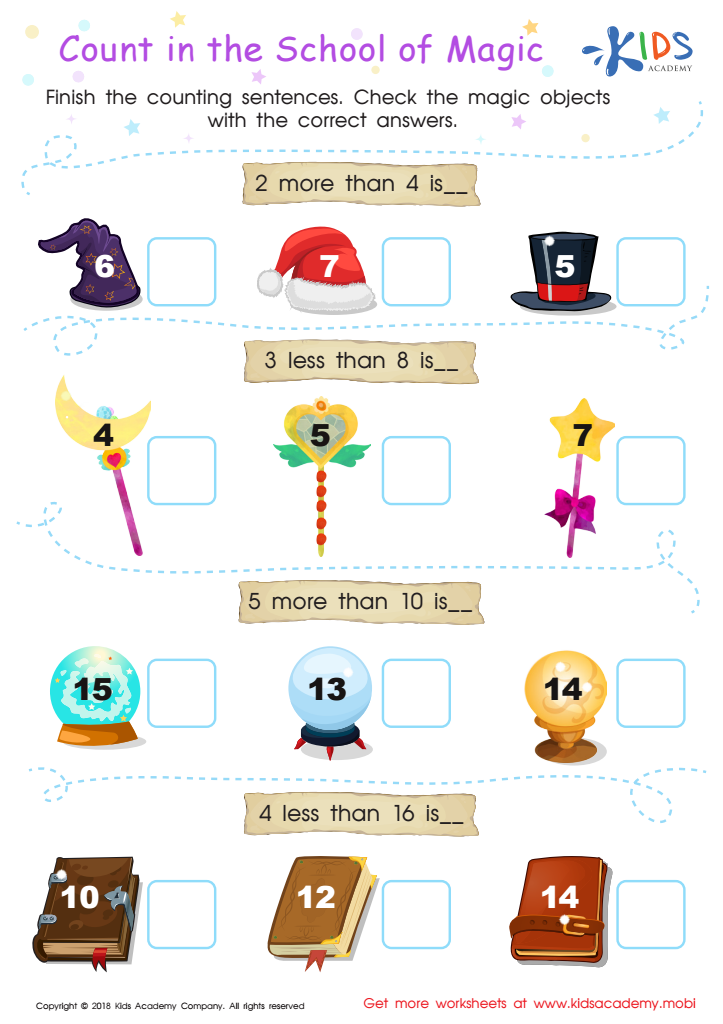
Count in the School of Magic Worksheet
Your math learners can explore the School of Magic with this worksheet. They'll read equations with addition and subtraction numbers under 20, count back and forth to find the answer, then complete the counting sentences. Fun pictures and easy accuracy make it an enjoyable and successful learning experience.
 Assign to My Students
Count in the School of Magic Worksheet
Worksheet
Join Kids Academy for Free
Who is primarily going to use this learning content?








Observational skills are crucial for children aged 6-8 as they form the foundation for understanding addition and everyday math concepts. At this developmental stage, children are curious, experimentative, and capable of discovering solutions through observation. When parents and teachers prioritize the enhancement of observational skills, they nurture a child's ability to recognize patterns, categorize objects, and make connections between numbers and their representations in the world around them.
Good observational skills help children distinguish quantities, recognize groups of objects, and understand the concept of addition as putting parts together. Activities that promote these skills—like counting items, comparing sets, or identifying patterns in nature—can be seamlessly integrated into daily routines. This not only enriches their learning experience but also encourages critical thinking and problem-solving.
Moreover, observational skills in addition can foster a collaborative learning environment where children learn from each other. When adults engage with children, asking open-ended questions about their observations in math, they enhance the child’s confidence and interest in numeracy. Overall, prioritizing observational skills cultivates a deeper, more meaningful understanding of addition, ultimately supporting academic success and a love for learning in essential early years.








