Improving counting skills Geometry Worksheets for Ages 6-8
3 filtered results
-
From - To
Enhance your child's counting skills with our engaging Geometry Worksheets tailored for ages 6-8. Designed to make learning fun and effective, these educational resources combine colorful shapes and patterns with counting exercises. Perfect for first-graders and second-graders, our worksheets stimulate young minds through interactive tasks that support both geometry and basic arithmetic. With a focus on fostering critical thinking and problem-solving abilities, our worksheets are ideal for traditional classroom settings, homeschooling, or supplementary home practice. Help your child build a strong mathematical foundation while nurturing a love for learning with our expertly crafted printable worksheets.
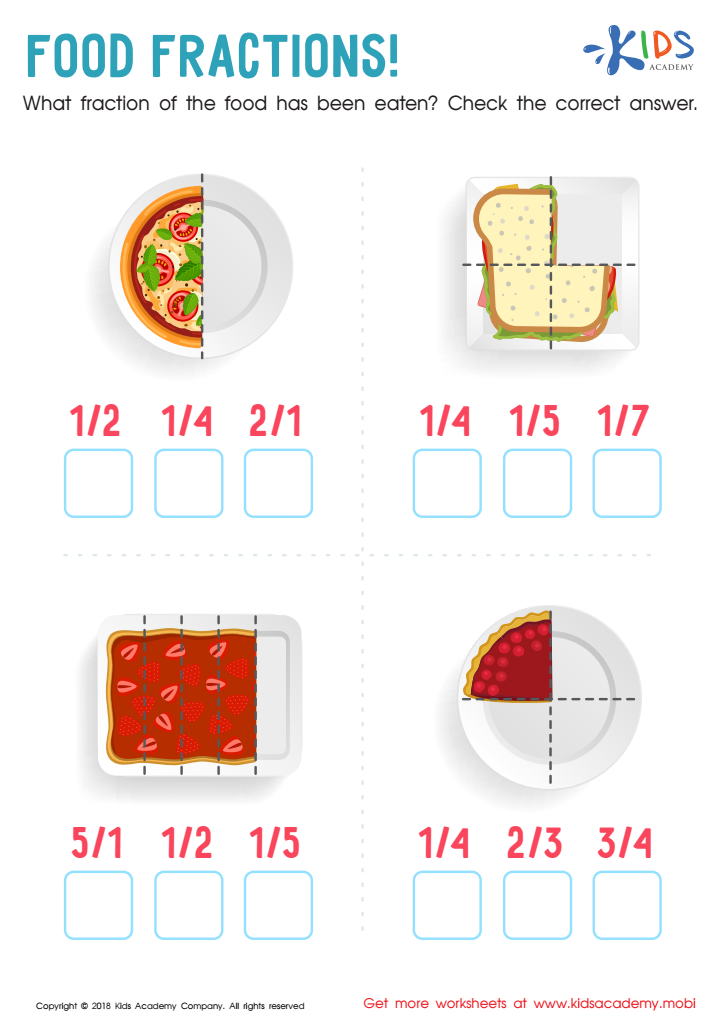
Food Fractions Worksheet
 Assign to My Students











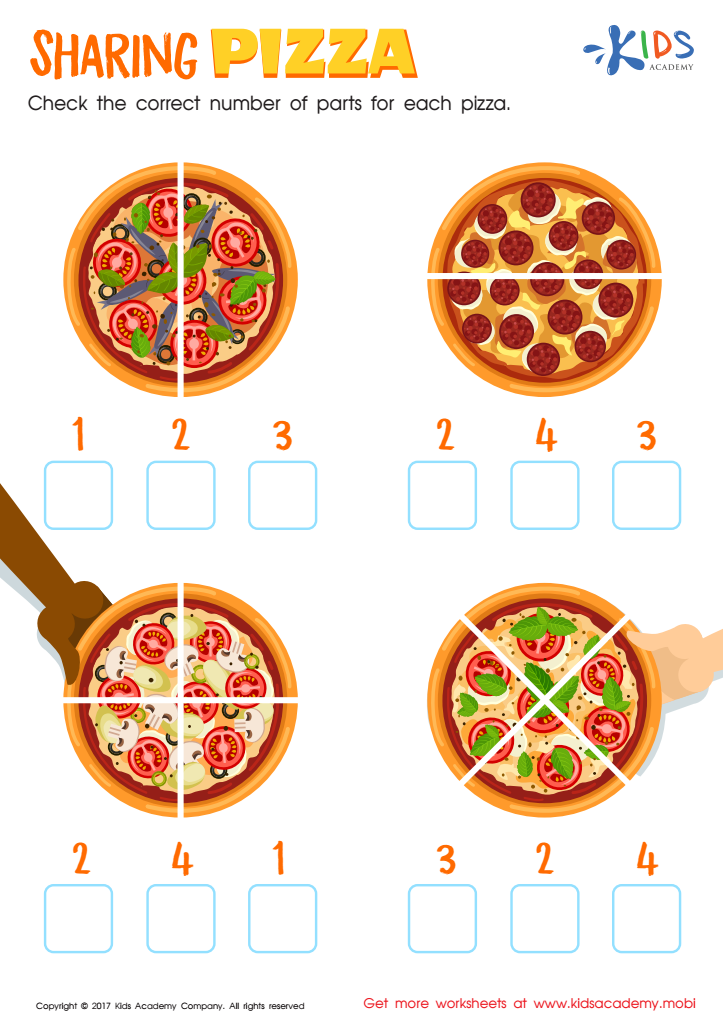
Sharing Pizza Worksheet
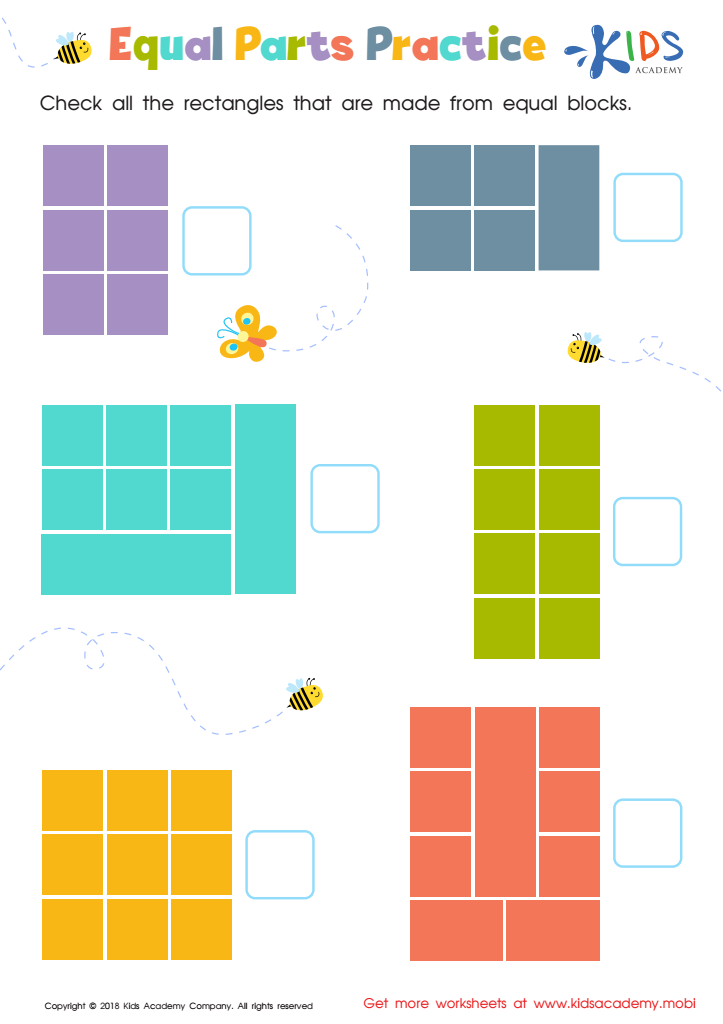
Equal Parts Practice Worksheet








Improving counting skills and geometry for children ages 6-8 is essential for developing a strong foundation in mathematics, which can influence academic success and everyday problem-solving abilities. At this age, children are naturally curious and eager to explore the world around them, making it a crucial time to introduce fundamental concepts in an engaging and comprehensible way.
Counting skills are the bedrock of number sense, enabling children to understand the concept of quantity, order, and the relationships between numbers. Mastery of counting lays the groundwork for more complex mathematical operations such as addition, subtraction, and multiplication. By strengthening these skills early on, children are better prepared to tackle future mathematical challenges with confidence.
Geometry, on the other hand, enhances their spatial awareness and reasoning abilities. It helps them comprehend shapes, sizes, patterns, and spatial relationships, which are prevalent not only in math but also in science, art, and even daily life activities. Understanding geometric concepts enables children to better navigate and interpret the physical world around them. Moreover, engaging with geometry can stimulate critical thinking and problem-solving skills.
Parents and teachers play a vital role in fostering these skills. Through hands-on activities, interactive games, and practical applications, they can make learning counting and geometry a fun and integral part of a child’s development, setting the stage for future academic and personal growth.








