
Understanding quadrilaterals Geometry Worksheets for Ages 6-8
4 filtered results
Difficulty Level
Grade
Age
-
From - To
Subject
Activity
Standards
Explore our engaging "Understanding Quadrilaterals" Geometry Worksheets designed specifically for children aged 6-8. These worksheets aim to enhance young learners' understanding of quadrilaterals, including shapes such as squares, rectangles, trapezoids, and parallelograms. With fun, interactive activities, kids will develop essential geometry skills while learning to identify and classify various quadrilaterals. Our resources are crafted to foster critical thinking and creativity, making math enjoyable and accessible. Parents and teachers will find these worksheets valuable for reinforcing classroom concepts at home or in educational settings. Dive into the world of shapes and transform geometry learning into an exciting adventure today!
Favorites
With answer key
Interactive
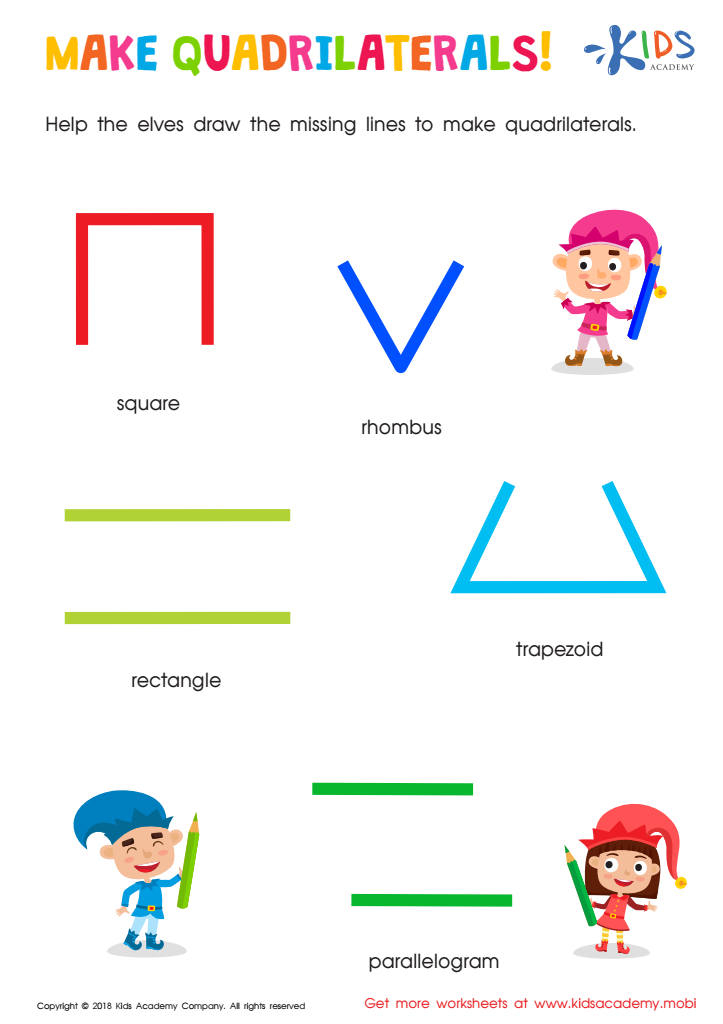
Make Quadrilaterals Worksheet
This fun and colorful worksheet will help your child understand and identify quadrilaterals. It's simple and encourages them to draw lines to create a square, rectangle, rhombus, trapezoid, and parallelogram. Stimulate their minds and watch them learn while they have fun!
 Assign to My Students
Make Quadrilaterals Worksheet
Worksheet











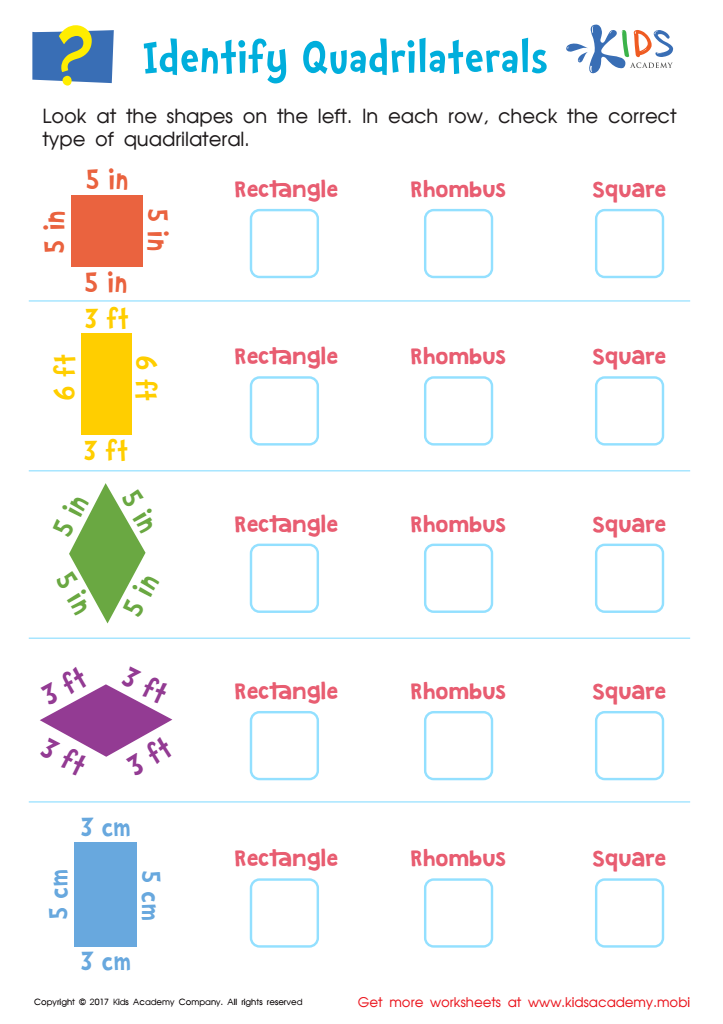
Identify Quadrilaterals Worksheet
This PDF worksheet helps kids identify different quadrilaterals using pictures and measurements. From rectangles to diamonds, children will use their knowledge of geometry to observe and classify shapes. A colorful and fun way to learn!
Identify Quadrilaterals Worksheet
Worksheet
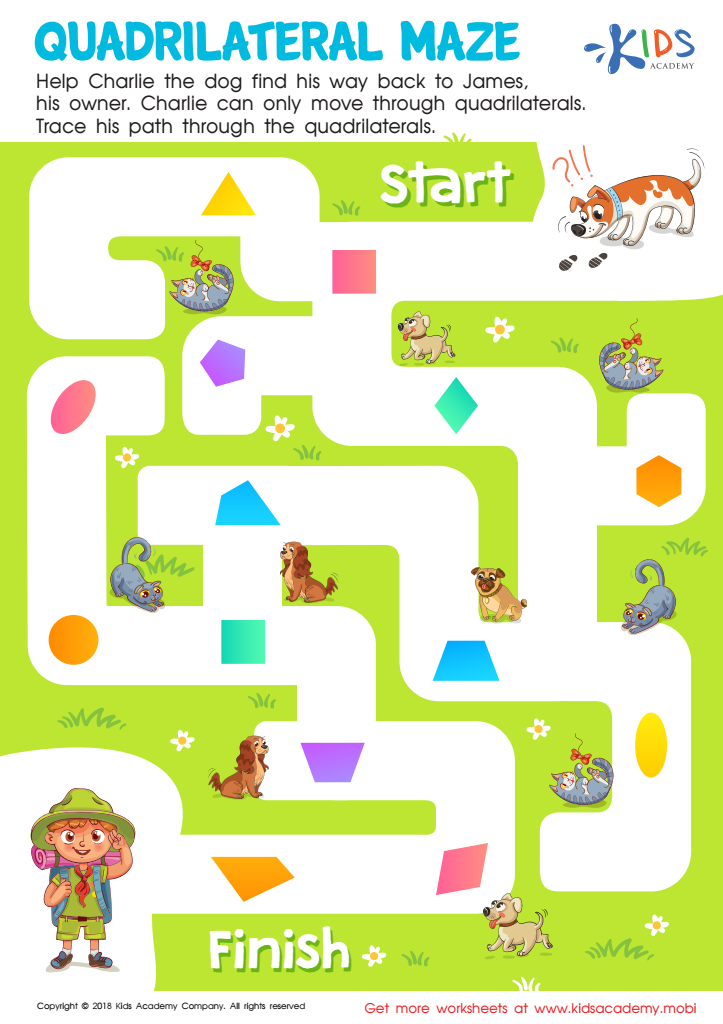
Quadrilateral Maze Worksheet
Does your kid love dogs? If so, this exercise is ideal for them! Help Charlie the pup find his way back to his owner, James, in the quadrilateral maze worksheet. Your child must trace Charlie's path only through squares and rhombuses in order to solve it. Careful planning is key!
Quadrilateral Maze Worksheet
Worksheet
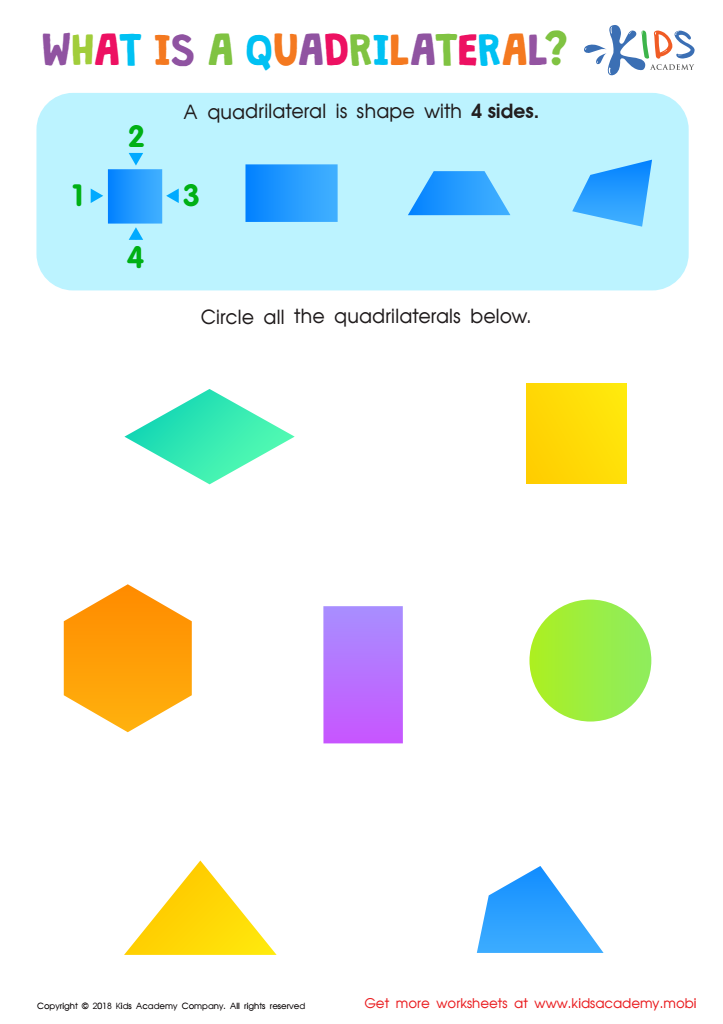
What Is a Quadrilateral? Worksheet
Does your kid know what a quadrilateral is? If not, this worksheet can help teach them. Explain that a quadrilateral is a shape with four sides and give examples, like a square or a rectangle. Then ask them to circle the quadrilaterals in the pictures. If they already know what a quadrilateral is, this task might be too easy.
What Is a Quadrilateral? Worksheet
Worksheet
Join Kids Academy for Free
Who is primarily going to use this learning content?








Understanding quadrilaterals is essential for children ages 6-8 as it lays the groundwork for their future mathematical knowledge and skills. At this developmental stage, children are already beginning to explore shapes, patterns, and spatial relationships. Introducing them to quadrilaterals—shapes with four sides, such as squares, rectangles, and trapezoids—helps them identify and categorize shapes, fostering critical thinking and problem-solving abilities.
Moreover, geometry, including the study of quadrilaterals, enhances children's spatial awareness. This is important not only for math but also for practical applications in everyday life, such as understanding maps, organizing spaces, and designing. Engaging with quadrilaterals encourages curiosity and creativity as children explore how different shapes can be combined and manipulated.
Additionally, teaching quadrilaterals aligns with early learning standards and prepares children for more complex mathematical concepts later, such as symmetry and angles. When parents and teachers emphasize geometry, they nurture a strong foundational skill set that promotes confidence and interest in STEM subjects. Ultimately, understanding quadrilaterals enriches students' learning experiences, helping them become not just proficient in math, but well-rounded thinkers capable of approaching problems from various angles.








