Analog Clock Understanding Math Worksheets for Ages 6-8
3 filtered results
-
From - To
Explore our engaging "Analog Clock Understanding Math Worksheets" designed specifically for children ages 6-8. These interactive worksheets provide a fun and comprehensive approach to learning about time-reading skills on traditional analog clocks. With vibrant illustrations and age-appropriate challenges, your child will enhance their understanding of time concepts, including telling time to the nearest hour, half-hour, and quarter-hour. Encourage critical thinking as they solve problems and related activities that bolster their mathematical abilities. Perfect for classroom use or at-home learning, these worksheets make mastering analog clocks an enjoyable and rewarding experience for young learners! Start their journey to confidence in time-telling today!
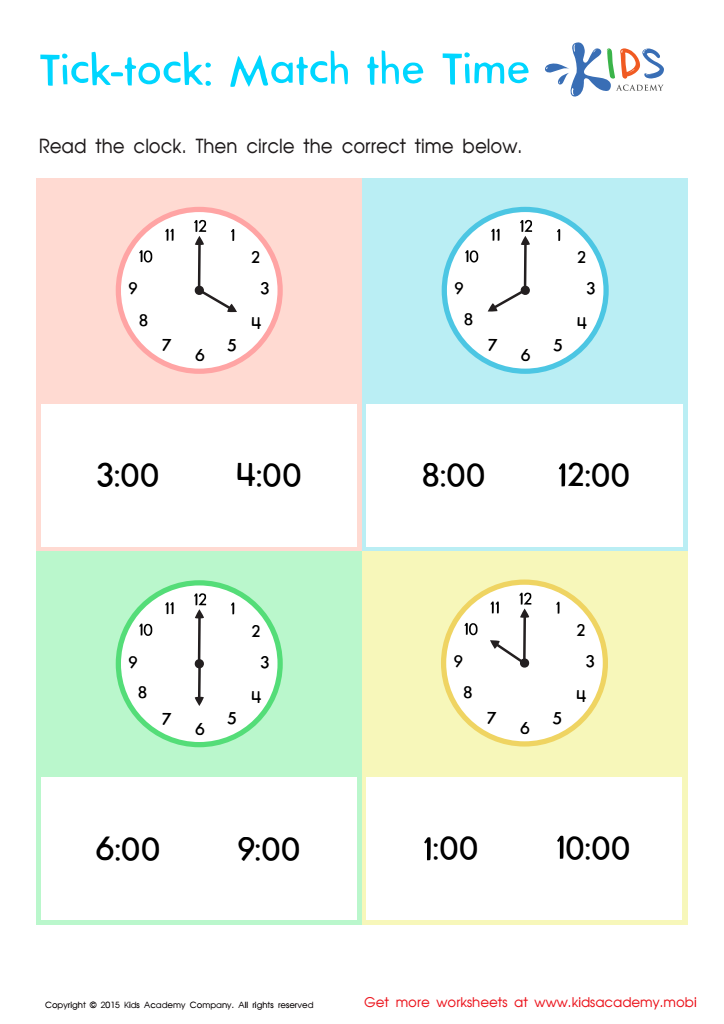
Telling The Time Worksheet: Part 4
 Assign to My Students
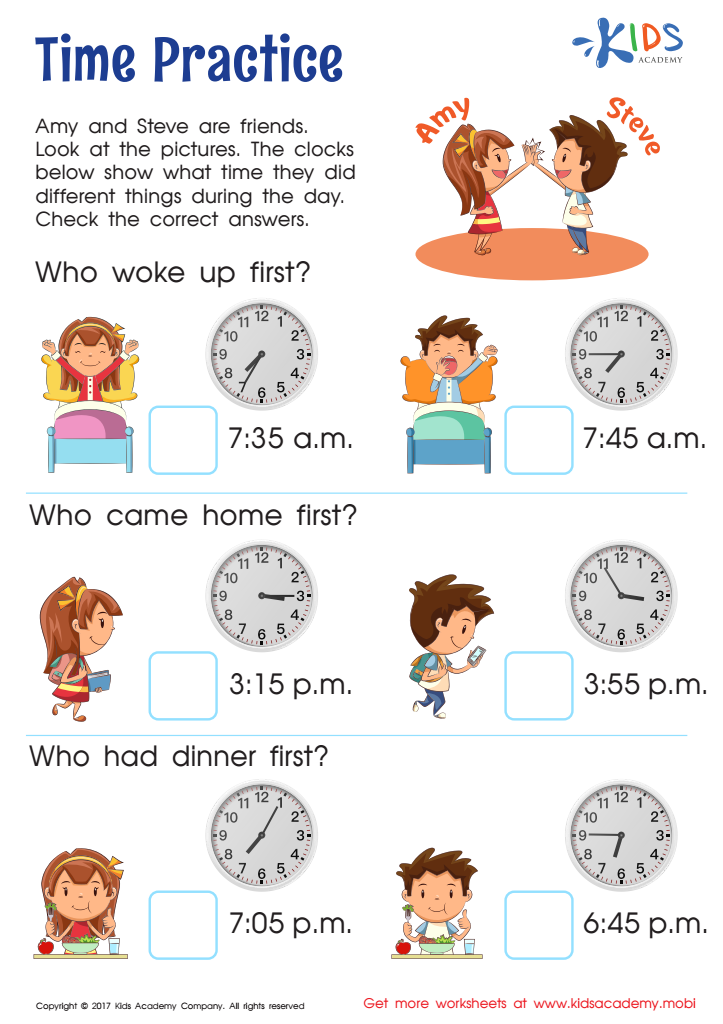
Time Practice Worksheet
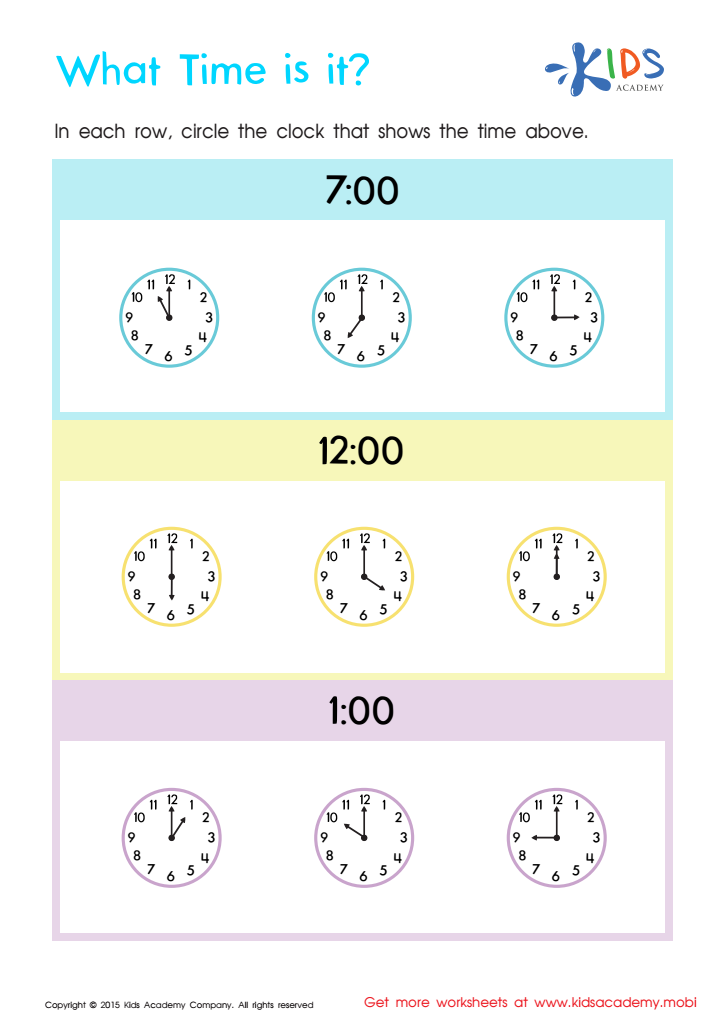
Telling The Time Worksheet: Part 3






.jpg)
Understanding analog clocks is a crucial mathematical skill for children aged 6-8. Teaching this concept cultivates a tangible grasp of time, which is fundamental in everyday life and enhances their cognitive development.
Firstly, learning to read an analog clock strengthens children’s number sense and enhances their ability to make connections between fractions and hours. By recognizing how the minute and hour hands represent parts of a whole, children develop essential skills in understanding divisions, ratios, and the concept of passing time.
Furthermore, analog clocks encourage mindfulness and time management, skills that are extremely beneficial as children grow. Mastering this skill equips them with the ability to estimate elapsed time, facilitating better planning and organization in daily activities like schoolwork and play.
For parents and teachers, fostering a child’s ability to read an analog clock also links to enhancing critical thinking and problem-solving abilities. It creates a context for children to engage in real-world mathematics applications. Thus, investing time in teaching analog clock reading is significant for a child’s holistic growth, ensuring they establish foundational skills for both academic pursuits and life experiences.








