
Develop subtraction skills Math Worksheets for Ages 6-8
3 filtered results
Difficulty Level
Grade
Age
-
From - To
Subject
Activity
Standards
Enhance your child's subtraction skills with our engaging math worksheets designed for ages 6-8! These printable resources offer a variety of activities that cater to different learning styles, making math both fun and educational. Your child will practice essential subtraction concepts through exciting exercises, including visuals, word problems, and hands-on challenges. Our worksheets encourage critical thinking and foster a strong math foundation, ensuring students gain confidence as they solve problems independently. Perfect for classroom use or homeschooling, these worksheets help children grasp subtraction fundamentals while keeping learning enjoyable. Download today to start your child's math journey!
Favorites
With answer key
Interactive
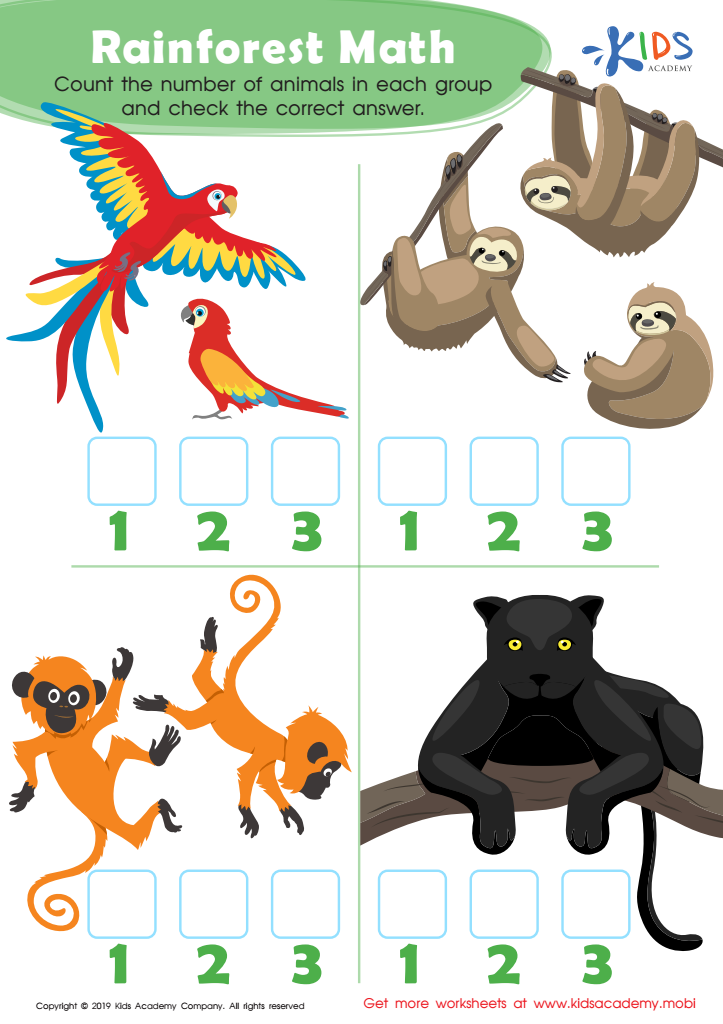
Rainforest Math Worksheet
Kids love learning about rainforest animals! This worksheet helps them with counting and number sense. It features recognizable rainforest animals and asks children to choose the correct number from the answer choices. It's a fun way for children to build their skills - without even knowing it!
 Assign to My Students
Rainforest Math Worksheet
Worksheet
Join Kids Academy for Free
Who is primarily going to use this learning content?








Developing subtraction skills in children aged 6-8 is crucial for their overall mathematical understanding and academic success. At this developmental stage, children are building foundational skills that will influence their future learning. Subtraction, as a fundamental operation, helps them learn about number relationships, understand the concept of taking away, and foster critical thinking skills.
Understanding subtraction enhances problem-solving abilities, as children navigate mathematical scenarios that require them to assess quantities and analyze outcomes. Moreover, proficiency in subtraction is essential for daily life activities, such as budgeting allowances, calculating time, or measuring portions in cooking. Mastery of these skills nurtures confidence and encourages a positive attitude toward math.
In addition, subtraction skills are interdependent with addition and other mathematical concepts introduced later. As such, parents and teachers play a vital role in encouraging practice through engaging games, real-world applications, and interactive activities. Supportive learning environments help children feel successful and motivate them to tackle more complex concepts in the future, laying a solid groundwork for lifelong learning. Ultimately, fostering strong subtraction skills not only benefits mathematical capabilities but also contributes to children's cognitive and emotional development.








