
Enhance logical thinking Math Worksheets for Ages 6-8
4 filtered results
Difficulty Level
Grade
Age
-
From - To
Subject
Activity
Standards
Discover our "Enhance Logical Thinking Math Worksheets" designed specifically for children aged 6-8. These engaging and interactive worksheets encourage critical thinking and problem-solving skills through fun math activities. Tailored to promote logical reasoning, our resources feature puzzles, patterns, and brain teasers that challenge young minds while reinforcing essential math concepts. Perfect for classroom use or at-home learning, these worksheets aim to boost confidence and foster a love for math in young learners. Help your child develop essential skills that will serve them well in their educational journey. Explore our collection today and watch their logical thinking skills flourish!
Favorites
With answer key
Interactive
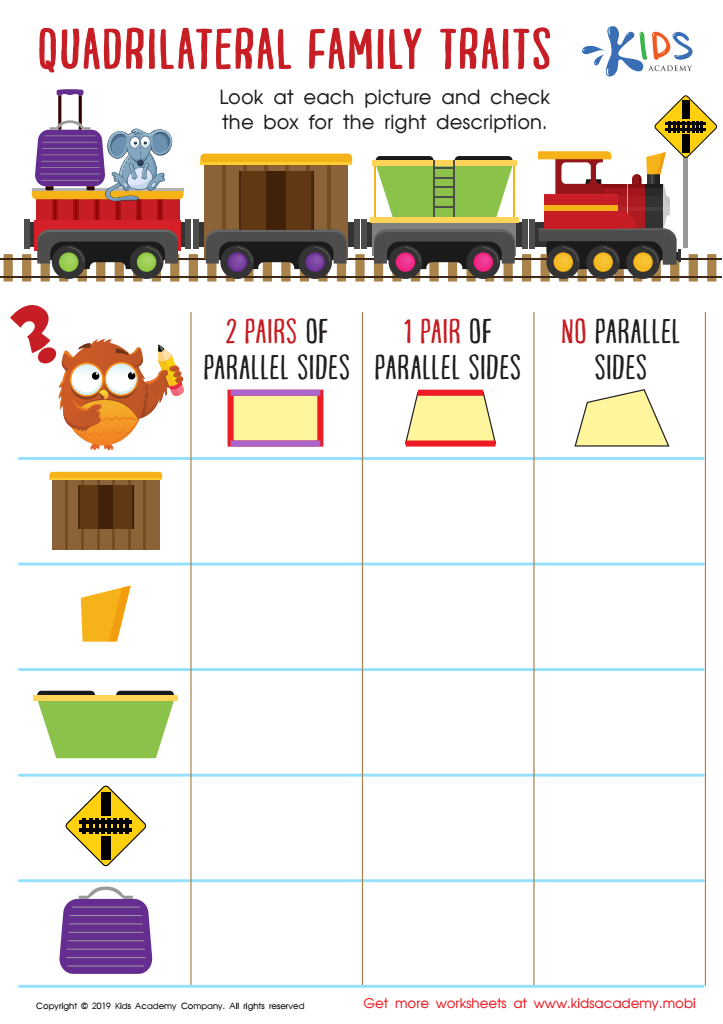
Quadrilateral Family Traits Worksheet
Review with your students what a quadrilateral is: four sides and angles. Now, go through the worksheet with them. Look at the pictures and help them check the boxes to identify the shapes.
 Assign to My Students
Quadrilateral Family Traits Worksheet
Worksheet
Join Kids Academy for Free
Who is primarily going to use this learning content?








Enhancing logical thinking in children aged 6-8 through math is crucial for several reasons. Firstly, this age group is at a developmental stage where they are beginning to think more abstractly and make connections between concepts. Engaging children in logical thinking helps them develop critical reasoning skills, which are essential not just in mathematics but across all areas of learning.
Math offers a structured way to nurture these skills. When children solve problems, they learn to analyze situations, identify patterns, and make decisions based on evidence. This builds their ability to think independently and tackle challenges with confidence. Moreover, strong logical thinking skills are foundational for future academic success, particularly in STEM fields, which are increasingly significant in today’s job market.
Additionally, investing in logical thinking through math fosters a positive attitude towards learning. When children experience success in solving problems, it boosts their self-esteem and encourages a lifelong love for education. Parents and teachers play a pivotal role in this process by providing engaging, age-appropriate activities that challenge and inspire young learners. Ultimately, enhancing logical thinking at this age equips children with tools that will benefit them for years to come, both personally and academically.








