
Learning subtraction Math Worksheets for Ages 6-8
3 filtered results
Difficulty Level
Grade
Age
-
From - To
Subject
Activity
Standards
Welcome to our "Learning Subtraction Math Worksheets for Ages 6-8"! This comprehensive resource is designed to make subtraction engaging and accessible for young learners. Our worksheets feature vibrant illustrations and age-appropriate exercises that help children practice essential subtraction skills. From basic subtraction facts to word problems, each activity fosters critical thinking and problem-solving abilities. Tailored for a fun and interactive learning experience, our worksheets allow kids to practice at their own pace, building confidence in their math skills. Perfect for classroom use or at-home learning, these subtraction worksheets will empower your child to master math with joy! Start exploring today!
Favorites
With answer key
Interactive
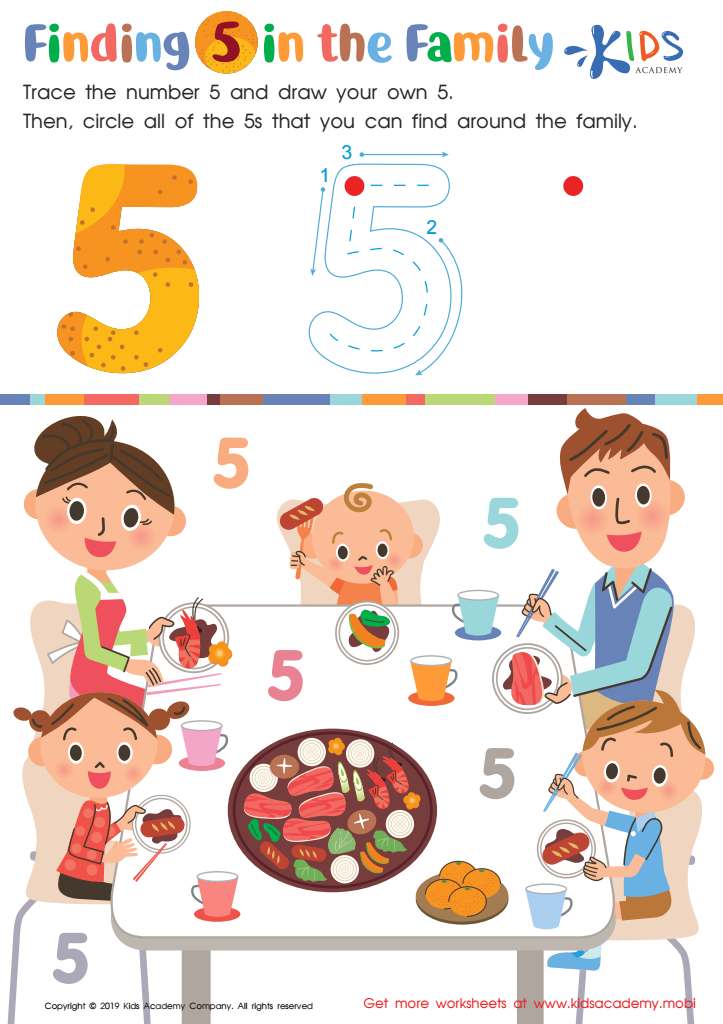
Finding 5 in the Family Worksheet
This worksheet helps kids identify and write the number 5. Ask what the family is doing and who the family members are. Help them trace and draw the 5, then have them circle all 5s in the picture.
 Assign to My Students
Finding 5 in the Family Worksheet
Worksheet
Join Kids Academy for Free
Who is primarily going to use this learning content?






%20(1).jpg)

Learning subtraction is a foundational aspect of mathematics that is crucial for children aged 6-8. At this age, students are developing critical thinking and problem-solving skills, and mastering subtraction lays the groundwork for future mathematical concepts. Understanding subtraction not only enhances numerical fluency, but also fosters cognitive development, encouraging logical reasoning and analytical skills.
Moreover, subtraction is essential for daily life activities, such as budgeting, shopping, and time management. By grasping subtraction, children learn to navigate challenges, enhancing their confidence in their abilities. It also introduces concepts such as 'take away' and 'comparison,' which help them comprehend larger mathematical ideas in the future.
Parents and teachers play a vital role in this learning process. Engaging children in fun and interactive ways—like games, manipulatives, or storytelling—can cultivate a positive attitude towards math. This helps instill a love for learning and encourages perseverance when tackling challenging tasks. Furthermore, monitoring and supporting progress in subtraction helps identify any learning gaps early on, ensuring students receive the help they need to succeed academically. Overall, subtraction proficiency is a stepping stone to valuable skills that have lifelong significance, making it imperative for caregivers to prioritize this learning.








