
Solve word problems Math Worksheets for Ages 6-8
3 filtered results
Difficulty Level
Grade
Age
-
From - To
Subject
Activity
Standards
Discover our engaging "Solve Word Problems" math worksheets designed specifically for children aged 6-8. These resources help young learners develop critical thinking and problem-solving skills through fun, age-appropriate scenarios. Each worksheet presents carefully crafted word problems that challenge students to apply their mathematical knowledge in real-world contexts. With varying difficulty levels, children will enjoy honing their skills in addition, subtraction, and logical reasoning. Perfect for classroom activities or at-home learning, these worksheets not only enhance math proficiency but also boost confidence and foster a love for learning. Explore our collection and support your child's mathematical journey today!
Favorites
With answer key
Interactive
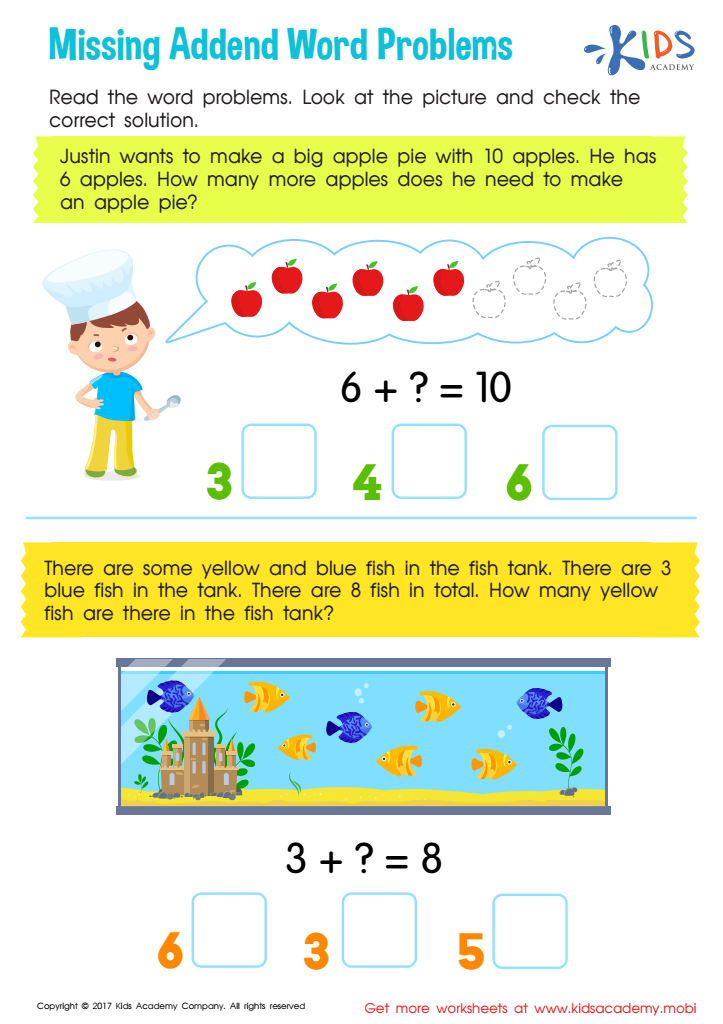
Missing Addend Word Problems Worksheet
Doing many addition and subtraction problems is key for fluency and mastery. Word problems can help kids understand how math works in everyday life. Our math worksheet uses fun scenarios and pictures to teach how to find the missing addend. It's the perfect tool to help kids understand math better!
 Assign to My Students
Missing Addend Word Problems Worksheet
Worksheet
Join Kids Academy for Free
Who is primarily going to use this learning content?








Parents and teachers should prioritize solving word problems in math for children aged 6 to 8, as it plays a crucial role in the development of critical thinking and problem-solving skills. At this age, children are transitioning from concrete to more abstract thinking, and word problems provide a context where they can apply mathematical concepts to real-world situations. This helps to bridge the gap between arithmetic and practical application, enhancing their understanding of math as useful and relevant.
Engaging with word problems aids in developing comprehension skills by requiring children to extract relevant information and visualize scenarios. This process fosters logical reasoning and encourages persistent and thoughtful approaches to challenges—skills that extend beyond math into other academic areas and everyday life.
Moreover, addressing word problems encourages collaboration among peers, as they often involve discussions requiring communication of ideas and strategies. This builds social skills, confidence, and a love for learning. By investing time in teaching children to solve word problems, parents and teachers adopt a holistic approach to education, cultivating not only mathematical proficiency but also adaptability and creativity in young learners. Celebrating their successes in this area also boosts their self-esteem and motivation to engage with mathematics.








