
Understanding length Measurement Worksheets for Ages 6-8
3 filtered results
Difficulty Level
Grade
Age
-
From - To
Subject
Activity
Standards
Our "Understanding Length Measurement Worksheets for Ages 6-8" offer engaging and practical activities designed to help young learners grasp the concept of measuring length. These worksheets, perfect for children in early grades, feature fun tasks that teach students how to use standard units such as inches, centimeters, and feet. By incorporating visually appealing graphics and hands-on exercises, these worksheets make learning measurement enjoyable and effective. Whether in the classroom or at home, kids will develop essential math skills and gain a solid foundation in understanding length, setting the stage for more advanced mathematical concepts.
Favorites
With answer key
Interactive
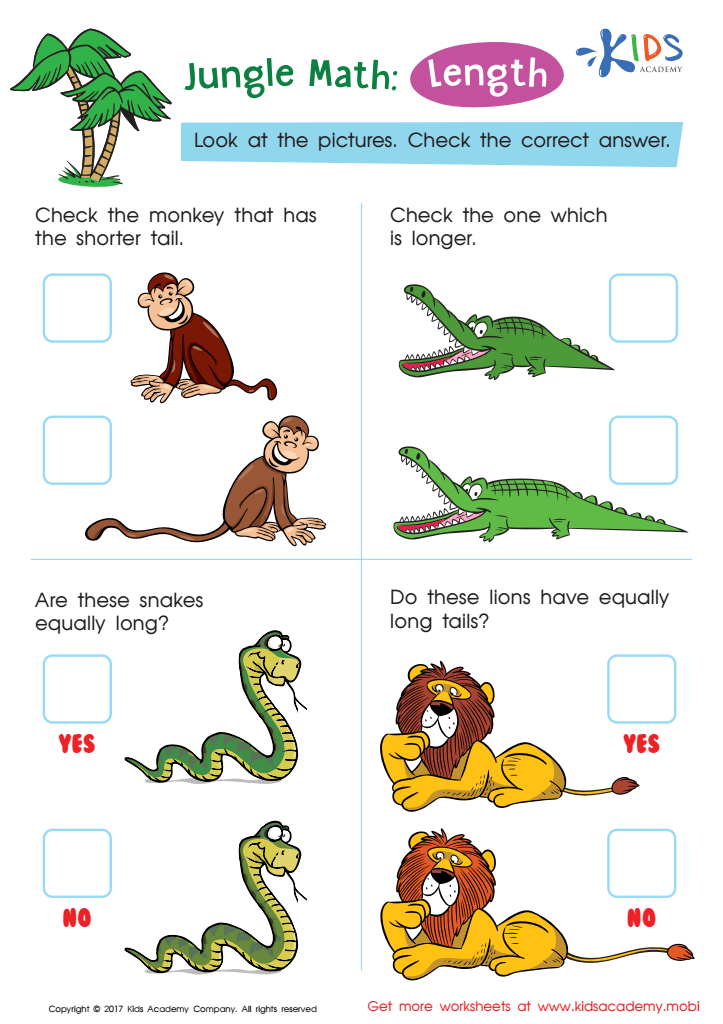
Which One Is Longer - Length Worksheet
Let's go to the jungle - kids get excited to practice math with animal-filled worksheets! This one is sure to have your pupil mastering length in no time.
 Assign to My Students
Which One Is Longer - Length Worksheet
Worksheet
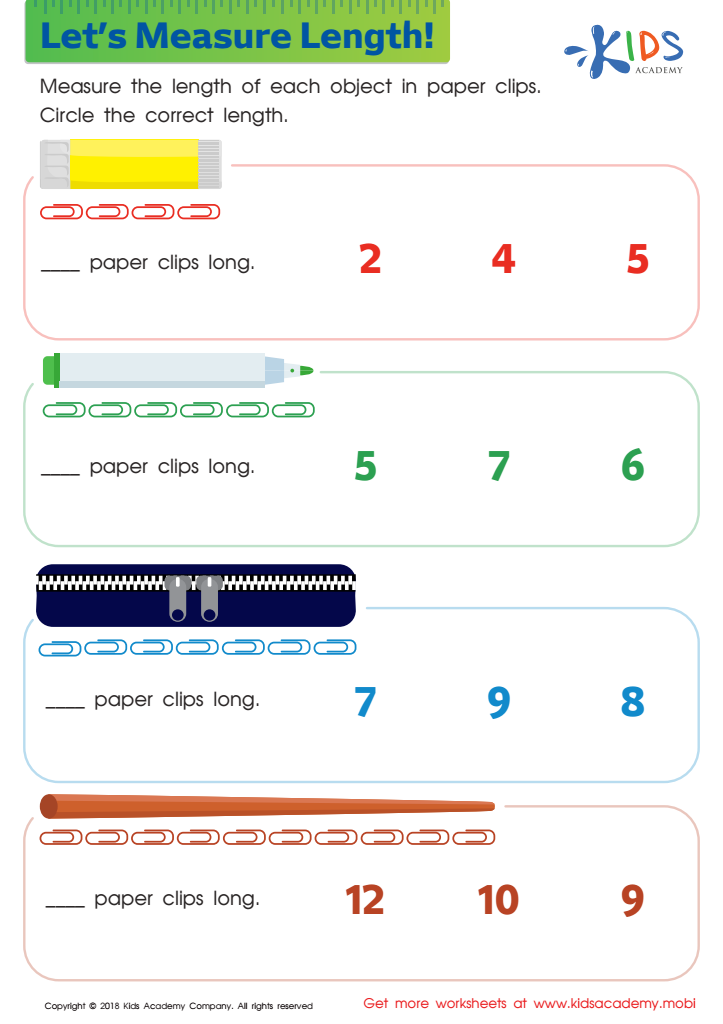
Lets Measure Length Worksheet
It's time to help your child take their measuring skills up a notch! This colorful PDF sheet from Kids Academy introduces kids to measuring with paperclips. Guide them through the page, showing them how to count the clips to measure each image. Then, circle the correct length for each to complete the sheet!
Lets Measure Length Worksheet
Worksheet
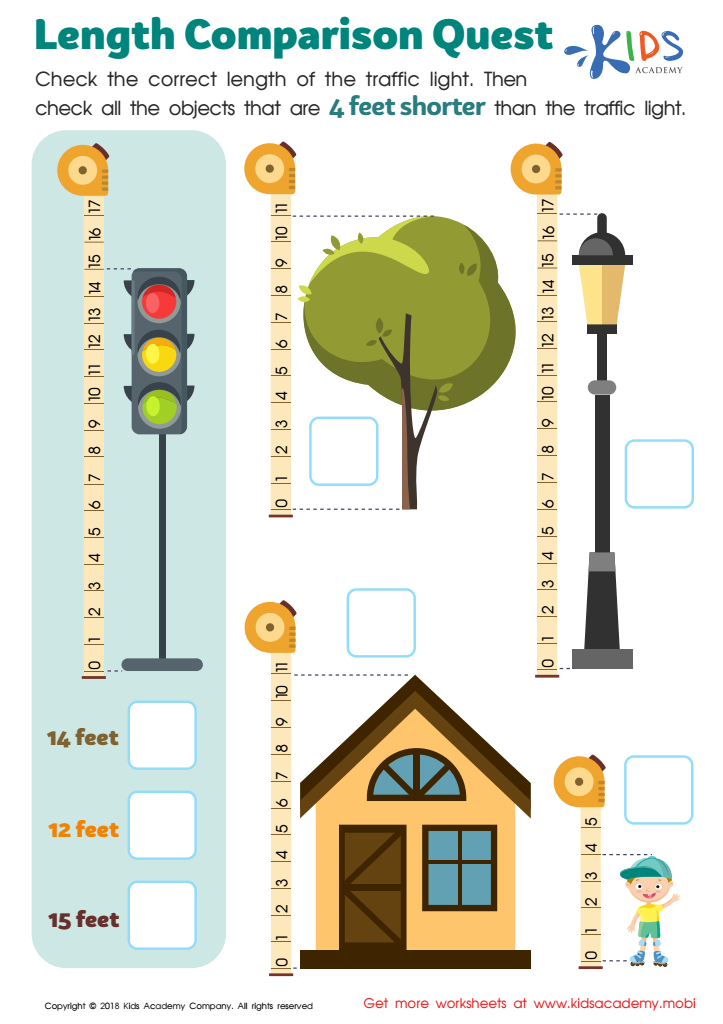
Length Comparison Quest Worksheet
Knowing measurement tools and how to use them is just the start. To be proficient, your kid must be able to accurately compare objects and their lengths. With the 'Length Comparison Quest' worksheet, they will check the correct length of the traffic light in the picture and then compare other objects to it, marking those that measure 4 feet shorter.
Length Comparison Quest Worksheet
Worksheet
Join Kids Academy for Free
Who is primarily going to use this learning content?








Understanding length measurement for children aged 6-8 is crucial for several reasons that span academic, practical, and developmental domains. At this stage, children are emerging learners who benefit significantly from concrete, hands-on experiences, and length measurement provides just that.
Firstly, measurement skills form a foundational part of the math curriculum. Mastering these not only meets educational standards but also boosts overall mathematical proficiency. Early exposure aids in the comprehension of more complex concepts like geometry and algebra that children will encounter later.
Furthermore, practical life skills heavily rely on an understanding of length. Daily activities such as cooking, crafting, or even playing sports often require measuring spaces, objects, or distances. Familiarity with measurement tools like rulers or measuring tapes enhances their problem-solving skills and independence in these activities.
Moreover, exploring length measurement helps develop a child's spatial awareness and fine motor skills. Tasks that involve measuring, comparing, and ordering lengths encourage logical thinking and precision.
Lastly, fostering an early appreciation and comprehension of measurement contributes to a child's ability to navigate the world around them accurately. It drives curiosity and scientific thinking, empowering children to ask questions and seek answers about their physical surroundings. Hence, both parents and teachers should actively encourage and nurture these skills through engaging and supportive experiences.








