
Number sequence recognition Worksheets for Ages 6-9
3 filtered results
Difficulty Level
Grade
Age
-
From - To
Subject
Activity
Standards
Discover our Number Sequence Recognition Worksheets designed specifically for children ages 6-9. These engaging worksheets enhance young learners' ability to recognize, understand, and complete number sequences—a fundamental skill in early mathematics. Our colorful and user-friendly activities involve various exercises, from filling in missing numbers to identifying patterns, fostering critical thinking and problem-solving skills. Ready to boost your child's numeracy and confidence in math? These worksheets are perfect for both classroom use and at-home learning, encouraging interactive and enjoyable practice. Let’s make learning numbers fun with our thoughtfully crafted resources that support foundational math skills! Perfect for parents and educators alike.
Favorites
With answer key
Interactive
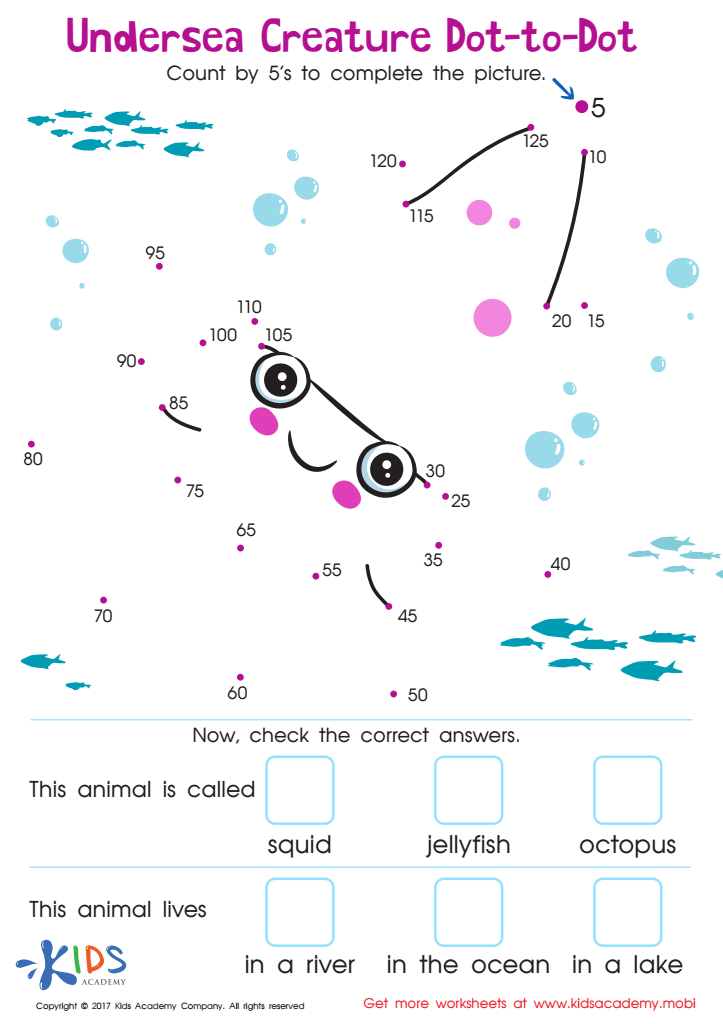
Undersea: Dot To Dot Worksheet
This dot-to-dot worksheet is a great way to teach kids about the undersea world while having fun. Kids will love connecting the dots and counting in 5s. Then they can check their answers.
 Assign to My Students
Undersea: Dot To Dot Worksheet
Worksheet
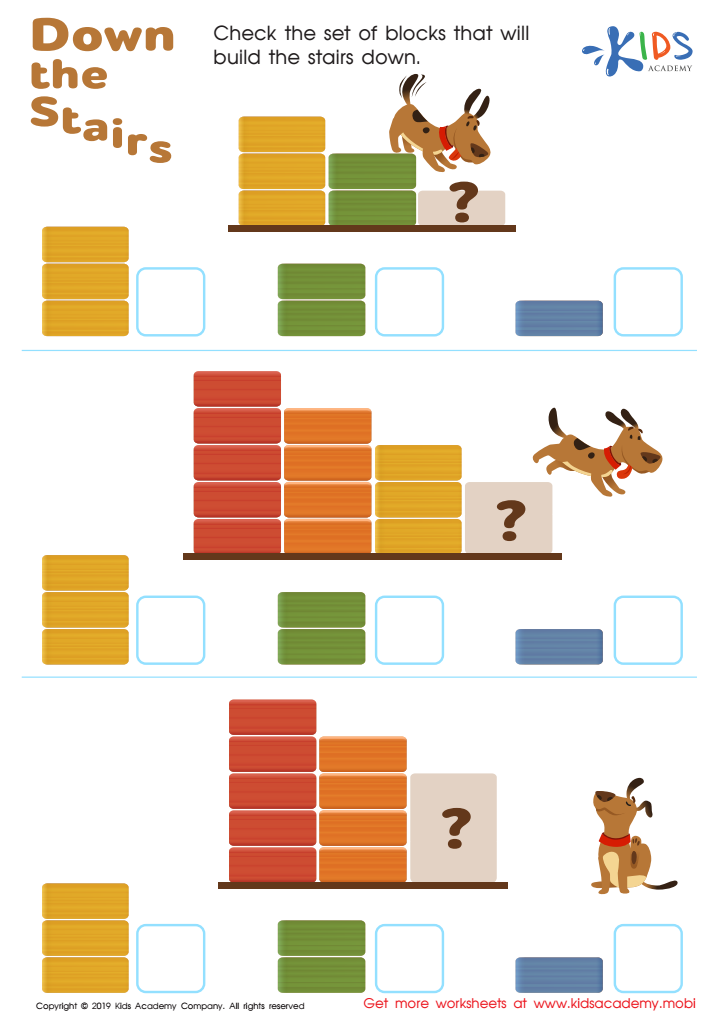
Down the Stairs Worksheet
Let your kids' imaginations run wild with this worksheet featuring a cute and friendly dog! Ask them to point out the dog in the printout, then help count the blocks in each set. Aim to stack them in descending order and build stairs for the pup to get down. Count each block and check the set - it's that easy!
Down the Stairs Worksheet
Worksheet
Join Kids Academy for Free
Who is primarily going to use this learning content?






Number sequence recognition is a crucial skill for children aged 6-9, fostering a solid foundation for their overall mathematical development. At this age, learners transition from concrete to more abstract thinking, making it vital for them to understand numerical patterns and sequences. Recognizing number sequences not only enhances their counting abilities but also helps them to grasp essential concepts such as addition, subtraction, multiplication, and division.
Parents and teachers should care about number sequence recognition because it promotes critical thinking skills. When children can identify patterns in numbers, they develop the ability to predict outcomes and solve problems more efficiently. This skill becomes increasingly important as they encounter more advanced mathematical concepts in higher grades. Furthermore, understanding sequences aids in real-life applications, such as telling time, counting money, or organizing information in daily tasks.
Additionally, fostering number sequence recognition can boost a child’s confidence in math. A strong grasp of numerical patterns can make abstract concepts more concrete and approachable. By nurturing this skill early on, parents and teachers empower children to become proficient in math and enthusiastic learners who view mathematics as an engaging and rewarding subject. This not only benefits them academically but also has lifelong implications for their problem-solving abilities.








