Pattern recognition Addition & Subtraction Worksheets for Ages 6-9
7 filtered results
-
From - To
Enhance your child's math skills with our engaging Pattern Recognition Addition & Subtraction Worksheets designed for ages 6-9! These interactive worksheets not only focus on fundamental arithmetic but also emphasize the importance of identifying patterns within numbers. By solving fun exercises, children learn to spot relationships and trends, improving their problem-solving abilities and number fluency. Our colorful and visually stimulating activities keep young learners motivated while they practice addition and subtraction skills in a playful way. Perfect for home schooling or supplementary learning, these worksheets will ensure that your child develops a strong mathematical foundation. Explore our collection today!
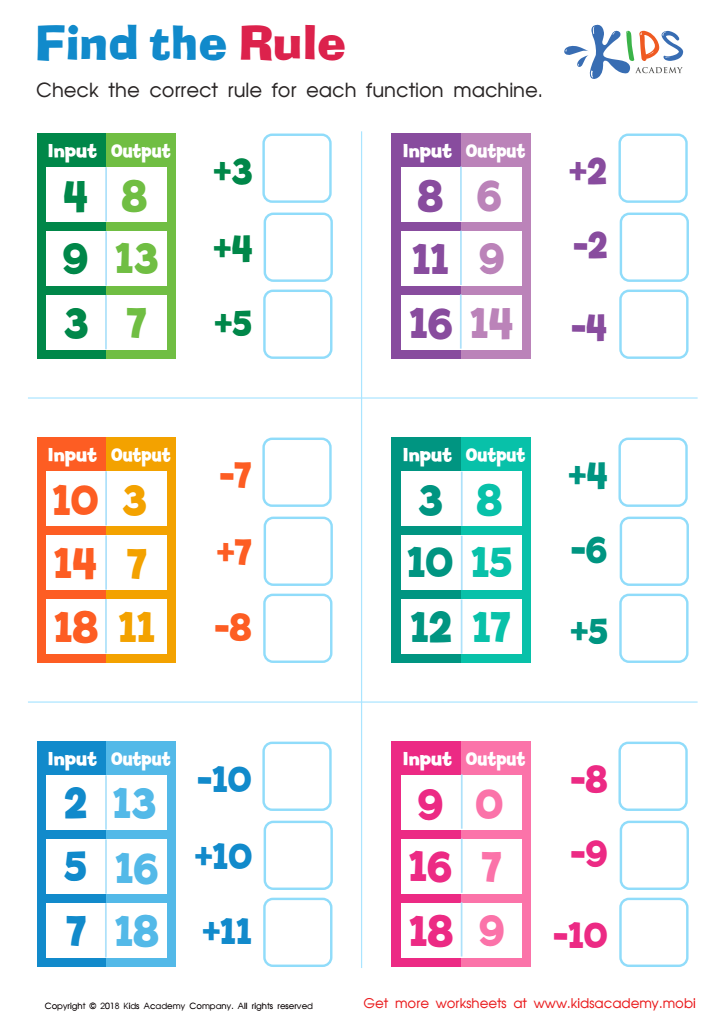
Find the Rule Worksheet
 Assign to My Students
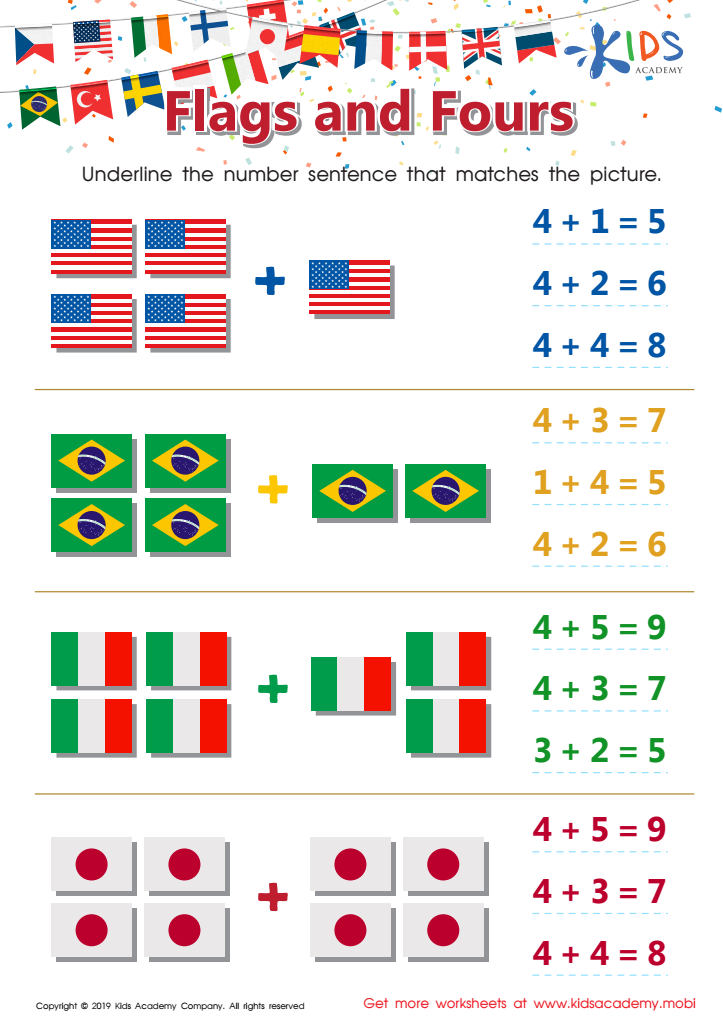
Flags and Fours Worksheet








Pattern recognition in addition and subtraction is crucial for children aged 6-9 because it lays the foundation for deeper mathematical understanding and problem-solving skills. During this developmental stage, children begin to see relationships and connections in numbers, which enhances their ability to grasp more complex concepts in algebra and beyond.
When children recognize patterns, they develop strategies that make calculations more manageable and efficient. For instance, understanding that adding two even numbers always results in an even number helps them predict outcomes, fostering independence in their mathematical reasoning. Additionally, pattern recognition encourages a joyful curiosity in exploring numbers, making mathematics more engaging and less intimidating.
Furthermore, as educators and parents promote these skills, they support cognitive development and enhance critical thinking abilities. Children learn to approach problems systematically, evaluate solutions, and discover multiple methods to arrive at the same answer. These skills are not only relevant in mathematics but are applicable in everyday life.
Investing time in teaching pattern recognition promotes a sound mathematical foundation, preparing children for future academic success and fostering a lifelong love for learning. Thus, both parents and teachers play a vital role in developing these essential skills in young learners.








