Solve word problems Addition & Subtraction Worksheets for Ages 6-9
3 filtered results
-
From - To
Enhance your child’s math skills with our "Solve Word Problems Addition & Subtraction Worksheets" designed for ages 6-9. Tailored to bolster critical thinking, our worksheets transform everyday scenarios into engaging math challenges. Each activity develops mastery in both addition and subtraction through relatable, age-appropriate problems. By practicing these word problems, kids will boost their confidence in problem-solving and arithmetic. Perfect for home or classroom use, these printable worksheets can be a valuable resource for teachers and parents aiming to ensure math success. Start your child on the path to mathematical achievement today with our fun and educational worksheets!
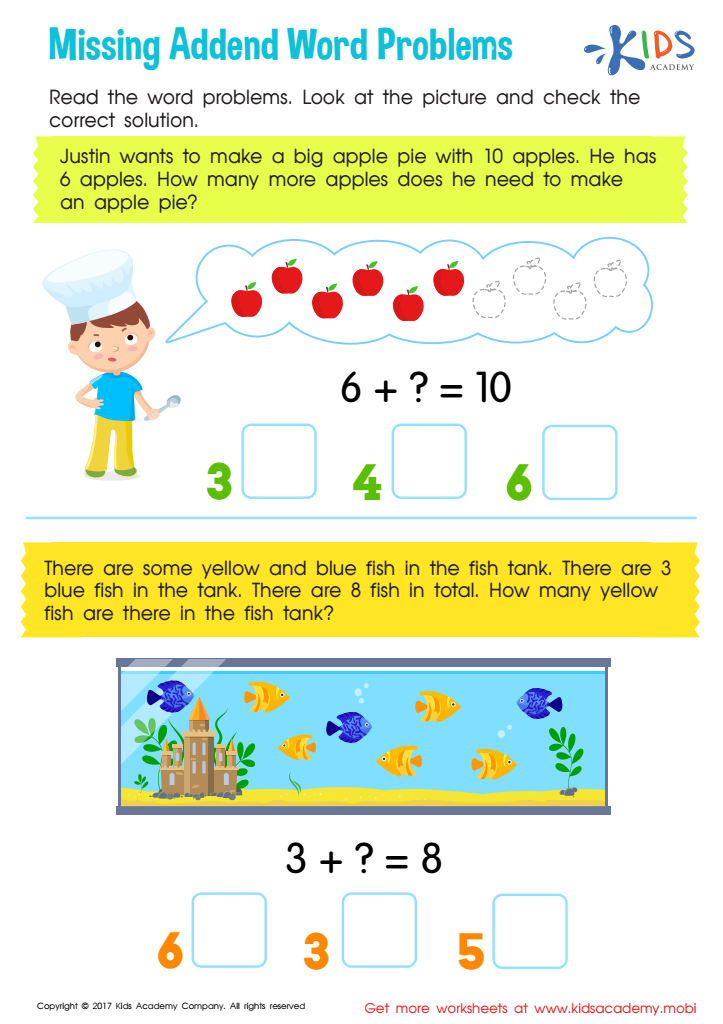
Missing Addend Word Problems Worksheet
 Assign to My Students








Parents and teachers should care about teaching children aged 6-9 to solve word problems in addition and subtraction because these skills are fundamental to their overall cognitive and mathematical development. Word problems transcend simple numerical calculations by integrating critical thinking, comprehension, and logic, fostering a more profound understanding of math as it relates to real-life scenarios.
At this stage, children are developing the ability to transition from concrete to abstract thinking. Solving word problems helps in cultivating analytical skills and problem-solving abilities essential for higher-order math and daily decision-making. By practicing word problems, children improve their reading comprehension as they follow multi-step directions and discern pertinent information, which bolsters their literacy skills.
Moreover, these problems enhance persistence and resilience as children learn to approach challenging tasks without giving up easily. They also build a foundation for collaborative learning; discussing word problems encourages teamwork and communication among peers.
Investing time in helping children master addition and subtraction word problems lays a key cornerstone for future academic success and offsets potential math anxiety. As they grow confident in their abilities, children’s positive attitude towards math will likely extend to other subjects, setting the stage for a well-rounded, enthusiastic approach to learning.








