
Identifying Animals Addition Worksheets for Ages 6-9
4 filtered results
Difficulty Level
Grade
Age
-
From - To
Subject
Activity
Standards
Discover our engaging "Identifying Animals Addition Worksheets," perfect for children ages 6-9. Combining math practice with animal identification, these worksheets make learning addition fun and exciting. Each sheet features diverse animal images and addition problems designed to boost arithmetic skills and enrich a child's understanding of wildlife. Conveniently printable, these worksheets are excellent for classroom use or at-home practice, helping kids seamlessly integrate math expertise with nature knowledge. Enhance your child’s learning journey with our cleverly crafted educational tools, designed to foster curiosity and confidence in both math and science. Start exploring and adding today!
Favorites
With answer key
Interactive
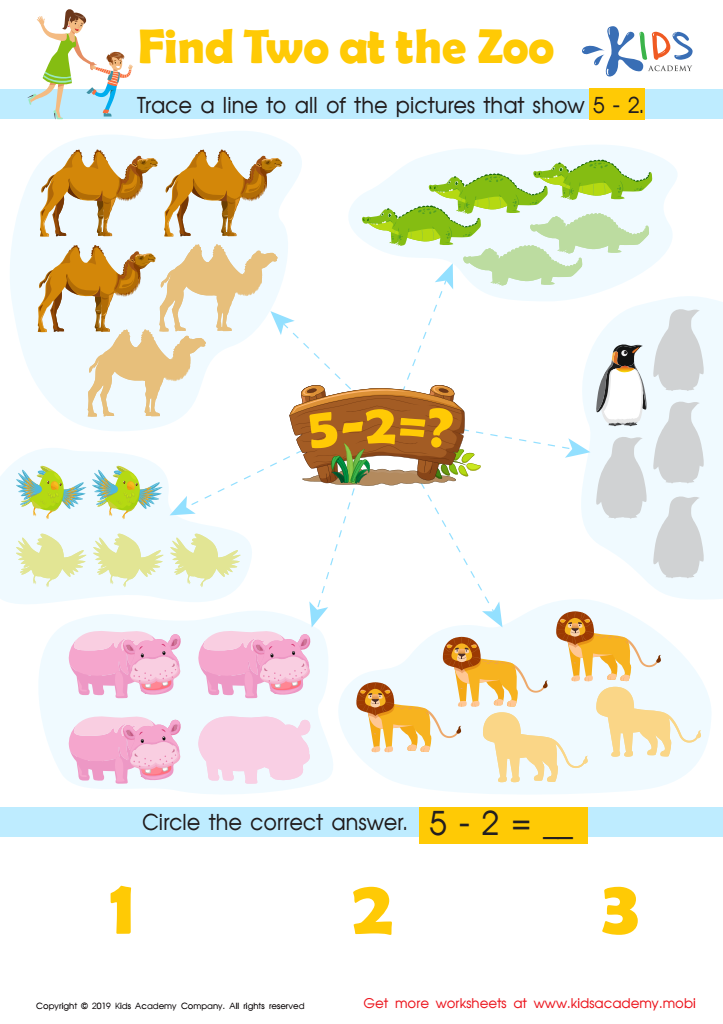
Find Two at the Zoo Worksheet
Help your kids overcome math fears and practice subtracting numbers with this traceable PDF. Ask them to identify the 6 groups of animals in the picture and count the animals in each group. Then, help them trace a line to all of the pictures that illustrate the equation 5-2.
 Assign to My Students
Find Two at the Zoo Worksheet
Worksheet
Join Kids Academy for Free
Who is primarily going to use this learning content?








Identifying animals and practicing addition are essential skills for children aged 6-9, and integrating them into educational activities can offer significant developmental benefits. Firstly, understanding how to identify animals nurtures children’s curiosity and connection with the natural world. It fosters observation skills, critical thinking, and vocabulary expansion. As they learn to distinguish different animals, children also cultivate an appreciation for biodiversity and the environment.
Simultaneously, addition is a fundamental mathematical skill that serves as the foundation for more complex arithmetic and problem-solving abilities. Incorporating addition exercises helps sharpen cognitive functions such as logical reasoning, pattern recognition, and memory. Engaging children in identifying animals addition activities, where they add characteristics, quantities, or distinctions between creatures, keeps learning interactive and enjoyable.
These activities cater to both visual and kinesthetic learners and help in bridging experiential and conceptual learning. Parents and teachers who emphasize these educational practices support holistic brain development—balancing factual knowledge with analytical skill set. Additionally, such dual-focus exercises promote engagement, reduce rote memorization tendencies, and heighten retention rates. Therefore, prioritizing these integrated learning approaches nurtures a well-rounded educational foundation in young learners, preparing them effectively for further academic challenges.








