Practicing addition Numbers Worksheets for Ages 6-9
3 filtered results
-
From - To
Enhance your child’s math skills with our engaging "Practicing Addition Numbers Worksheets" designed for ages 6-9. These worksheets provide a variety of addition problems that are perfect for young learners who are just starting to explore the world of numbers. Through fun and educational exercises, children will strengthen their addition skills, build confidence, and develop a strong mathematical foundation. The age-appropriate challenges and playful design make learning enjoyable and effective. Visit our page to discover a wealth of free, printable resources tailored to inspire your 6-9-year-old’s journey in mastering addition.
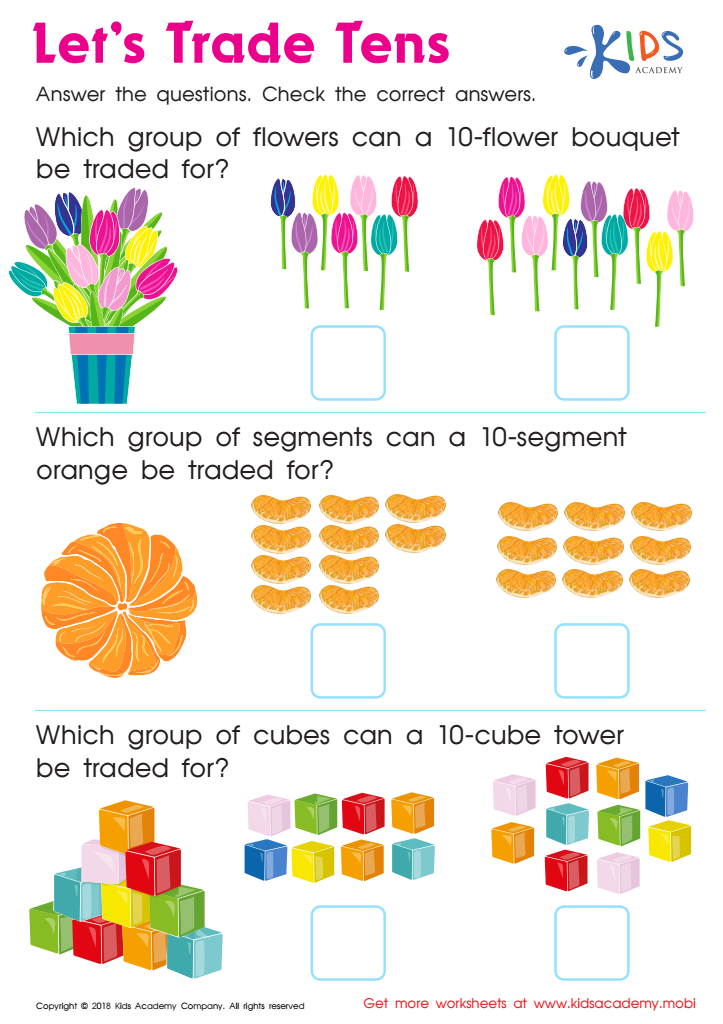
Lets Trade Tens Worksheet
 Assign to My Students
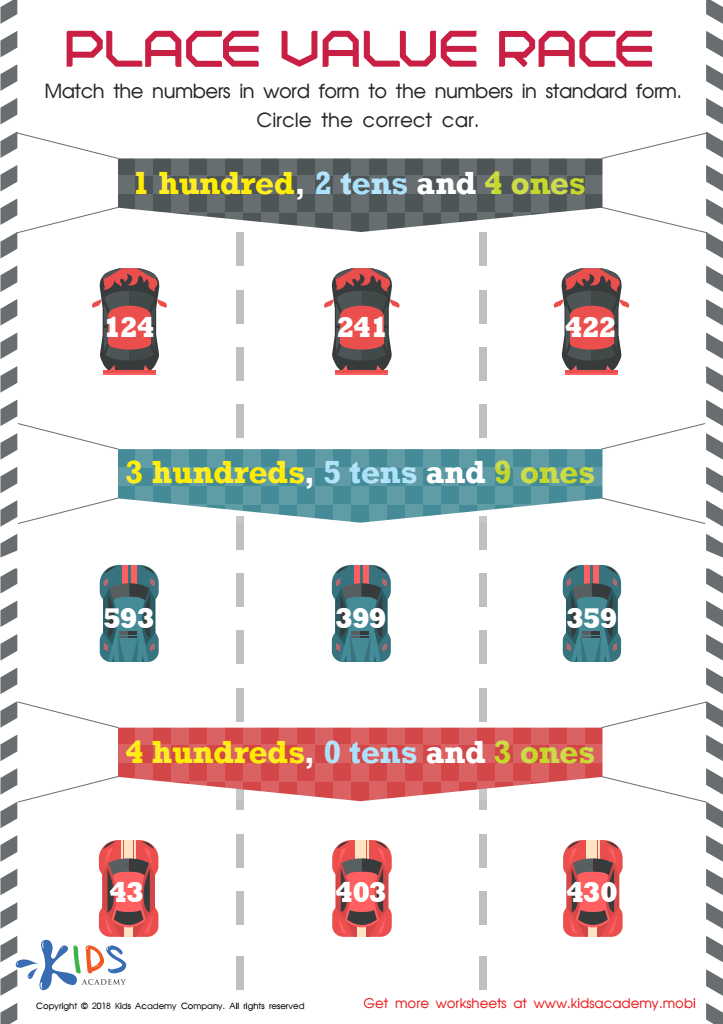
Place Value Race Worksheet
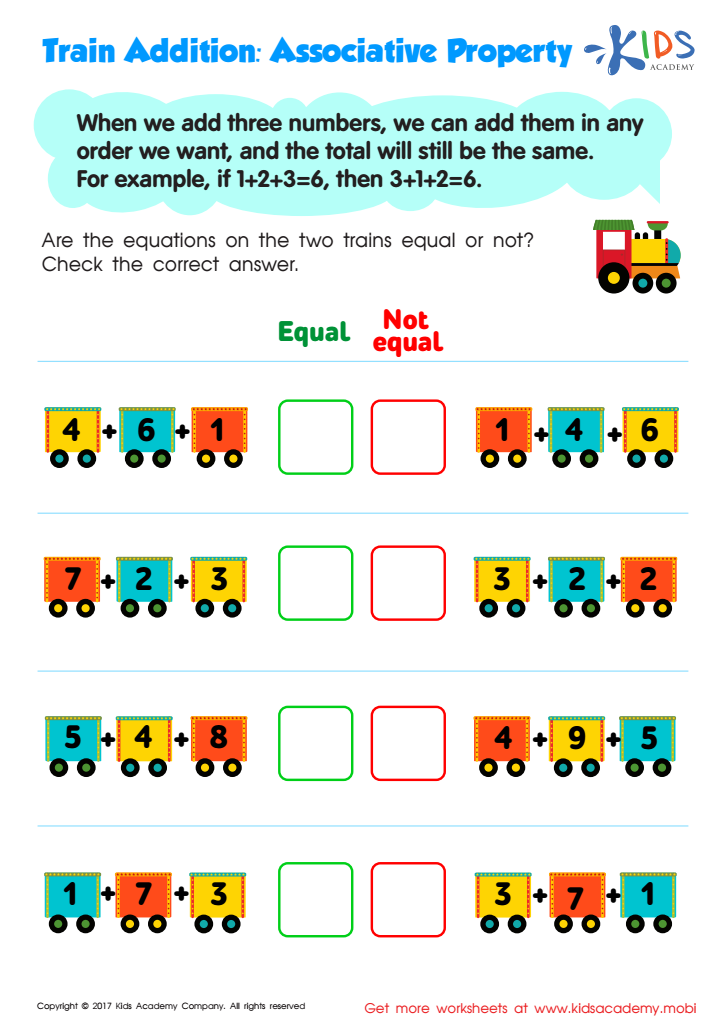
Train Addition: Associative Property Worksheet








Practicing addition for children aged 6-9 is crucial because it forms the foundation for future mathematical learning and essential life skills. During these formative years, children's brains are highly adaptable and capable of forming new neural connections, making it an ideal time to establish basic arithmetic principles.
Firstly, understanding addition aids in the development of number sense, helping children to comprehend quantity, sequence, and patterns. This foundational skill is not only pivotal for more advanced mathematical concepts like subtraction, multiplication, and division but also for everyday tasks such as telling time, cooking, or managing money.
Moreover, developing math skills enhances cognitive abilities including memory, reasoning, and problem-solving skills. These skills are transferrable to other academic areas and foster overall intellectual growth. Practicing addition can also build a child's confidence and encourage a positive attitude towards math, which is often viewed as a challenging subject.
Engaging in regular practice helps solidify knowledge through repetition, enabling children to recall basic facts quickly and effortlessly. This fluency is instrumental in improving their performance on more complex problems, reducing stress and frustration in future coursework.
For parents and teachers, recognizing the importance of practicing addition ensures that children receive the support and resources they need to thrive both academically and in everyday life.








