
Understanding multiplication Numbers Worksheets for Ages 6-9
3 filtered results
Difficulty Level
Grade
Age
-
From - To
Subject
Activity
Standards
Explore our "Understanding Multiplication Numbers Worksheets" designed for children ages 6-9. These engaging and interactive worksheets provide young learners with the foundational skills needed to grasp multiplication concepts with confidence. Our carefully crafted activities introduce basic multiplication, helping students understand the relationship between numbers through visual aids and practical exercises. Each worksheet focuses on fundamental operations, ensuring that kids can master multiplication while having fun. Ideal for home or classroom use, these resources encourage independent learning and reinforce crucial math skills. Dive into a world of numbers and boost your child's mathematical abilities today!
Favorites
With answer key
Interactive
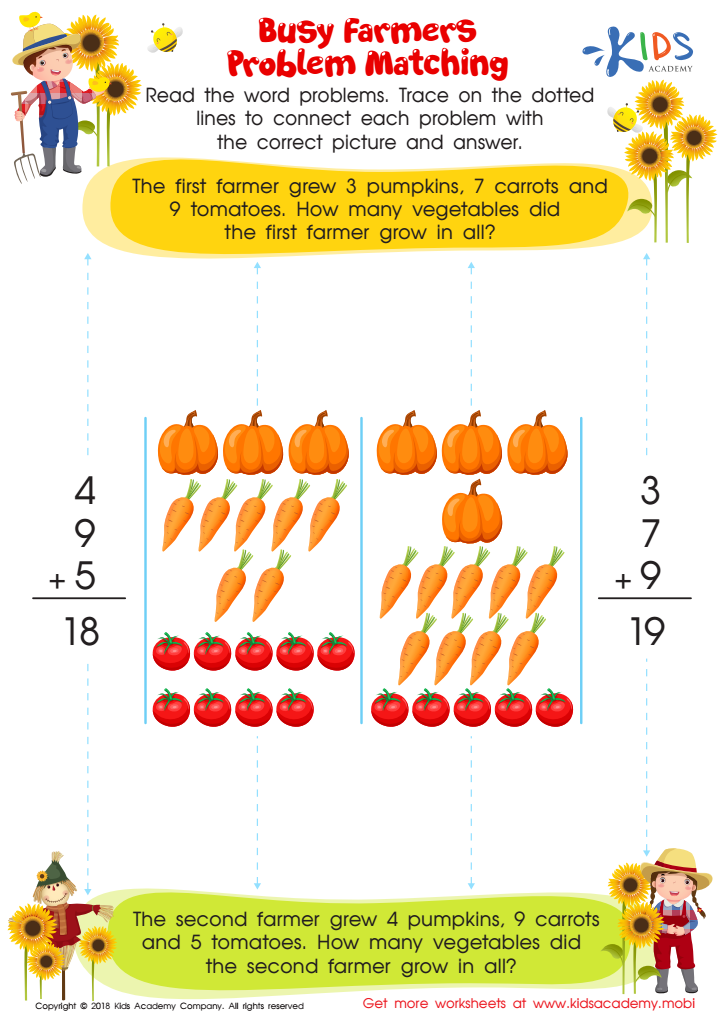
Busy Farmers: Problem Matching Worksheet
Farming is tough, so help your mathematician out with this fun and stimulating worksheet! They'll read word problems and connect each to its correct picture, using traceable lines. They'll practice addition with three addends, and use the harvest veg pictures to ensure accuracy.
 Assign to My Students
Busy Farmers: Problem Matching Worksheet
Worksheet
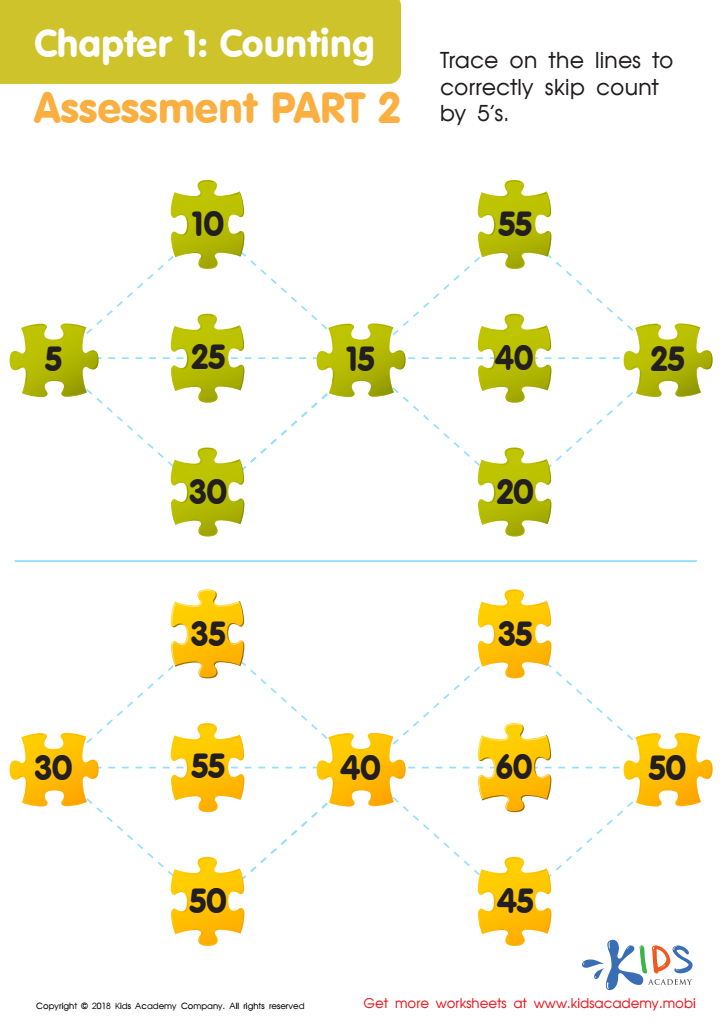
Counting: Assessment 2 Worksheet
By now, your child should be able to count up to the hundreds. If they're still learning the tens, that's okay - as long as they're going at their own pace. This worksheet will be easy if they can count to ten. Ask them to trace the lines and skip count by 5's.
Counting: Assessment 2 Worksheet
Worksheet

Enrichment: Firefighter Ladders Worksheet
Firefighters are vital to their communities. If your kids want to become firefighters, they'll love this worksheet. Ask them to spot the firemen in the picture. Then, help the firemen pick the right ladders to reach the windows. Draw lines to connect the ladders that match. It's a great learning activity!
Enrichment: Firefighter Ladders Worksheet
Worksheet
Join Kids Academy for Free
Who is primarily going to use this learning content?








Understanding multiplication is crucial for children aged 6-9 as it lays the foundation for their mathematical competence and problem-solving skills. This concept is not just about learning to calculate; it fosters critical thinking and reasoning abilities. At this developmental stage, children begin to shift from concrete to more abstract thinking, making it an ideal time to introduce multiplication as repeated addition, helping them to grasp its significance.
Parents and teachers should care because mastering multiplication by this age supports children's confidence in math, encouraging a positive attitude towards the subject that will influence their future academic pursuits. Moreover, multiplication is a fundamental skill that recurs in various real-life situations, from sharing items equally to managing time and resources.
Additionally, proficiency in multiplication enables children to tackle more complex mathematical concepts, such as division, fractions, and later, algebra. Helping children build a strong multiplication foundation not only enhances their numerical fluency but also equips them with essential skills for critical thinking and decision-making, vital for their overall growth and education. By investing time and resources in teaching multiplication effectively, parents and teachers can significantly impact children's academic trajectories and lifelong learning.








