Color differentiation Math Worksheets for Ages 6-9
4 filtered results
-
From - To
Enhance your child's math skills with our Color Differentiation Math Worksheets, perfect for ages 6-9! Designed by educational experts, these worksheets effortlessly blend visual learning with mathematical concepts. Kids will engage in fun activities that require them to categorize objects by color while practicing essential math skills such as counting, addition, and subtraction. This multi-sensory approach not only helps in improving color recognition but also strengthens cognitive abilities. Enjoy a diverse range of exercises that keep young minds active and interested in learning. Spark excitement in your child's educational journey with our expertly crafted worksheets!
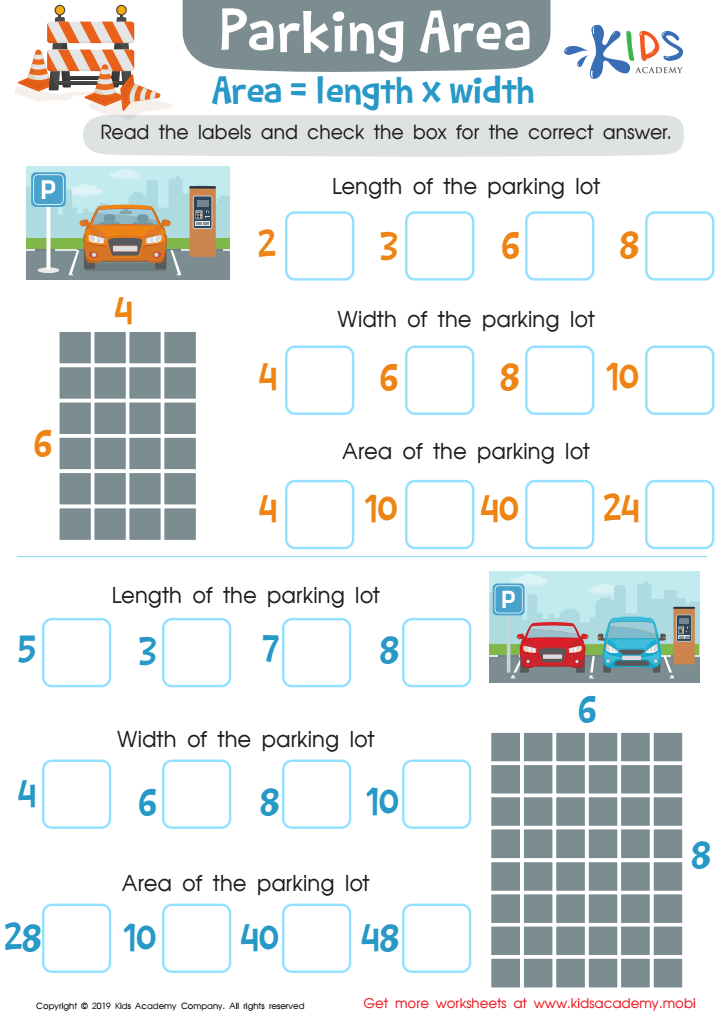
Parking Area Worksheet
 Assign to My Students








Color differentiation in math for children ages 6-9 is a crucial pedagogical tool that enhances cognitive development and mathematical understanding. At this stage, children's brains are highly receptive to visual stimuli, and colors can significantly aid in the learning process. By incorporating diverse colors into math activities, we can facilitate pattern recognition, a core mathematical skill. For instance, distinguishing patterns in sequences, grouping objects, and identifying relationships between numbers become more accessible and engaging with color-coded visuals.
Moreover, color differentiation supports memory retention. Young learners are more likely to remember lessons that are vibrant and visually stimulating. This can be particularly helpful when teaching foundational concepts like addition, subtraction, multiplication, and division. For example, each arithmetic operation could be associated with a specific color, making it easier for children to grasp and recall.
Additionally, using colors can address the varying learning needs of children. Visual learners, in particular, benefit from color-coded materials, as they can better understand and interact with content that visually engages them. Ensuring that math lessons are inclusive and cater to diverse learning styles helps foster a positive learning environment.
Lastly, a colorful approach to teaching math makes learning fun and reduces anxiety around the subject. When lessons are enjoyable, children are more likely to develop a lifelong interest in math, setting a strong foundation for future academic success.








