
Improve comprehension Math Worksheets for Ages 6-9
4 filtered results
Difficulty Level
Grade
Age
-
From - To
Subject
Activity
Standards
Enhance your child's math skills with our specially designed Improve Comprehension Math Worksheets for ages 6-9. Our worksheets are crafted to build a strong foundation in math through engaging problems and exercises that make learning fun. Each worksheet focuses on different key concepts, bolstering skills in addition, subtraction, multiplication, and more. With clear instructions and captivating visuals, children can easily comprehend complex ideas while progressing at their own pace. Perfect for homeschooling or supplemental practice, these worksheets help young learners develop confidence and proficiency in math, preparing them for more advanced challenges. Make math enjoyable and effective today!
Favorites
With answer key
Interactive
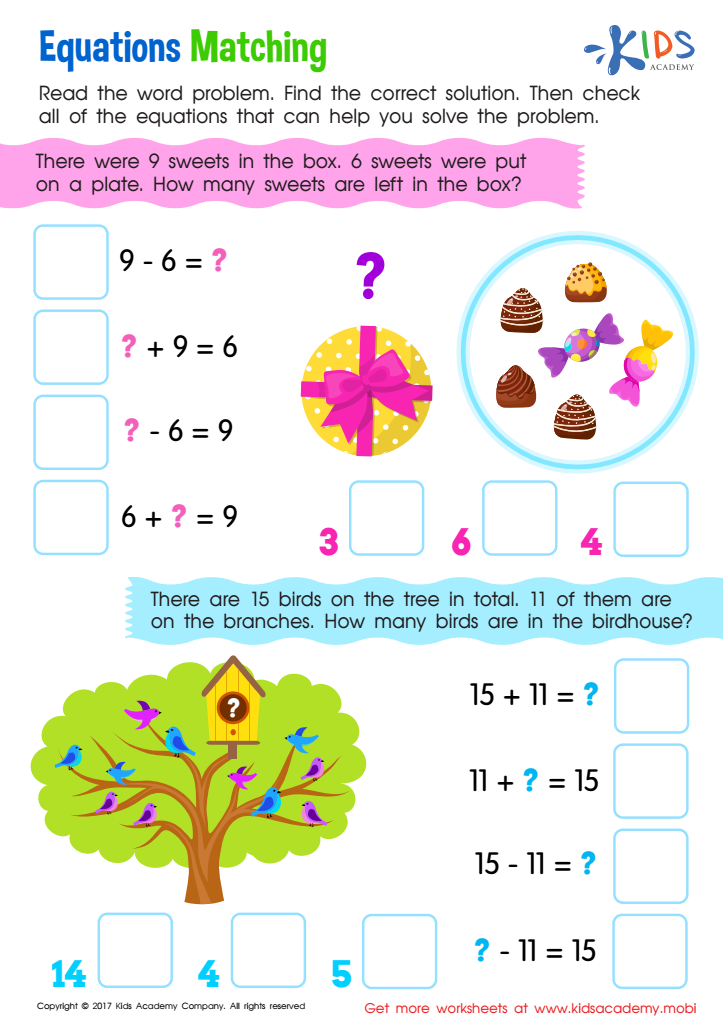
Equations Matching Word Problems Worksheet
Download this worksheet and give your young mathematician practice in solving equations using matching numbers and number family facts. They'll solve word problems, develop critical thinking and algebraic reasoning, and gain success with addition and subtraction.
 Assign to My Students
Equations Matching Word Problems Worksheet
Worksheet
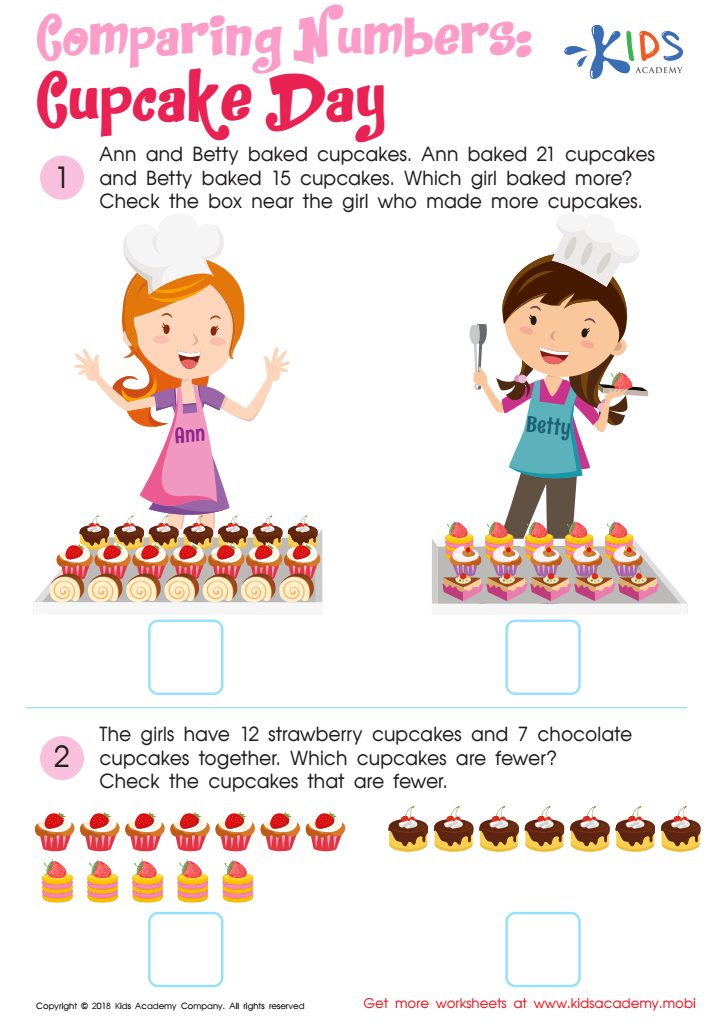
Cupcake Day Worksheet
This free downloadable worksheet will make math more enjoyable for your youngster! They'll have to carefully read and answer the straightforward questions, while counting the colorful cupcakes - what fun!
Cupcake Day Worksheet
Worksheet
Join Kids Academy for Free
Who is primarily going to use this learning content?




.jpg)



Improving math comprehension for children ages 6 to 9 is crucial because these early years form the foundation of their future learning and thinking skills. At this formative stage, kids are not just learning to count or add; they're also developing critical reasoning abilities and problem-solving skills that affect all areas of life.
Mathematics enhances cognitive development. When children understand basic math concepts, they learn to think logically and systematically. It trains their brains to recognize patterns, make predictions, and develop short-term and long-term memory skills.
Additionally, early math proficiency boosts self-confidence. Kids who struggle with math can often feel left behind, leading to frustration and a negative attitude toward school in general. Conversely, success in math literacy boosts self-esteem, encouraging them to tackle other challenges with courage and resilience.
Math is also linked to everyday activities. Understanding numbers, measurements, and basic arithmetic allows children to navigate daily tasks more effectively and gains practical life skills. This includes anything from handling money to telling time, cooking, or even understanding sports statistics.
Teachers and parents play a critical role by providing the resources, encouragement, and patience needed to nurture these skills. Early intervention and support set the stage for academic success and lifelong love for learning.








