Math problem-solving skills Math Worksheets for Ages 6-9
4 filtered results
-
From - To
Enhance your child's math skills with engaging Math Worksheets for Ages 6-9 from Kids Academy. Our expertly designed worksheets focus on developing essential problem-solving abilities, helping young learners confidently tackle math challenges. Each worksheet combines fun exercises with core math principles, covering topics such as addition, subtraction, multiplication, division, and word problems. Ideal for classroom or home use, our materials provide a solid foundation for academic success. Boost your child's logical thinking, analytical skills, and math confidence with these interactive, age-appropriate resources. Equip your young mathematician for a bright future with Kids Academy's Math Problem-Solving Worksheets.
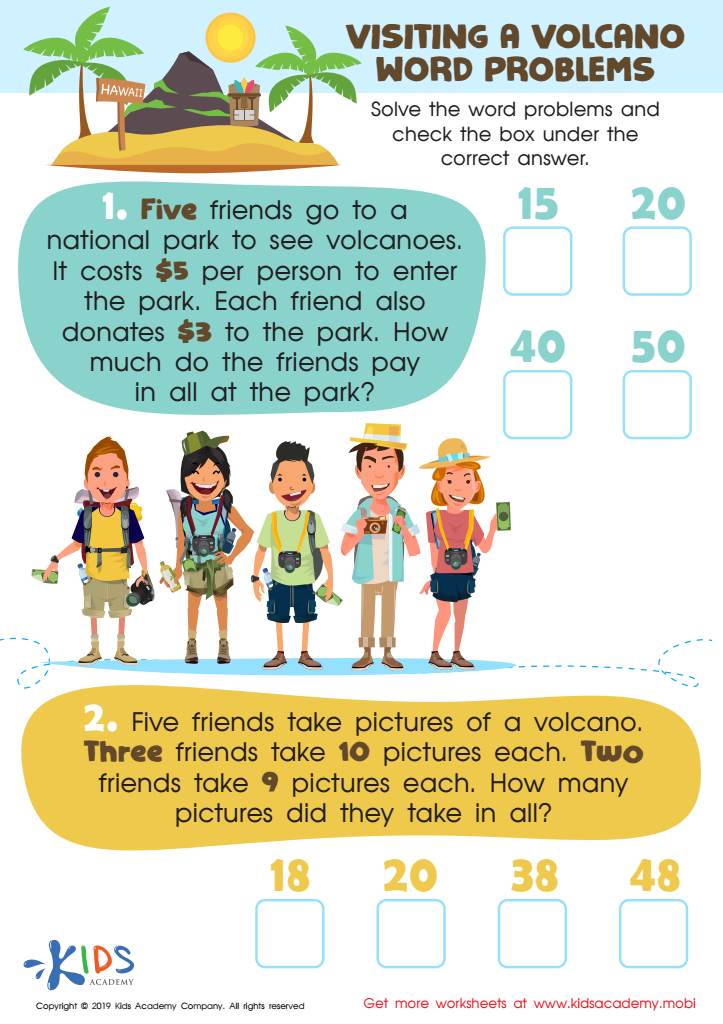
Visiting a Volcano Word Problems Worksheet
 Assign to My Students








Math problem-solving skills are essential for children aged 6-9 because they lay the foundation for critical thinking and logical reasoning that support their academic and life pursuits. This early childhood stage is when kids can best develop these skills through engaging activities that prompt them to think deeply and analytically.
When children learn to solve math problems, they improve their ability to analyze situations, recognize patterns, and understand relationships between different concepts. This logical way of thinking isn't limited to mathematics; it translates to other subjects like science, reading comprehension, and even art. For instance, figuring out how many apples are left if a few are taken or organizing building blocks to create specific structures integrates their cognitive skills, enhancing their general problem-solving abilities.
Moreover, mastering math fosters confidence. Success in solving problems, even simple arithmetic, gives kids a sense of achievement and encourages a growth mindset. They begin to understand that effort and strategy can overcome challenges.
Teachers and parents have pivotal roles; they can provide a supportive environment where making mistakes is seen as a learning opportunity rather than a failure. This encourages persistence. By caring about children's math skills, adults help cultivate lifelong learners who are equipped to tackle complex problems, adapt to new situations, and pursue STEM careers in an increasingly technical world.








