Understanding commutative property Math Worksheets for Ages 6-9
4 filtered results
-
From - To
Discover our engaging "Understanding Commutative Property Math Worksheets" designed for children aged 6 to 9! These worksheets provide a fun and interactive way for young learners to grasp the commutative property of addition and multiplication. Featuring colorful illustrations and easy-to-follow exercises, these resources help solidify essential math concepts while boosting confidence and critical thinking skills. With clear explanations and a variety of problems, kids will enjoy practicing and mastering this foundational principle. Perfect for home or classroom use, our worksheets make learning math an enjoyable experience. Begin your child's journey to math proficiency today!
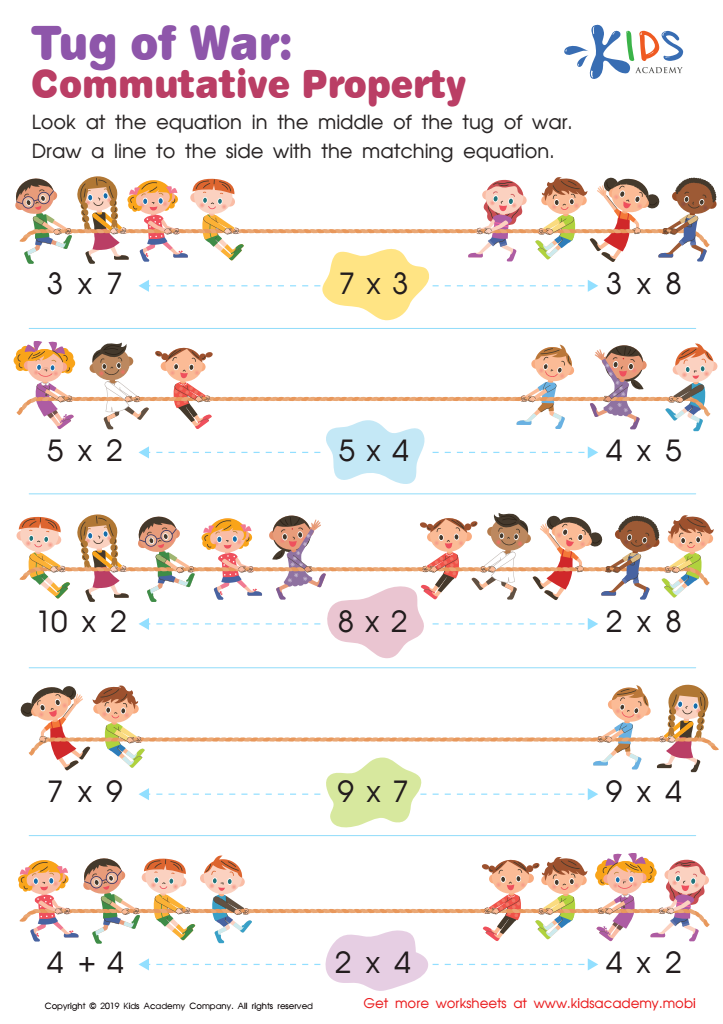
Tug of War: Commutative Property Worksheet
 Assign to My Students
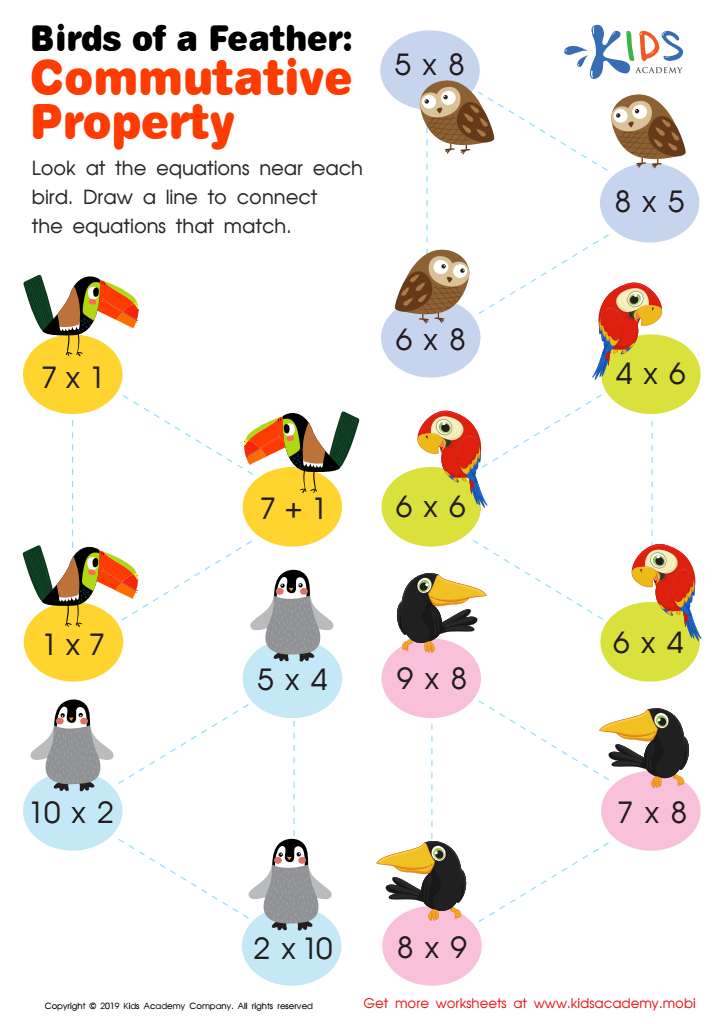
Birds of a Feather: Commutative Property Worksheet
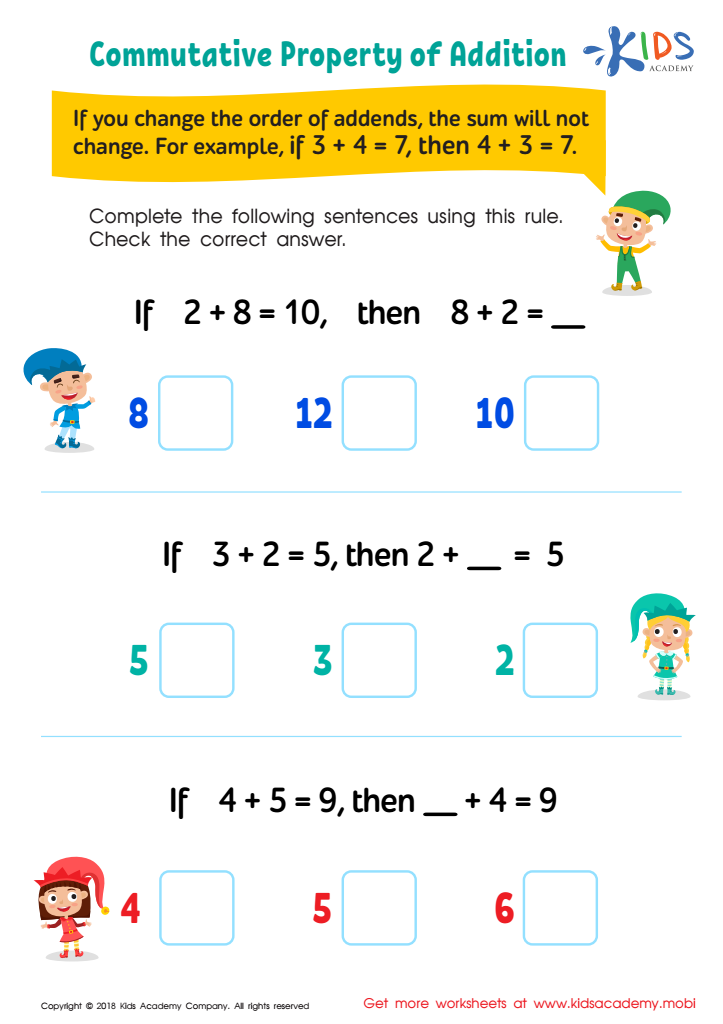
Commutative Property of Addition Worksheet
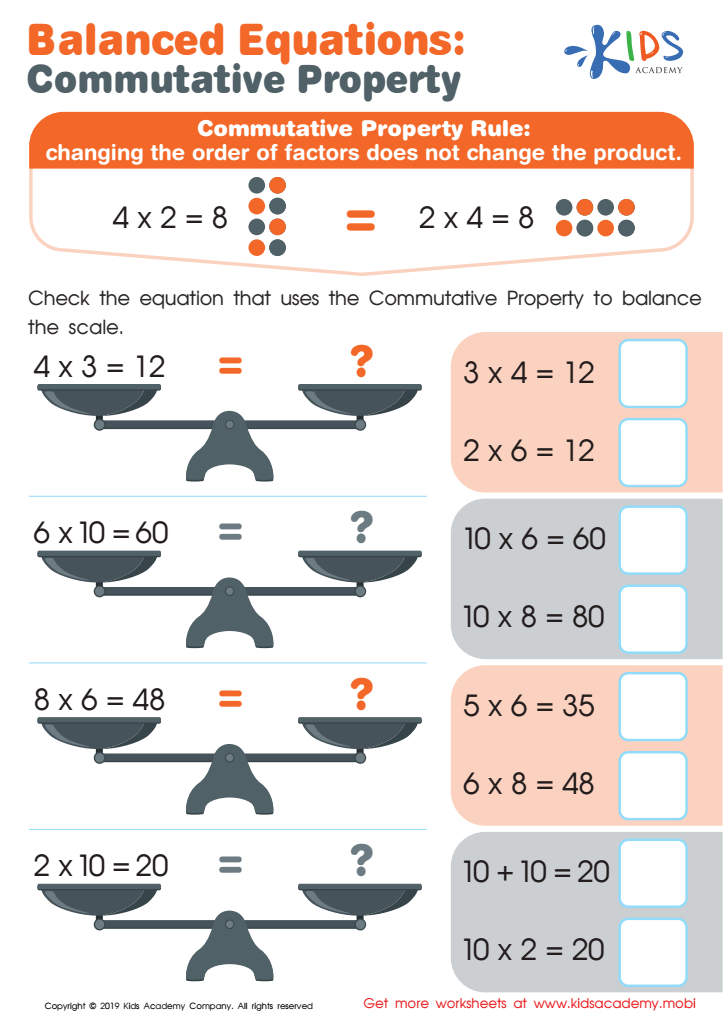
Balanced Equations: Commutative Property Worksheet







Understanding the commutative property is crucial for students aged 6-9 as it lays a strong foundation for their mathematical literacy. This property states that the order in which we add or multiply numbers does not change the sum or product; for example, 3 + 4 = 4 + 3 and 2 × 5 = 5 × 2. Parents and teachers should care about imparting this concept because it enhances students' number sense and fosters flexibility in thinking.
When children grasp the commutative property, they become better problem solvers. They can rearrange numbers to simplify calculations, making them more efficient in math-related tasks. This foundational knowledge also helps students tackle more complex concepts in later grades, such as algebra.
Moreover, understanding this property encourages a positive attitude towards math. It builds confidence, as students recognize that there are multiple pathways to reach the same answer. This exploration promotes critical thinking and creativity.
By reinforcing the commutative property, parents and teachers actively participate in nurturing mathematical thinkers who are equipped with essential skills for academic success and everyday decision-making. Ultimately, fostering this understanding equips children for a future where math plays a pivotal role in their lives.








