Understanding Perimeter Math Worksheets for Ages 6-9
3 filtered results
-
From - To
Unlock your child's mathematical potential with our "Understanding Perimeter Math Worksheets for Ages 6-9" at Kids Academy! These engaging and educational worksheets guide children through the foundational concepts of perimeter, using fun activities and relatable examples. Specially designed to support young learners, the exercises help kids measure and calculate the perimeter of various shapes, enhancing their spatial awareness and problem-solving skills. Perfectly tailored for ages 6-9, our printable resources make mastering perimeter math both enjoyable and informative. Give your child the tools they need to succeed in math with these easy-to-follow and interactive worksheets!
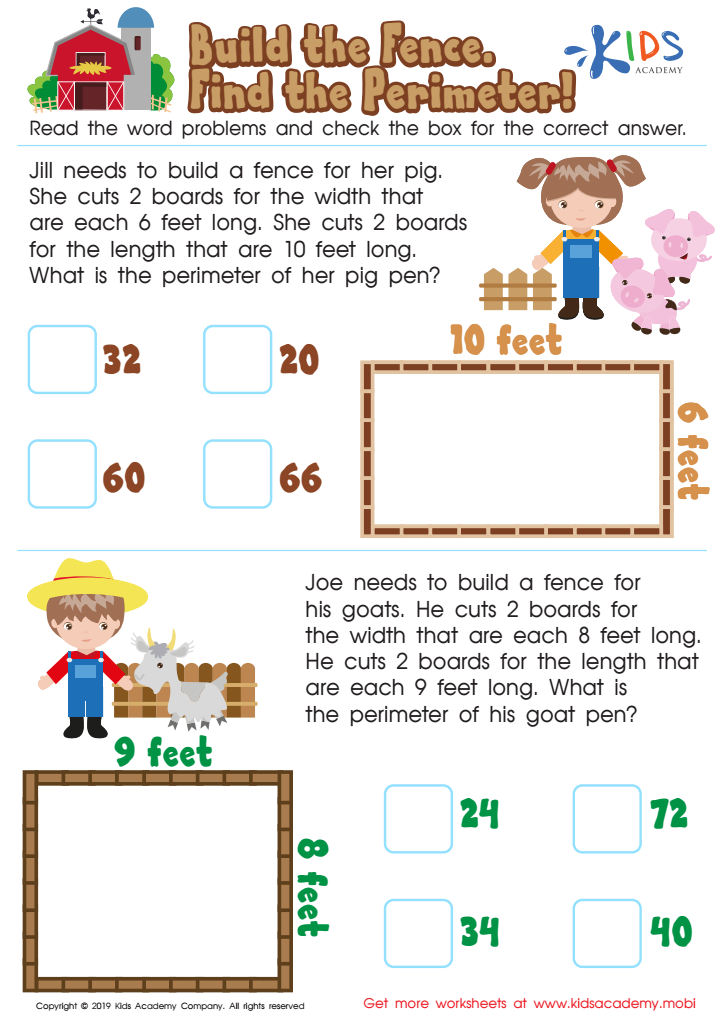
Build the Fence, Find the Perimeter Worksheet
 Assign to My Students
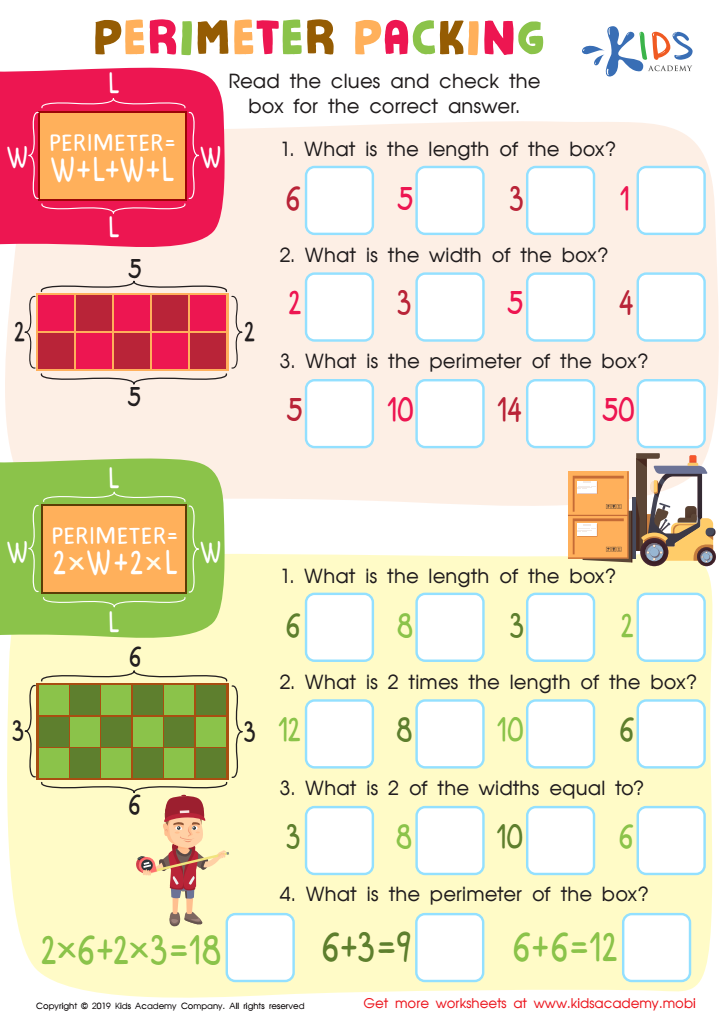
Perimeter Parking Worksheet
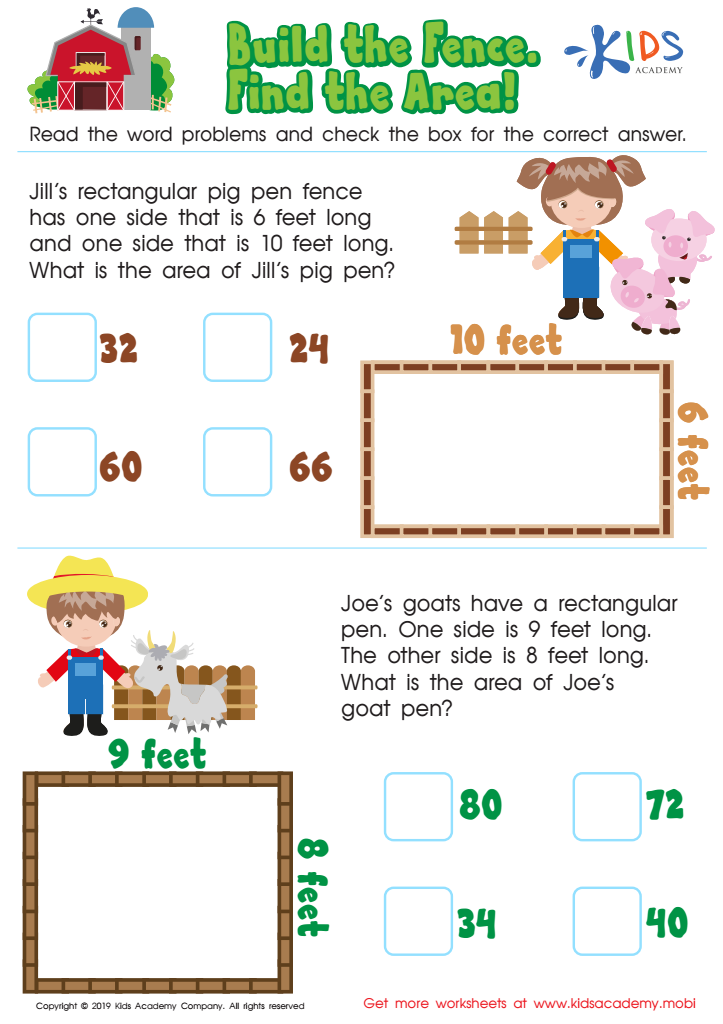
Build the Fence, Find the Area Worksheet





Understanding perimeter math for children aged 6-9 is essential for several reasons, and both parents and teachers have a significant role in this process. Perimeter, the distance around a shape, lays the foundational skills for later mathematical and practical concepts. Here is why it matters:
Firstly, learning about perimeter at a young age improves spatial awareness. Children begin to understand the properties of shapes and develop an early aptitude for geometry. This comprehension is a crucial building block for more sophisticated mathematical topics they will encounter in later grades.
Secondly, it enhances problem-solving skills. Understanding how to calculate perimeter encourages logical thinking and reasoning, as children need to understand the strategy behind summing the sides of different shapes. This type of thinking is transferable to various academic and real-life situations.
Moreover, it reinforces arithmetic skills. Practices in adding and understanding units of measurement are intrinsic to perimeter calculations. This repeated practice helps solidify core addition skills, aiding overall number sense and fluency.
Finally, perimeter knowledge has practical applications. Whether planning to put a fence around a garden, arranging furniture, or even walking around a playground, the concept of "perimeter" makes these real-world tasks more comprehensible for young learners.
In conclusion, both parents and teachers should prioritize teaching perimeter math to foster cognitive development, mathematical competency, and practical life skills in children.








