Understanding skip-counting Skip Counting Worksheets for Ages 6-9
3 filtered results
-
From - To
Enhance your child's math skills with our "Understanding Skip Counting" worksheets, designed for ages 6-9. These engaging and educational printables help young learners grasp the concept of skip counting by 2s, 5s, and 10s. By practicing with vivid illustrations and fun activities, kids will learn to count quickly and efficiently, laying a strong foundation for future arithmetic. Ideal for both classroom use and at-home learning, our worksheets make mastering skip counting a delightful experience. Give your child the advantage they need to excel in math with Kids Academy’s expertly crafted resources.
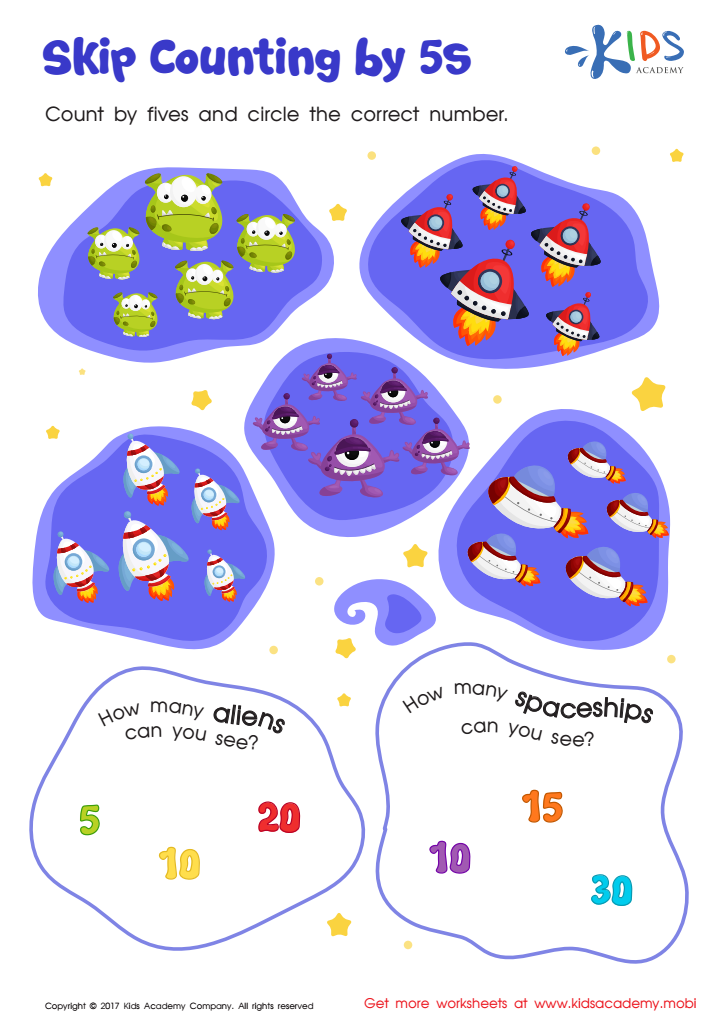
Skip Counting by 5s: Aliens and Spaceships Printable
 Assign to My Students
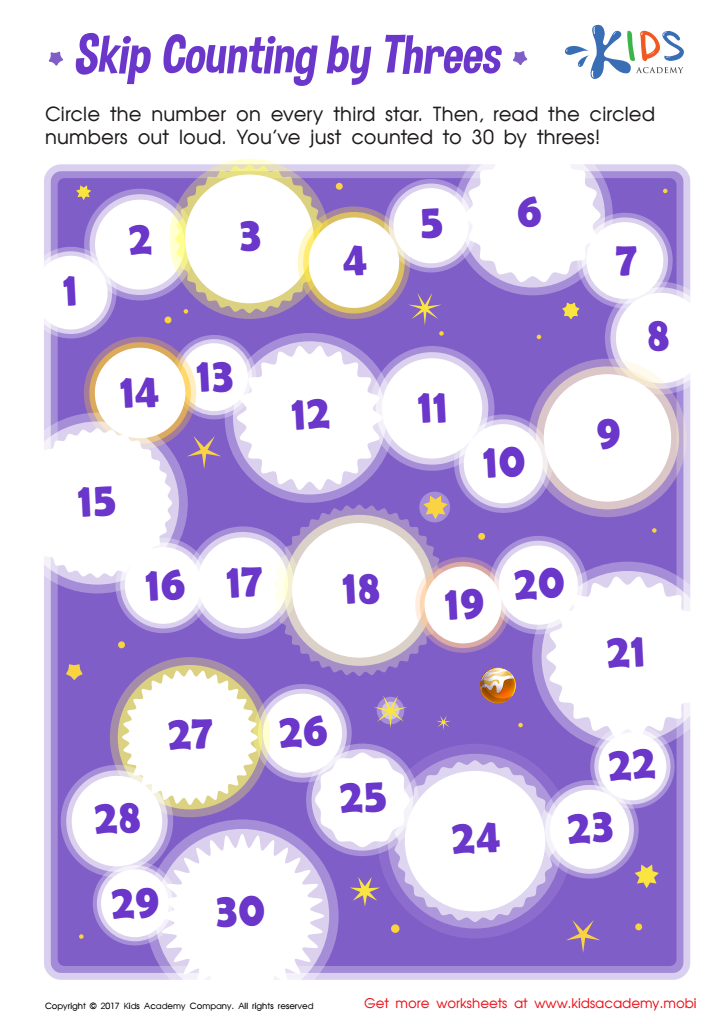
Skip Counting By Three Printable
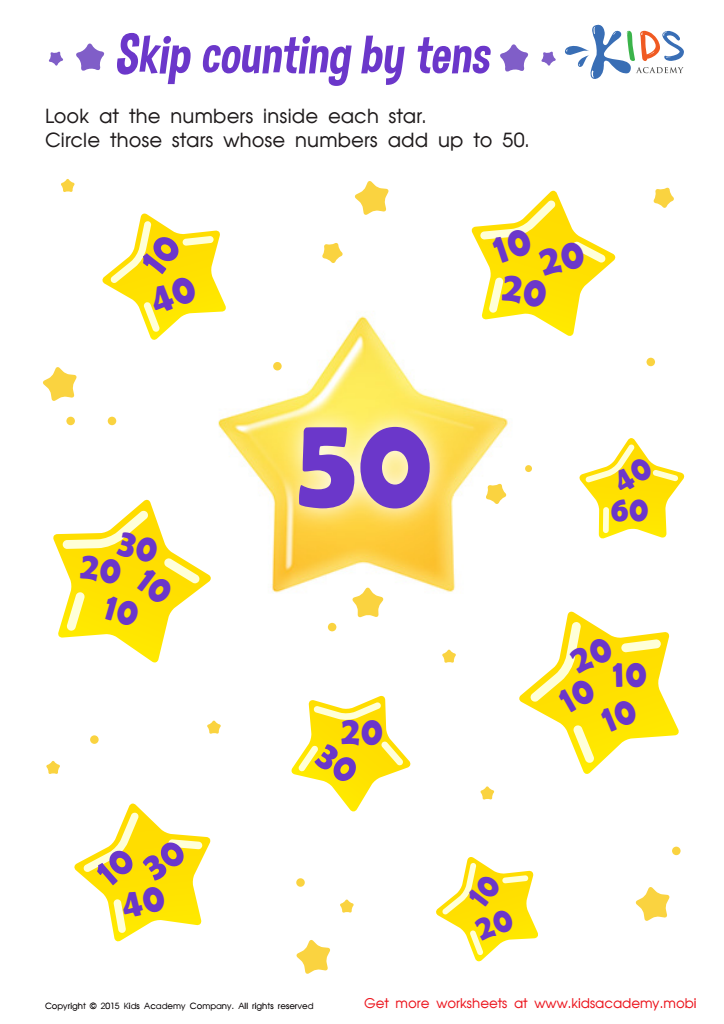
Learn Dozens: Skip Counting by Tens Printable








Understanding skip counting is fundamental for children aged 6-9 as it establishes critical math skills that serve as building blocks for more advanced concepts. Skip counting enhances number sense, an essential foundation for all future math learning. By enabling children to count by 2s, 5s, 10s, and other increments, it enriches their ability to see patterns in numbers, thereby improving their fluency in basic arithmetic operations such as addition and multiplication.
For parents and teachers, ensuring that children master skip counting means they are better prepared for systematic, logical thinking. This skill also translates to practical everyday scenarios, such as counting money, where one might skip count by 5s or 10s for easier totaling.
Moreover, skip counting fosters problem-solving abilities. When children learn to skip count, they can more readily tackle word problems involving quantities and measurements, giving them a head start on more complex mathematical ideas they will encounter later.
Additionally, it supports mental math capabilities, allowing children to perform quicker calculations in their heads without always relying on visual aids or finger counting. This foundational skill paves the way for confidence and enjoyment in mathematics, encouraging a positive attitude that can transform their entire educational experience.
Understanding and mastering skip counting is invaluable, making it an essential focus for parents and teachers alike in early childhood education.








