
Understanding time Time Worksheets for Ages 6-9
3 filtered results
Difficulty Level
Grade
Age
-
From - To
Subject
Activity
Standards
Welcome to our "Understanding Time Worksheets" designed specifically for children aged 6-9! These engaging and interactive worksheets help young learners grasp essential concepts of time, such as reading clocks, understanding hours and minutes, and differentiating betweenam and pm. With a variety of fun activities and exercises, we aim to make learning about time both enjoyable and effective. Our worksheets cater to different learning styles, ensuring that every child can find the right approach to master this fundamental skill. Empower your child to confidently tell time with our carefully crafted resources that promote independent learning and mathematical comprehension.
Favorites
With answer key
Interactive
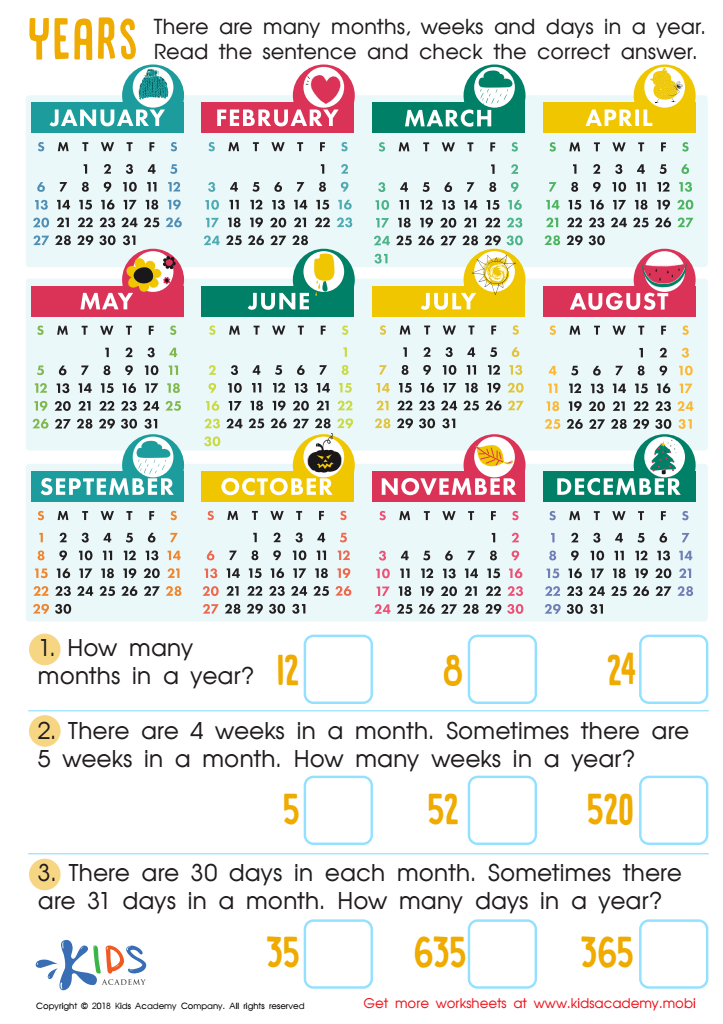
Years Worksheet
This worksheet is a great way to test your children's knowledge of the calendar. Ask them if they can name the days of the week and months in a year. Read and discuss the questions with them and help them find the right answers. Encourage them to check their answers.
 Assign to My Students
Years Worksheet
Worksheet
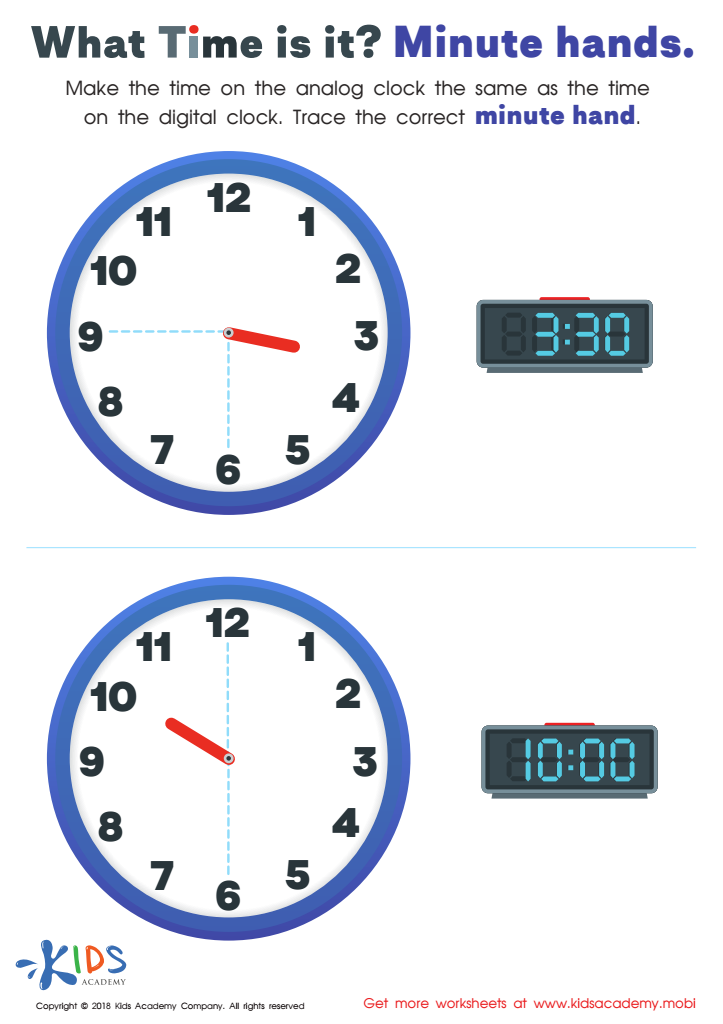
What Time Is it? Minute Hands Worksheet
Help your kids telling time with the minute hand correctly with this tracing sheet. Trace the correct minute hand to make the time on the analog clock the same as the time on the digital clock. Give them a pictured demonstration of how to do it and you'll be all set!
What Time Is it? Minute Hands Worksheet
Worksheet
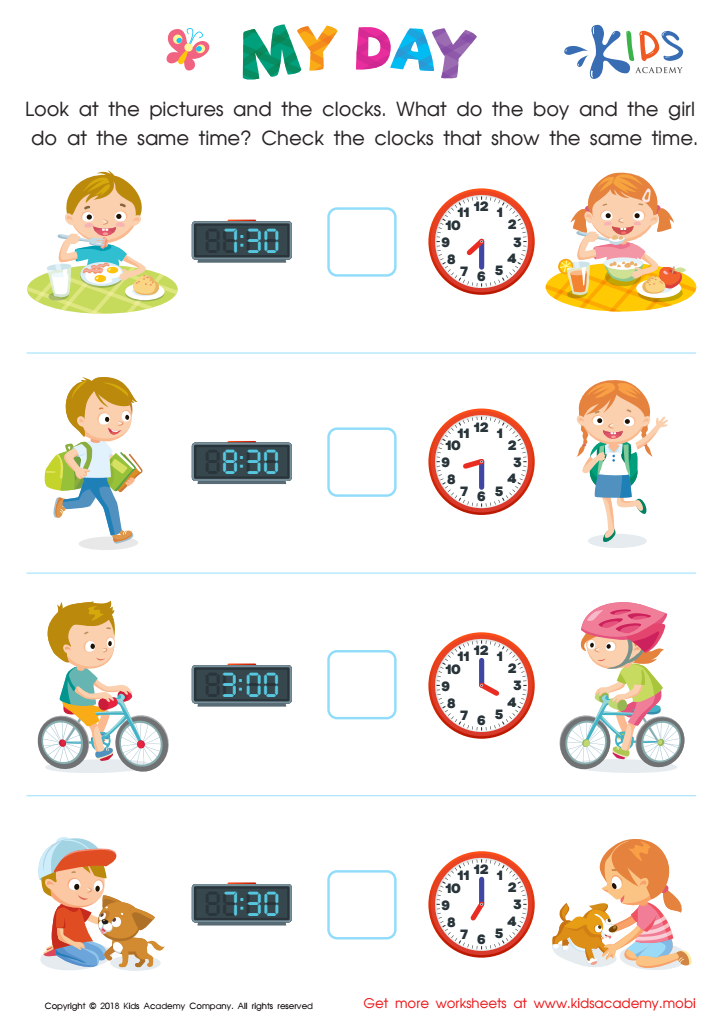
My Day Worksheet
Show your students the pictures and clocks in the colorful worksheet. Ask what the boy and girl are doing in each, then what time the clocks show. Finally, ask what activities they both do at the same time. Help them check the clocks showing the same time in both pictures.
My Day Worksheet
Worksheet
Join Kids Academy for Free
Who is primarily going to use this learning content?








Understanding time is a crucial skill for children aged 6 to 9, as it lays the foundation for their ability to organize daily activities and manage schedules effectively. Parents and teachers should prioritize this learning because time management is essential for academic success and personal development. At this age, children start to encounter structured environments—like school schedules—and recognizing time helps them navigate these structures.
Furthermore, grasping the concept of time enhances critical cognitive skills, such as concentration, attention, and memory. It promotes an understanding of cause-and-effect relationships, as children learn to associate certain activities with specific times, such as bedtime or lunchtime. Additionally, an understanding of time aids in recognizing patterns, sequencing events, and planning tasks, which can lead to greater independence and confidence.
Moreover, as children engage in social activities, understanding concepts like punctuality helps them interact positively with peers. Parents and teachers play a pivotal role in reinforcing these concepts through everyday discussions about clocks, calendars, and timelines, thus fostering a more structured environment both at home and school. Cultivating a solid sense of time at a young age equips children with skills they'll benefit from throughout their lives.








