
Basic Addition Building Vocabulary Worksheets for Ages 6-9
3 filtered results
Difficulty Level
Grade
Age
-
From - To
Subject
Activity
Standards
Unlock your child's mathematical potential with our Basic Addition Building Vocabulary Worksheets, designed specifically for ages 6-9. These engaging and interactive worksheets not only teach essential addition skills but also help enhance vocabulary related to numbers and arithmetic. With colorful illustrations and relatable scenarios, children will enjoy practicing addition in a fun way. Each worksheet focuses on different concepts, providing ample opportunities for learning and reinforcement. Perfect for classroom use or home schooling, our resource supports young learners in building confidence while mastering basic math terms and operations. Start your child's journey to mathematical excellence today!
Favorites
With answer key
Interactive
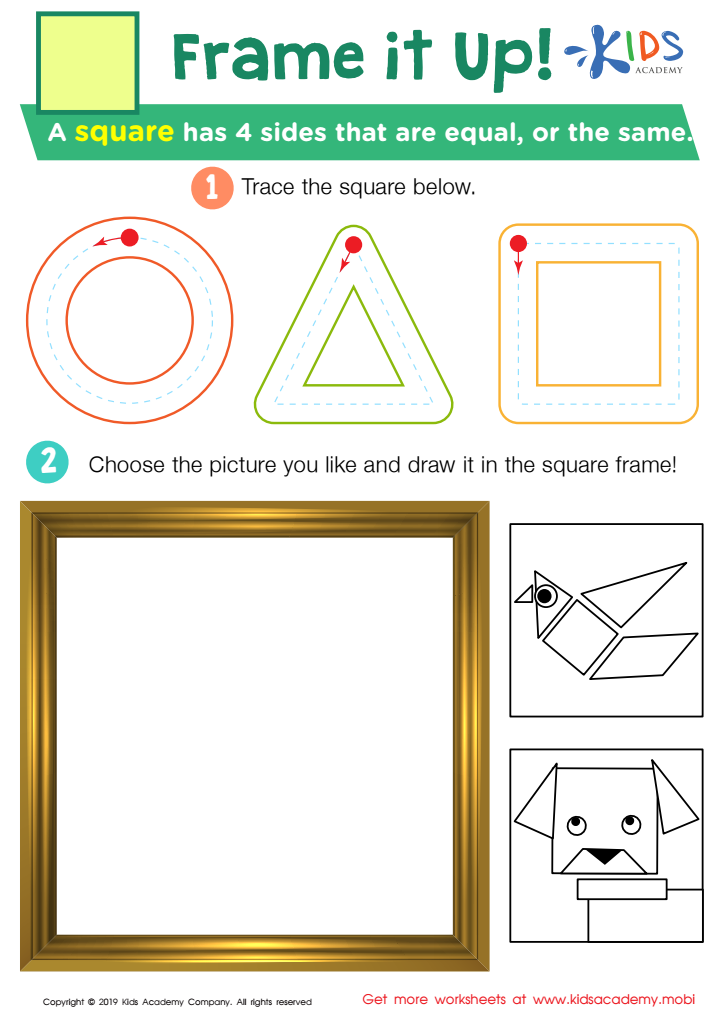
Frame it Up Worksheet
This worksheet helps kids learn the difference between squares and other shapes. It guides them to trace a square and draw a picture inside it. Examples of shapes-based drawings are included. Kids will have fun and clear up any confusion about squares.
 Assign to My Students
Frame it Up Worksheet
Worksheet











Join Kids Academy for Free
Who is primarily going to use this learning content?







Building a strong mathematical vocabulary around basic addition for children aged 6-9 is crucial for their academic development. This foundational stage of learning establishes not only numerical fluency but also critical thinking skills that contribute to problem-solving capabilities. By equipping children with the right vocabulary—terms such as sum, total, plus, and equals—they gain a better understanding of mathematical concepts and operations.
Parents and teachers should prioritize this vocabulary because language directly influences comprehension. When children can articulate what addition means and discuss how to approach problems, they actively engage in learning rather than passively receiving information. This engagement fosters a positive attitude toward mathematics and encourages children to explore complex problems confidently.
Additionally, a strong vocabulary reinforces connections to real-life situations where math is applicable, such as in budgeting, shopping, or cooking. Supporting vocabulary development also prepares children for more advanced mathematics in later grades, reducing anxiety and fostering independence.
Ultimately, a solid understanding of basic addition terms builds a sense of achievement and proficiency in children, empowering them in their educational journey. Investing time in developing this vocabulary creates a ripple effect, enhancing overall literacy and academic success.








