
Fraction comparison Building Vocabulary Worksheets for 6-Year-Olds
6 filtered results
Difficulty Level
Grade
Age
-
From - To
Subject
Activity
Standards
Our "Fraction Comparison Building Vocabulary Worksheets for 6-Year-Olds" are thoughtfully designed to help young learners master essential fraction concepts while expanding their vocabulary. These engaging worksheets provide a variety of fun activities, from colorful visuals and interactive exercises to strengthening comparison skills between halves, thirds, and quarters. Our age-appropriate tasks make learning fractions exciting and relatable, encouraging children to confidently recognize and use fraction-related terms. Perfect for both classroom and home use, our worksheets are an invaluable resource for nurturing early math proficiency and language development in first graders.
Favorites
With answer key
Interactive
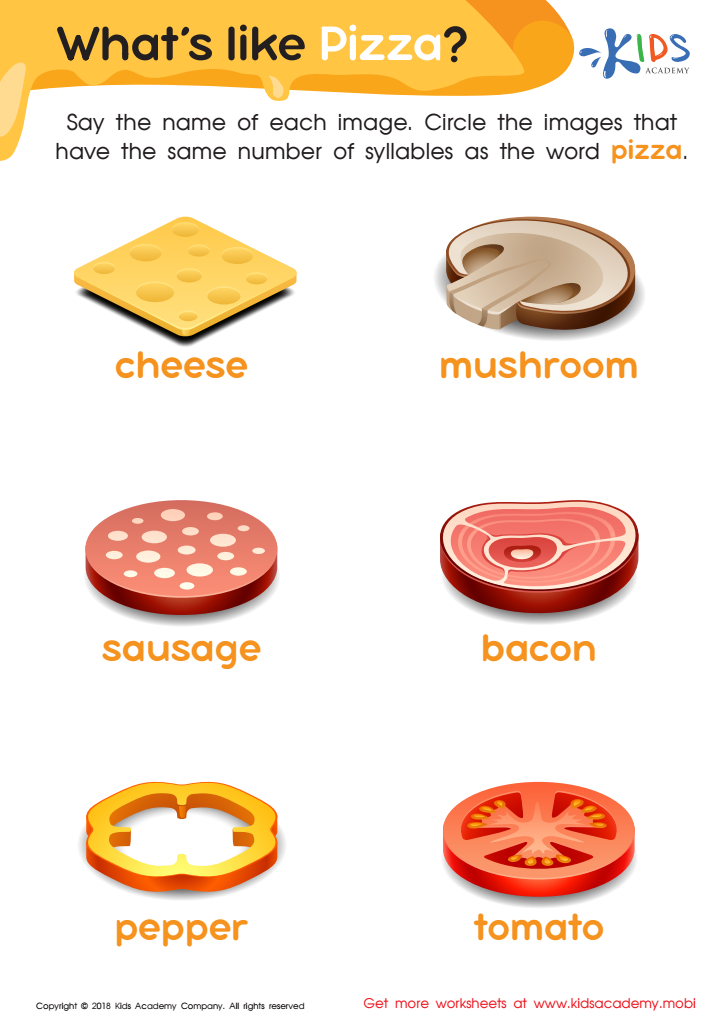
What's Like Pizza? Worksheet
Encourage your kids to exercise their minds with this pizza worksheet! Ask them to name the ingredients they like on their favourite pizzas. Then, help them circle the images that have the same number of syllables as 'pizza'. They'll have fun while learning too!
 Assign to My Students
What's Like Pizza? Worksheet
Worksheet











Join Kids Academy for Free
Who is primarily going to use this learning content?





.jpg)


Parents and teachers should care about building vocabulary related to fraction comparison for 6-year-olds because it lays a foundational understanding for essential math skills later on. At this age, children are developing their cognitive and problem-solving abilities, and early exposure to mathematical concepts like fractions can significantly boost these skills. Learning vocabulary specific to fractions helps children grasp the idea that numbers can represent parts of a whole, which is a critical aspect of mathematics and real-life scenarios such as sharing, measuring, and cooking.
Moreover, understanding fractions and their comparisons fosters better mathematical reasoning. For example, recognizing that 1/2 is larger than 1/4 equips children with the ability to think critically and make decisions based on numerical relationships. Incorporating such vocabulary into everyday learning makes the concept less abstract and more relatable, thus reducing math anxiety in later years. Additionally, early familiarity with fraction comparisons can enhance a child's confidence in math class, improving overall academic performance. By integrating this vocabulary into daily routines and playful activities, parents and teachers set children on a path to not only excel in mathematics but also cultivate a lifelong appreciation for the subject.








