Logical thinking development Chess Worksheets for Ages 7-8
3 filtered results
Difficulty Level
Grade
Age
-
From - To
Subject
Activity
Standards
Enhance your child's critical and analytical skills with our "Logical Thinking Development Chess Worksheets for Ages 7-8." Our expertly designed worksheets offer a fun and engaging way for young minds to delve into the world of chess, fostering logical thinking and problem-solving abilities. Each worksheet is tailored to challenge and inspire kids, helping to build a strong foundation in strategy while boosting concentration and patience. Perfect for beginners and young enthusiasts, these resources make learning chess both educational and enjoyable. Invest in their cognitive development today with Kids Academy's comprehensive chess worksheets.
Favorites
With answer key
Interactive
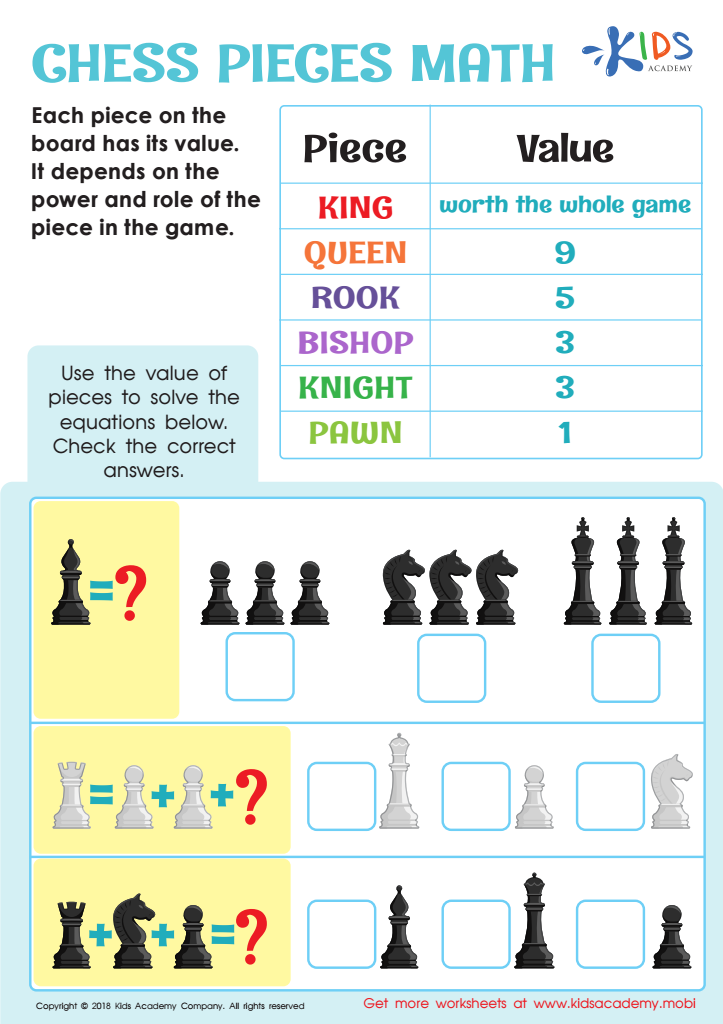
Chess Pieces Math Worksheet
Chess involves math! Each piece has its own value, from the king (worth the entire game) to the queen (9 points), varying according to their power and role. In the worksheet, your child must use these values to solve the equations at the bottom.
 Assign to My Students
Chess Pieces Math Worksheet
Worksheet
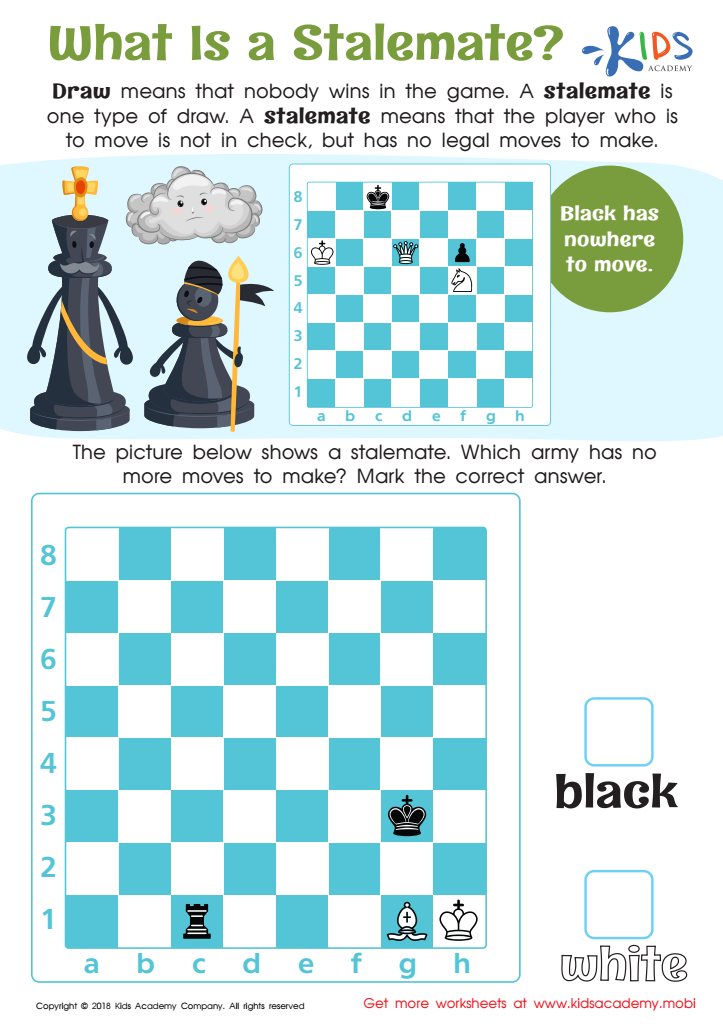
What Is a Stalemate? Worksheet
Chess is an ideal way to develop logic, strategizing, problem-solving and more! Even kids can learn it. With this worksheet, children can learn about draws and stalemates. Sample boards will help them decide which team, black or white, is at a stalemate.
What Is a Stalemate? Worksheet
Worksheet
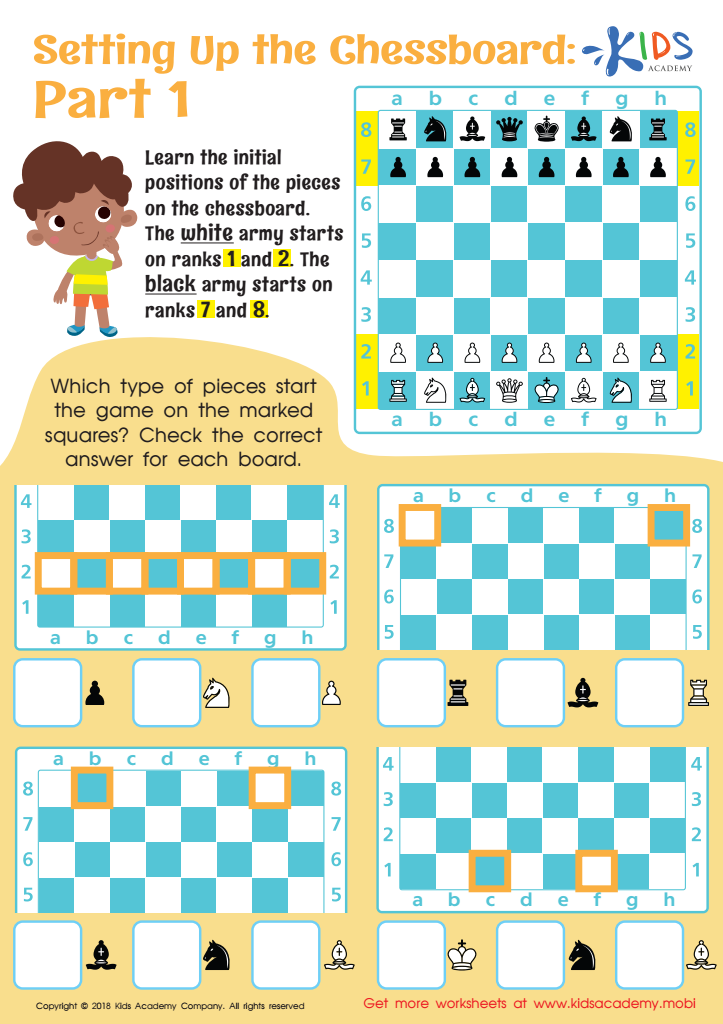
Setting up the Chessboard: Part 1 Worksheet
Teach your child the starting positions of the black and white armies on the chessboard. Black pieces are placed on ranks 7 and 8, and white pieces on ranks 1 and 2. Have them check the highlighted boxes on the chessboard to make sure they know the correct pieces to start with.
Setting up the Chessboard: Part 1 Worksheet
Worksheet
Join Kids Academy for Free
Who is primarily going to use this learning content?






Logical thinking is a fundamental skill that underpins a child's ability to solve problems, make decisions, and understand complex concepts. Chess is an excellent tool for developing logical thinking in children, especially those aged 7-8. At this developmental stage, children's brains are rapidly growing and are particularly receptive to activities that promote cognitive skills.
Chess requires players to think ahead, plan strategically, and anticipate their opponent's moves. It fosters patience and concentration, as players must remain focused and think critically to succeed. This cognitive rigor helps children develop their logical reasoning and problem-solving abilities, which are crucial for academic success and everyday decision-making.
Moreover, chess encourages children to analyze various possible scenarios and outcomes, enhancing their understanding of cause-and-effect relationships. It teaches them to weigh options and make informed choices, skills that are not only essential in mathematics and science but in all areas of learning.
Additionally, chess can boost self-esteem and resilience. Children learn to cope with losses and celebrate their improvements, fostering a growth mindset. This emotional resilience, combined with enhanced logical thinking, prepares children for future challenges both in and out of the classroom.
In summary, engaging children aged 7-8 in chess supports their intellectual and emotional development, laying the groundwork for a well-rounded, capable individual.