Identify shapes Worksheets for Ages 7-8
12 filtered results
-
From - To
Explore our engaging "Identify Shapes Worksheets for Ages 7-8" designed to enhance your child's understanding of geometric figures. These fun and interactive worksheets provide a variety of activities to help kids confidently recognize and differentiate between shapes such as circles, squares, triangles, and more. Each printable worksheet promotes critical thinking and fine motor skills while making learning enjoyable. Tailored to support young learners in building a solid foundation in geometry, our resources seamlessly integrate fun with education. Perfect for teachers and parents alike, these worksheets are an excellent way to reinforce shape recognition in a playful, effective manner. Start exploring today!
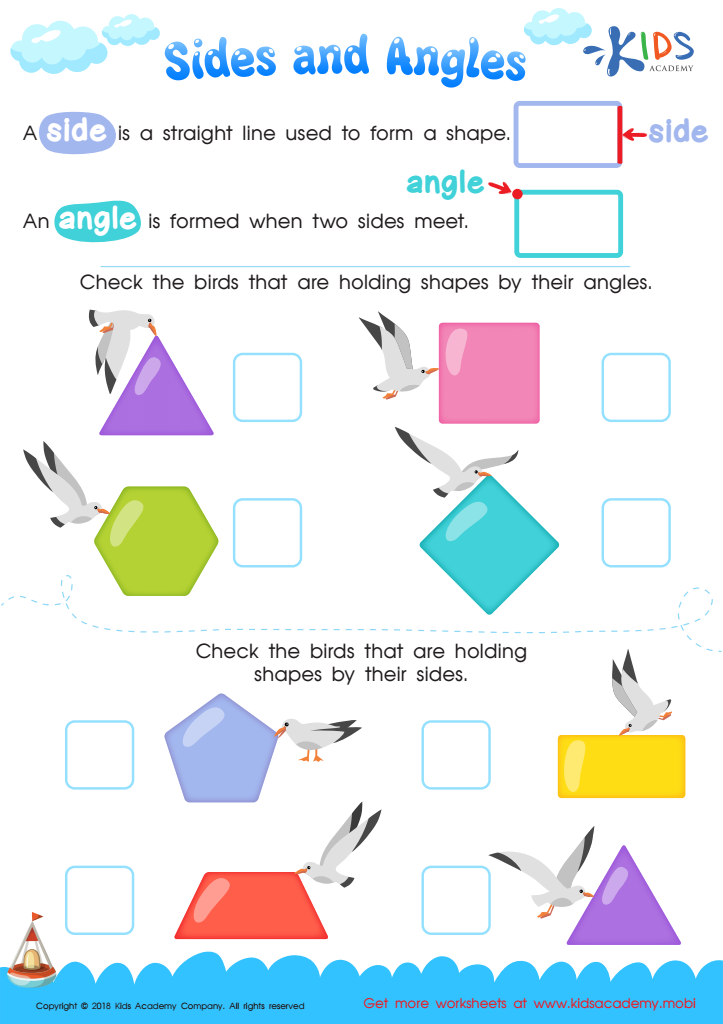
Sides and Angles Worksheet
 Assign to My Students








Identifying shapes is a foundational skill for children aged 7-8, integral to their overall cognitive development. Parents and teachers should prioritize this learning objective as it lays the groundwork for advanced mathematical concepts. Recognizing shapes helps children understand spatial relationships and encourages visual discrimination, essential when solving problems in geometry and everyday life.
Active engagement with shapes enhances critical thinking and promotes observational skills. For instance, when children differentiate between 2D and 3D shapes, they learn to analyze, categorize, and make connections within their environment. This cognitive process fosters creativity, as children explore how shapes interact and fit within their world.
Moreover, understanding shapes improves children’s ability to gather and analyze data, which is crucial in disciplines beyond mathematics, such as art and science. Through integrating shape recognition into playful learning activities, children are motivated to engage collaboratively, enhancing their social skills and teamwork.
In addition, recognizing shapes forms the basis for navigating maps, understanding technology interfaces, and even participating in sports, where spatial awareness is key. Thus, investing time in shape identification equips children with essential life skills, ensuring they are well-prepared for future academic challenges and real-world applications.








