Telling time Worksheets for Ages 7-8
4 filtered results
-
From - To
Discover engaging and educational Telling Time Worksheets designed for ages 7-8 at Kids Academy! Our printable worksheets help young learners master reading clocks, understanding hours and minutes, and converting digital to analog time. With colorful illustrations and fun activities, children will develop confidence in telling time through hands-on practice. Perfect for both classroom and home use, these worksheets align with common core standards to support math skills growth. Make learning time enjoyable and effective with Kids Academy’s expertly crafted resources. Explore our collection today and set the foundation for your child’s lifelong time-telling skills!
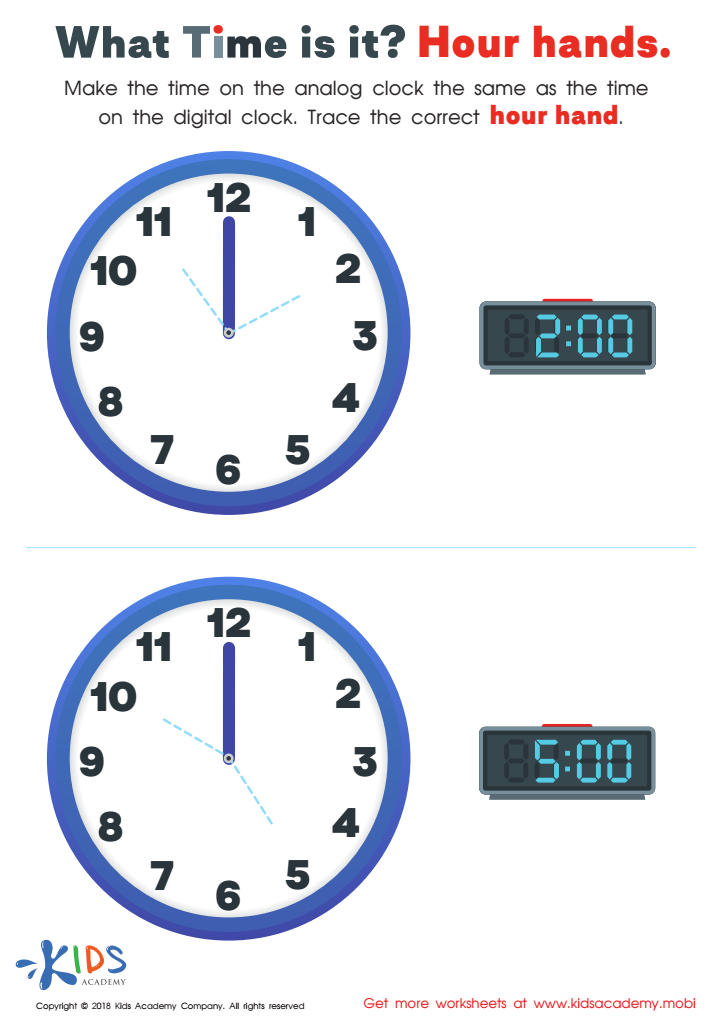
What Time Is it? Hour Hands Worksheet
 Assign to My Students






Teaching children aged 7-8 to tell time is fundamental for several reasons. At this developmental stage, kids are building essential life skills that contribute to their independence and responsibility. Understanding time is crucial for fostering punctuality and time management, which are integral for daily routines like getting ready for school, completing homework, and participating in extracurricular activities.
Moreover, learning to tell time enhances mathematical ability. Children grasp the concept of numbers, sequence, and fractions as they recognize the positions of the clock's hands and understand terms like "half past" and "quarter to." This real-world application of math not only improves academic skills but also boosts cognitive development and critical thinking.
Additionally, knowing how to tell time helps children understand the importance of time in relation to events and schedules, thereby cultivating an appreciation for the passage of time. It also nurtures social and emotional growth as kids become more reliable individuals who can manage their own and others' expectations.
Parents and teachers play a crucial role in this learning process. Through engaging activities, games, and real-life practice, they can make learning to tell time an enjoyable and rewarding experience. Offering positive reinforcement and incremental challenges keeps kids motivated and self-assured, laying the groundwork for lifelong time-management skills and accountability.








